What should you check?
Start with each guest’s ingredient requirements, then work out how many biscuits to serve and how you will keep their packaging information available.
| Priority | What to check | Your needs |
|---|
| Ingredients and allergens |
Read the exact pack for wheat, milk and precautionary allergen statements. If wheat or gluten must be avoided, look for an explicit label that meets that requirement; check other allergies separately. |
I need every guest to be able to identify which biscuits fit their requirements, rather than assuming a standard and a free-from biscuit are interchangeable. |
| Pack size and portions |
Compare pack weight with guest numbers and the other food being served. The researched standard packs include 200 g and 400 g sizes; the Schar alternative is a 125 g pack of five 25 g portions. |
For a mixed table, I can count the separately packed alternative for the guests who need it and plan the shared biscuits around everyone else. |
| Nutrition information |
Compare labels on the same basis, such as per biscuit or per 100 g, and check the stated serving size. Tesco lists 59 kcal, 3.4 g sugars and 1.5 g saturates per biscuit for its researched 400 g pack. |
I want to see what a serving represents before deciding how many biscuits to put out. A per-biscuit figure should not be compared directly with a per-100 g figure. |
| Storage and presentation |
Follow the current pack’s storage directions, including any advice for after opening. Retain its ingredient and allergen information when biscuits are moved to a serving plate. |
If I prepare the table ahead of time, I still want guests to be able to check the label beside the biscuits. |
| School-provided food |
For food supplied by a state-funded school in England, check the applicable school-food standards and the particular menu. Department for Education guidance covers school food; Department of Health and Social Care HFSS guidance concerns qualifying retail promotions and placement. |
I’m organising a school tea and need a decision about the food being served, not an assumption drawn from how a product is promoted in shops. |
Relevant brand references
These examples illustrate pack formats and ingredient checks; a brand name alone does not establish suitability for a particular guest.
Tesco
Tesco’s researched standard custard cream comes in a 400 g pack for a shared tea table.
- Tesco lists 59 kcal, 3.4 g sugars and 1.5 g saturates per biscuit.
- The researched recipe contains wheat and milk ingredients; check the current pack before serving.
Asda
Asda’s researched standard 400 g pack contains vanilla-cream sandwich biscuits.
- The 400 g format can be considered when planning a shared plate.
- Asda lists wheat and milk and says the product may contain rye, barley, oats and sesame.
Sainsbury’s
The researched 200 g standard pack offers a smaller quantity for a mixed biscuit selection.
- Sainsbury’s lists 3.3 g sugars and 1.2 g saturates per biscuit for this pack.
- Its ingredients include wheat and milk; Sainsbury’s also says it is unsuitable for customers with a barley allergy.
M&S
M&S describes its 165 g Extra Cream Custard Creams as having more vanilla cream and real custard powder.
- The extra-cream filling distinguishes this variation from a standard custard cream.
- The researched ingredients include wheat and milk; M&S lists 40.2 g sugars and 13.5 g saturates per 100 g.
Crawford’s
The researched Crawford’s product is a 300 g vanilla-cream sandwich biscuit.
- Iceland Foods describes the product as suitable for vegetarians.
- Its listed ingredients include wheat flour and milk-derived whey solids.
McVitie’s
The researched Tasties Custard Creams listing describes a 300 g branded pack.
- The listing describes the biscuits as suitable for vegetarians.
- It lists wheat and milk and says the product may contain sesame.
Joybuy product options
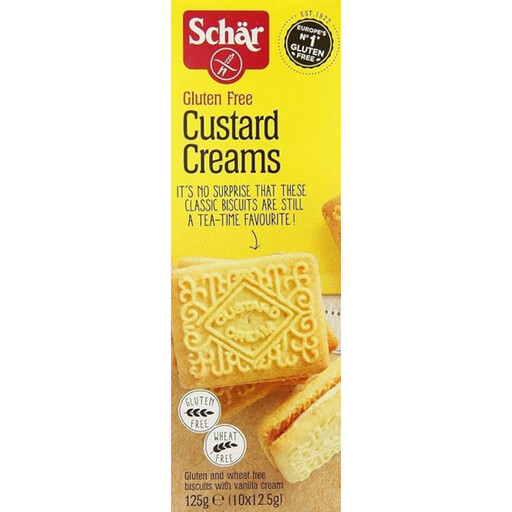
This Schar custard cream is an option for a guest who needs a biscuit labelled gluten free; check the current pack for their full set of ingredient requirements.
 No image available
Schar Gluten Free Custard Creams 125g
A labelled gluten-free custard cream to consider when setting out a separate afternoon-tea option. The pack is 125 g; check its current ingredients and allergen advice against each guest’s requirements before serving.
View on Joybuy
Frequently asked questions
Can I serve ordinary custard creams to guests avoiding wheat, gluten or milk?
Do not assume so. The standard Tesco, Asda, Sainsbury’s, M&S, Crawford’s and researched McVitie’s products contain wheat and milk ingredients. Check the exact current pack, including precautionary allergen advice, and provide a separately labelled option where one fits the guest’s needs.
What is a gluten-free custard cream option for a tea party?
The researched Schar Gluten Free Custard Creams are labelled wheat free and gluten free and come in five 25 g portions. Keep them identifiable as a separate option, and check the full current label for any other ingredient or allergy requirements.
Does an HFSS label decide whether custard creams can be served at a school tea?
No: an HFSS description alone does not settle a school-menu decision. In England, Department of Health and Social Care HFSS guidance concerns qualifying retail promotions and placement, while Department for Education guidance covers the separate requirements for food supplied in state-funded schools. Check the current school-food rules against the particular menu.
How should I handle opened packets before guests arrive?
Follow the pack’s storage directions, including any instruction to use an airtight container after opening. Keep the original wrapper available when serving so guests can read the current ingredients and allergen declaration.
What allergen information should a caterer keep when biscuits are decanted?
Keep accurate, current allergen information for the exact biscuits being served outside their packaging. Food Standards Agency guidance covers allergen-information requirements for food businesses, including institutional caterers; retaining the product details helps staff answer guests’ questions about what is on the plate.


