Shoppers avoiding wheat or milk
Ordinary custard creams and products with specific free-from claims need different checks. Compare the claim with your own allergen, then read the full label on the pack supplied.


Choose custard creams by checking the supplied pack for your particular allergen first: the ordinary Tesco, Crawford’s and Asda biscuits examined list wheat and milk, while specific free-from products make different claims. Check any FAIRTRADE Mark separately, on the exact biscuit you are buying; an ethical-sourcing label is not an allergy label, and a cocoa claim for another product does not apply to these biscuits.
Ordinary custard creams and products with specific free-from claims need different checks. Compare the claim with your own allergen, then read the full label on the pack supplied.
Make the allergen decision separately from the sourcing decision. Fairtrade International says an ingredient-specific mark identifies the named Fairtrade ingredient; it does not describe the biscuit’s allergen content.
Use the product listing to assess a purchase, but check the label when the biscuits arrive. Tesco, Asda and M&S warn that ingredients or allergy information can change.
Start with the ingredients and precautionary statements for your allergen. Then check any cocoa-sourcing claim on the same product, rather than treating it as part of the allergy assessment.
| Priority | What to check | Your needs |
|---|---|---|
| Your allergen | Read the exact pack’s ingredients. Tesco, Crawford’s and Asda list wheat and milk in the ordinary products examined; Sainsbury’s describes its separate Free From product as milk- and gluten-free, while Asda describes Schär’s as gluten- and wheat-free. | I need a claim that addresses my particular allergen, not a general assumption about plain or free-from biscuits. |
| Precautionary wording | Check any “may contain” statement separately from the ingredients. The examined Tesco and Crawford’s listings mention sesame; Asda’s ordinary custard creams mention rye, barley, oats and sesame. | A precautionary statement naming my allergen matters to my choice, even when that allergen is not listed as an ingredient. |
| Coating and sourcing | Read the coated biscuit’s own allergen list: the examined Asda and M&S chocolate-coated products list milk, wheat and soya. For Fairtrade, check the exact pack for the relevant FAIRTRADE Mark; Asda describes its coated biscuit’s cocoa as Rainforest Alliance certified. | If I want chocolate or Fairtrade-sourced cocoa, I still need to assess that biscuit’s allergens and its own sourcing label. |
| The pack received | Compare the delivered pack with the listing and read its current ingredients and allergy advice before eating. Retailers including Tesco, Asda and M&S warn that product information may change. | On a repeat order, I cannot rely on the label I checked on an earlier pack. |
Fairtrade International’s ingredient marks concern how the named ingredient was sourced, not which allergens the finished biscuit contains.
Use the exact pack’s ingredient and precautionary information for your allergen, and check any FAIRTRADE Mark separately.
Sainsbury’s milk- and gluten-free claim and Asda’s gluten- and wheat-free description of Schär address specified ingredients, not every possible allergy.
Match the precise claim and full supplied label to the ingredient you need to avoid.
Asda identifies the cocoa in its chocolate-coated custard creams as Rainforest Alliance certified. That statement is not a Fairtrade claim.
If Fairtrade sourcing matters to you, look for the relevant FAIRTRADE Mark on that exact product.
Tesco, Asda and M&S caution that product ingredients and allergy information can change.
Read the label on every pack supplied, including repeat purchases, before deciding whether to eat the biscuits.
These examples show why the exact product and variant matter; a claim for one biscuit or range does not extend to everything bearing the same brand.
Sainsbury’s lists ordinary custard creams and a separate 125g Free From product.
Asda lists Schär’s 125g custard creams as a gluten-free option.
Tesco lists ordinary own-label custard creams with ingredients and allergy information.
Asda lists both ordinary and milk-chocolate-coated own-label custard creams.
M&S lists extra-cream and chocolate-coated custard creams as distinct products.
Tesco lists Crawford’s 300g vanilla-filled custard creams.
Joybuy has a listing for McVitie’s Tasties Custard Creams 300g.
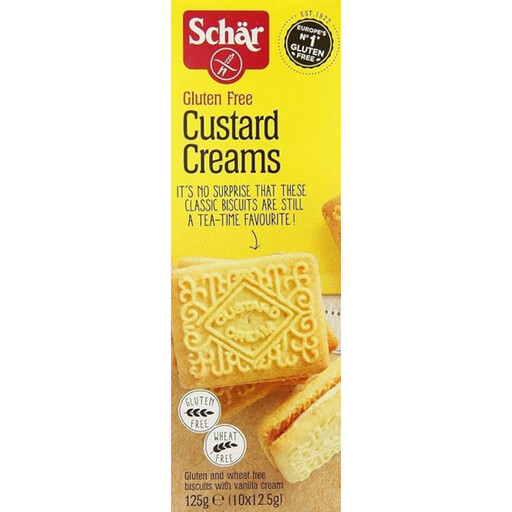
This gluten-free custard cream is an option to examine when comparing biscuits for a specific ingredient need. Check its supplied label for your own allergens and any Fairtrade preference.
 No image available
For shoppers comparing gluten-free custard creams, Joybuy describes this 125g product as gluten-free and lactose-free. Lactose-free does not establish milk-free: check the full label on the pack received for milk and any other allergen relevant to you. If Fairtrade sourcing matters, check that exact pack for a relevant FAIRTRADE Mark.
No. Fairtrade International’s ingredient marks identify sourcing of the named ingredient, not the allergens in the finished biscuit. Read the exact pack’s ingredients and precautionary information for your allergen.
Do not assume so. The examined M&S and Asda chocolate-coated custard creams list soya alongside milk and wheat; compare each coated product’s own label with the plain biscuit you are considering.
Use the delivered pack’s current label when deciding whether to eat the biscuits, not an earlier listing. Tesco, Asda and M&S warn that product information can change; ask the seller or manufacturer if the allergy information you need is unclear.
M&S identifies Fairtrade cocoa for its Choc Marks range, not for the chocolate-coated custard cream in the examined product listing. Check that biscuit’s own pack for a relevant FAIRTRADE Mark rather than applying a claim from another range.