How should you choose a pack?
Start with the recipient’s allergens, then decide whether separately packed servings matter or whether you can portion a larger packet yourself.
Separate free-from portions
Consider when: You need a separately packed lunchbox serving and Schär’s stated gluten- and wheat-free claims match the recipient’s requirements; Asda lists five 25 g packs with two biscuits in each.
Still check: Those claims do not cover every allergy, so read the supplied pack for other ingredients and precautionary statements.
Free From packet
Consider when: You need the gluten- and milk-free claims on Tesco Free From Custard Creams and can portion the biscuits yourself.
Still check: The 125 g listing does not establish separate inner packs, and its vegan label is not a substitute for checking allergens.
Ordinary larger packet
Consider when: Wheat and milk are suitable for the recipient and you can divide a 300–400 g packet for individual lunches.
Still check: Tesco, Asda, Crawford’s and McVitie’s ordinary products contain wheat and milk; their precautionary statements must be assessed product by product.
| Priority | What to check | Your needs |
|---|
| Ingredients |
Compare the supplied pack’s ingredient and allergen declarations with the recipient’s specific allergens. The ordinary Tesco, Asda, Crawford’s and McVitie’s products listed by retailers contain wheat and milk. |
I need to rule out ingredients that matter to the person eating the biscuits before choosing a brand or pack size. |
| Precautionary wording |
Read any “may contain” statement separately from the ingredients. Asda lists possible rye, barley, oats and sesame; Tesco and Crawford’s list possible sesame for their ordinary custard creams. |
A warning about an allergen matters to me even when that allergen is not listed as an ingredient. |
| Portion format |
Look for an explicit inner-pack count rather than relying on total weight. Asda lists Schär’s 125 g product as five 25 g packs, each containing two biscuits. |
I want a portion I can put straight into a lunchbox, rather than biscuits I must pack separately. |
| Free-from claims |
Check which substance each claim names. Schär describes its product as gluten- and wheat-free; Tesco labels its Free From product free from cereals containing gluten and milk. The Food Standards Agency cautions that vegan labelling alone is not a proxy for allergen labelling. |
If milk or wheat is my concern, I need the relevant declaration on this particular biscuit, not a different dietary term. |
Brand and product-line references
A familiar brand name does not establish an allergen profile or an inner-pack format; compare the particular product.
Schär
A portion-packed custard cream to consider when separate lunchbox servings and its stated gluten- and wheat-free claims are relevant.
- Schär describes the UK product as gluten- and wheat-free; Asda lists five individual packs.
- Those descriptions do not establish suitability for every allergy. Check the supplied packaging.
Tesco
Its listed 125 g Free From custard creams and ordinary 400 g custard creams have different ingredient declarations.
- Tesco labels the Free From product free from cereals containing gluten and milk.
- Its ordinary custard creams contain wheat and milk and may contain sesame. Neither listing establishes separate inner portions.
Asda
Its ordinary custard creams come in a 400 g packet; that weight does not establish individually wrapped servings.
- The listing gives ingredient and precautionary information for checking the particular product.
- It declares wheat and milk and lists possible rye, barley, oats and sesame. Asda advises that online product information can change.
Crawford’s
The listed 300 g ordinary custard creams are a larger-packet option where their ingredients suit the recipient.
- Tesco’s listing identifies the product’s wheat and milk ingredients.
- The listing also warns of possible sesame; it does not establish individual inner packs.
McVitie’s
Tasties Custard Cream Biscuits are listed by Iceland Foods as a 300 g ordinary packet, not a separately packed free-from option.
- Iceland Foods provides an ingredient declaration for the named product.
- That declaration identifies wheat and milk; separate inner portions are not established.
M&S
Extra Cream Custard Creams are a distinct 165 g variation to assess by their own ingredients.
- M&S lists wheatflour, milk ingredients and soya lecithin for this product.
- Its product description does not establish individually wrapped servings; check the current pack information.
Custard creams on Joybuy
This option addresses the separate-portion lunchbox route; its free-from claims still need to be checked against the recipient’s allergens.
 No image available
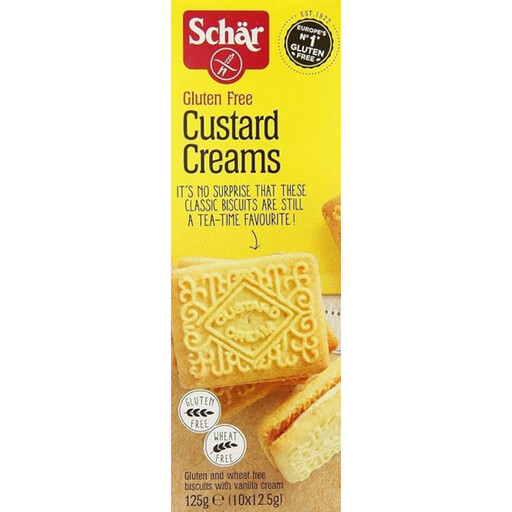
Schär Gluten Free Custard Creams 125g
For a lunchbox needing separate portions, Asda lists this 125 g product as five 25 g packs with two biscuits in each. Schär describes its custard creams as gluten- and wheat-free; check the supplied pack’s full ingredients and precautionary statements for the recipient’s other allergens.
View on Joybuy
Common questions
What should I check before putting a portion pack in a lunchbox?
Check the actual outer pack’s ingredients and precautionary statements against the recipient’s allergens. Keep the relevant packaging information available when sending an individual portion away from home; the inner wrapper’s appearance is not an allergen check.
Does “gluten free” also mean wheat-free or milk-free?
No: read the separate wheat and milk declarations for the exact product. Coeliac UK explains that the gluten-free labelling threshold concerns gluten content and can apply to some foods containing gluten-free wheat starch. Schär separately describes its custard creams as wheat-free, while Tesco separately labels its Free From custard creams milk-free.
How does a “may contain” warning differ from an ingredient declaration?
An ingredient declaration identifies what was used to make the food; a “may contain” warning concerns possible unintended presence. Food Standards Scotland explains how allergens used as ingredients are identified on prepacked food labels, while the Food Standards Agency describes precautionary wording as a warning about possible unintended presence.
What if the delivered packet differs from the online listing?
Use the current physical pack’s information and resolve a discrepancy with the retailer or manufacturer before offering the biscuits to the person with the allergy. Asda cautions that online ingredients and allergy information can change.
How should I keep an opened larger packet?
Follow that packet’s storage directions. Tesco’s ordinary custard-cream listing says to use an airtight container once opened; storage does not change the biscuits’ allergen profile.


