What should you check first?
Check the specific allergy and the current pack label before deciding whether its size works for the group.
| Priority |
What to check |
Your needs |
| Declared allergens |
Read the current ingredients and allergen declaration for each relevant ingredient. Check that any free-from claim names the allergen you need to avoid. |
Someone sharing these biscuits needs to avoid milk, wheat or another specific allergen; I need a pack whose full declaration addresses that requirement. |
| Precautionary warnings |
Read may-contain statements and manufacturing warnings as well as the ingredients. ASDA Groceries lists rye, barley, oats and sesame as may contain on its standard 400g pack. |
An ingredient may be absent from the recipe but still appear in a warning that matters to the person eating the biscuits. |
| Meaning of the claim |
Keep lactose-free distinct from milk-free. A gluten-free or wheat-free claim does not address every other allergen on the pack. |
If milk is the concern, I need an explicit milk declaration rather than relying on lactose-free wording. Other allergies still need separate checks. |
| Sharing quantity |
Compare pack weight and stated servings after checking allergens. ASDA Groceries suggests approximately 34 servings for its 400g standard pack and nine for its 125g Free From pack; its Schär listing describes five 25g portions. |
There are several people to serve, but a bigger bag is useful only if everyone eating from it can have that particular product. |
| Pack at serving time |
Read the physical label after delivery or a substitution. Retailers including ASDA Groceries and Morrisons warn that ingredients and allergen information can change. |
A familiar name or a saved listing is not enough when I am serving a newly supplied pack. |
Which brand ranges are relevant?
These product references show why a brand name alone cannot establish whether a particular custard cream suits an allergy.
ASDA
ASDA Groceries lists both a 400g conventional custard cream and a 125g Free From alternative.
- The 125g Free From pack is labelled free from milk and cereals containing gluten.
- The 400g pack contains wheat and milk and may contain rye, barley, oats and sesame; check each current pack separately.
Schär
ASDA Groceries lists Schär Custard Creams in a 125g pack divided into five 25g portions.
- The listing describes the product as gluten-free and wheat-free.
- Its lactose-free claim must not be treated as a milk-free claim; check the full label for other relevant allergens.
McVitie’s
Morrisons lists McVitie’s Tasties Custard Creams in a 300g pack.
- The listing gives a stated pack size for comparison once allergen requirements have been checked.
- It declares milk and wheat and says it may contain sesame.
Crawford’s
Lewis Food Wholesalers lists Crawford’s Custard Creams as a 300g conventional pack.
- The listing states the pack weight and its allergen declarations.
- It declares wheat, milk and gluten and says it may contain sesame.
Sainsbury’s
Sainsbury’s lists a 200g conventional custard cream containing wheat flour and whey powder from cows’ milk.
- The product listing identifies ingredients that matter when checking wheat and milk requirements.
- Sainsbury’s also says the product is not suitable for customers with a barley allergy because of manufacturing methods.
M&S
Marks & Spencer lists Extra Cream Custard Creams in a 165g pack.
- The listing provides a stated pack weight and ingredient information.
- Its ingredients include wheat, milk and soya; Marks & Spencer advises reading the current label.
Tesco
Tesco Groceries lists Tesco Free From Custard Creams Biscuits in a 125g pack.
- The listing identifies a custard cream in Tesco’s Free From range.
- Check the current pack’s full ingredient and allergen declaration for the specific allergy rather than assuming what its range name excludes.
Custard creams on Joybuy
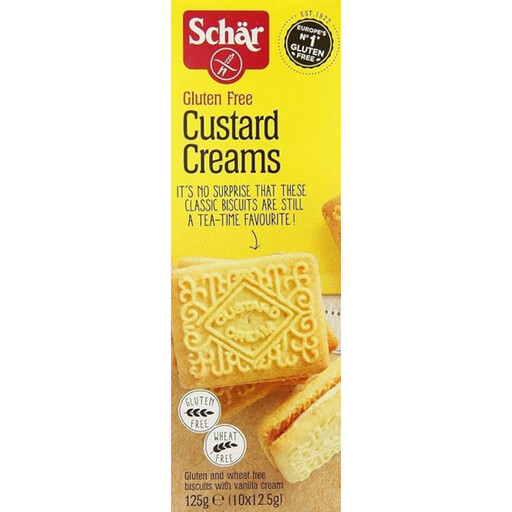
This 125g Schar option is relevant when checking custard creams for gluten or wheat avoidance; its smaller, portioned format is not equivalent to a large sharing bag. Check the current pack for any other allergens that matter to the people eating it.
 No image available
Schar Gluten Free Custard Creams 125g
For gluten or wheat avoidance, this pack is described as gluten-free and wheat-free. ASDA Groceries lists five 25g portions; its lactose-free wording does not establish that the product is milk-free. Check the current pack for every other relevant allergen before sharing.
View on Joybuy
Common questions
Can I assume standard custard creams are suitable for someone avoiding milk or wheat?
No. The conventional custard creams listed by ASDA Groceries, Sainsbury’s, Morrisons, Lewis Food Wholesalers and Marks & Spencer contain wheat and milk. Check the particular pack for any further ingredients or precautionary warnings that matter to the person eating it.
Does lactose-free mean a custard cream is milk-free?
No. A lactose-free claim is not a milk-free allergy claim. ASDA Groceries describes Schär Custard Creams as lactose-free, but explicitly labels its own Free From Custard Creams as free from milk and cereals containing gluten. Read the full current declaration whichever product you choose.
What should I do with a ‘may contain’ warning?
Treat it as information relevant to the specific allergy, not as a free-from assurance. Food Standards Agency technical guidance says precautionary allergen wording should be used where an unavoidable cross-contact risk exists. Check the wording on the pack and follow the affected person’s allergy-management plan.
Is the online ingredient list enough after a biscuit order arrives?
No. Retailers including ASDA Groceries and Morrisons warn that ingredients and allergen information can change. Read the supplied pack before serving, including when an ordered product has been substituted.
Will warming a custard cream remove a food allergen?
No. Food Standards Scotland states that cooking at high temperatures cannot remove food allergens. Choose a pack compatible with the eater’s requirements and keep shared serving equipment from coming into contact with foods containing their allergen.


