Choose custard creams by the specific allergen you need to avoid: check the supplied pack’s ingredients, named free-from claims and precautionary warnings. Then compare sugars per 100g and per biscuit; a free-from, vegan or gluten-free description does not establish a reduced-sugars claim or suitability for a different allergy.
Who needs to check what?
Shoppers avoiding milk or gluten
Look for a claim that names the allergen you need to avoid, then read the ingredients and any precautionary warning on the pack. Sainsbury’s and Asda list custard creams described as free from both milk and gluten, but those claims do not address every other allergy.
Shoppers comparing sugar alongside allergen information
Check allergy suitability first, then compare sugars on the same per-100g basis and look at the amount per biscuit. Free-from, vegan and gluten-free labels answer different questions from the nutrition panel.
What matters when choosing?
Start with the eater’s specific allergen, then compare sugar figures between suitable packs and check the information on the pack supplied.
| Priority | What to check | Your needs |
|---|
| Specific allergen |
Find a claim naming the allergen you need to avoid. Read the full ingredients and any may-contain warning; a claim about one allergen does not cover every allergy. |
I need the biscuit’s label to address my particular allergy, not just a general dietary preference. |
| Sugars |
Compare sugars in g per 100g on the same basis. Check the stated amount per biscuit and its serving size; do not infer a reduced-sugars claim from a single figure. |
Once I have an allergy-compatible option, I want to compare the sugar amount in the biscuits I would actually eat. |
| Dietary wording |
Distinguish a named free-from claim from vegan or lactose-free wording. UK government vegan-labelling guidance says a vegan label should not be assumed safe for an allergy. |
A vegan or lactose-free description alone does not answer my question about milk allergens. |
| Supplied pack |
Read its current ingredients, allergen advice and nutrition panel. Similarly named Tesco 125g free-from listings report different formulations and sugar figures. |
Before eating an online order, I want to check the pack that arrived rather than rely on a listing I saw earlier. |
Common label mistakes
-
Assuming vegan means suitable for a milk allergy
UK government guidance says vegan labelling should not be treated as assurance that a food is safe for someone with an allergy.
Look for information addressing milk specifically, and read the supplied pack’s ingredients and precautionary statements.
-
Calling a free-from biscuit reduced sugar
An allergen-free claim and a reduced-sugars claim describe different properties. A lower listed sugar figure on its own does not establish the latter claim.
Compare sugars per 100g and per biscuit without treating either figure as an allergen check.
-
Using one Tesco free-from listing for every pack
Tesco’s two similarly named 125g free-from custard-cream listings give different formulations and report 19.9g and 25.2g sugars per 100g respectively.
Use the ingredients, allergen information and nutrition panel on the exact pack supplied.
Brand and product-line references
These examples describe particular listings, not every biscuit sold under each brand; the pack remains the final check for an allergy.
Sainsbury’s
Its 125g Free From Custard Creams listing states that the biscuits are milk and gluten free.
- Sainsbury’s lists 24.9g sugars per 100g and 3.5g per biscuit.
- Check the pack for any other allergens relevant to the eater; the free-from claims do not cover every allergy.
Asda
Its 125g Free From custard-cream listing names milk and cereals containing gluten as exclusions.
- Asda lists 25g sugars per 100g and 3.5g per biscuit.
- Asda warns that ingredients and allergy advice can change, so check the pack supplied.
Schär
Tesco lists Schär Custard Creams as gluten free and describes a 125g pack containing five portion packs.
- The listing identifies the gluten-free claim and the portion-pack format separately.
- Its lactose-free wording does not, by itself, establish suitability for a milk allergy.
Tesco
Tesco lists both standard and free-from custard creams, so the exact product matters.
- Its standard 400g listing reports 28.3g sugars per 100g; two 125g free-from listings report 19.9g and 25.2g per 100g for their respective products.
- The standard 400g listing includes wheat and milk ingredients and a may-contain-sesame warning. Do not transfer ingredients or nutrition figures between packs.
Crawford’s
The 300g custard creams listed by Tesco provide a conventional biscuit comparison, not an allergen-free option.
- The listing reports 30.7g sugars per 100g for this product.
- It lists wheat and milk ingredients and says the biscuits may contain sesame.
M&S
Its 165g Extra Cream Custard Creams are a distinct conventional variant that needs its own label check.
- M&S lists 40.2g sugars per 100g for this specific product.
- The listed ingredients include wheat, milk and soya; the figures do not describe other M&S biscuits.
Custard creams on Joybuy
This gluten-free custard-cream option is relevant when gluten avoidance is the starting point. Check the pack for any other allergy requirements and its current sugar figures.
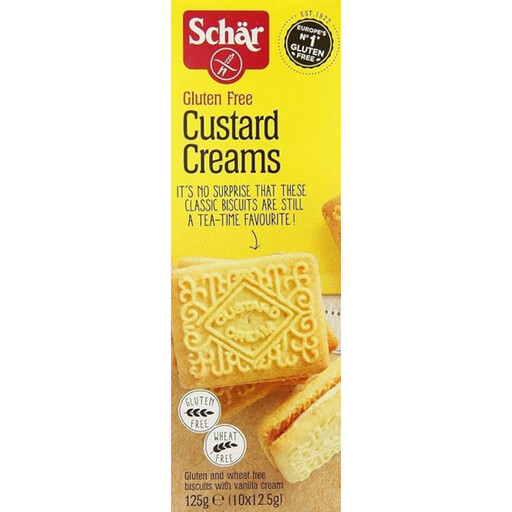 Image unavailable
Schar Gluten Free Custard Creams 125g
The 125g custard-cream pack is labelled gluten free, making that the relevant claim to check if you avoid gluten. Read the supplied pack for its full ingredients, precautionary warnings and sugars per 100g; the gluten-free description does not establish suitability for a milk allergy or a reduced-sugars claim.
View on Joybuy
Questions about labels and packs
Does reduced sugars mean a custard cream is suitable for an allergy?
No. A reduced-sugars claim concerns a comparison with a similar product, not its allergens. Check the ingredients, named free-from claims and precautionary information for the particular allergy, then assess the nutrition panel separately.
Can I rely on vegan or lactose-free wording for a milk allergy?
No. UK government guidance says a vegan label should not be assumed safe for an allergy, while lactose-free wording addresses a different issue from milk-allergen avoidance. Look for information that names milk and check the complete pack.
What should I check when an online biscuit order arrives?
Read the supplied pack’s ingredients, allergen information and precautionary warnings before eating the biscuits. Check its nutrition panel too: retailer listings may differ from the pack supplied, including for similarly named products.


