What should you check before buying?
Confirm the requested biscuit type and the school's arrangements first. Then compare the labels on the exact packs you plan to bring.
| Priority |
What to check |
Your needs |
| School arrangements |
Ask whether packaged biscuits containing milk or wheat are permitted and how the school wants allergen information displayed. |
I need to bring something the school can serve under its own allergy arrangements. |
| Milk and gluten labels |
Read the current pack's ingredients and allergen statement. If both milk-free and gluten-free biscuits are needed, check for both claims on the exact product. |
A gluten-free label alone does not answer my question about milk. I need to check each relevant allergen separately. |
| Serving arrangements |
Keep packaging available for ingredient checks. Where standard and allergy-friendly biscuits are both offered, arrange a separate display and utensils for the latter, as Anaphylaxis UK recommends. |
I want visitors to be able to identify the biscuits and check the pack without the two options being mixed at the table. |
| Biscuit type |
Confirm whether the organiser requested custard creams or digestives. If you change biscuit type, check the replacement pack's ingredients afresh. |
If the request is specifically for digestives, I should not substitute custard creams just because both are packaged biscuits. |
Relevant brands and product lines
These product examples illustrate why the exact pack matters more than the brand name when checking allergens.
McVitie's
McVitie's Tasties Custard Creams are a conventional 300g option.
- The Amazon UK ingredients listing identifies the biscuit as a custard cream.
- That listing identifies milk and wheat as allergens, so this pack does not meet a milk-free or wheat-free requirement.
Morrisons Free From
Morrisons Free From Custard Creams offer a different route when both milk and cereals containing gluten must be avoided.
- Morrisons labels this product free from milk and cereals containing gluten, and suitable for vegans.
- Those claims apply to the named product, not every allergy or every Morrisons biscuit. Check the pack brought to the sale.
Waitrose essential
Essential Custard Creams are a conventional own-label option.
- Waitrose provides an ingredients list and directs shoppers to emphasised allergens.
- The listed ingredients include wheat flour and milk whey powder. Waitrose advises checking the product label because recipes can change.
Sainsbury's
Sainsbury's Custard Creams 200g are another conventional example.
- Sainsbury's publishes ingredients and allergen directions for the named pack.
- Its listed ingredients include wheat flour and whey powder from cows' milk; check the current label before serving.
ASDA
ASDA Milk Chocolate Coated Custard Creams are a chocolate-coated variation, rather than a plain custard cream.
- ASDA provides product-level allergen and per-biscuit nutrition information.
- The listed allergens are soya, milk and wheat. Check whether that format fits the organiser's request before substituting it.
A Joybuy custard cream option
This gluten-free custard cream is an option to consider if the sale calls for that label. If milk-free biscuits are also required, check the complete allergen information on the pack separately.
 No image available
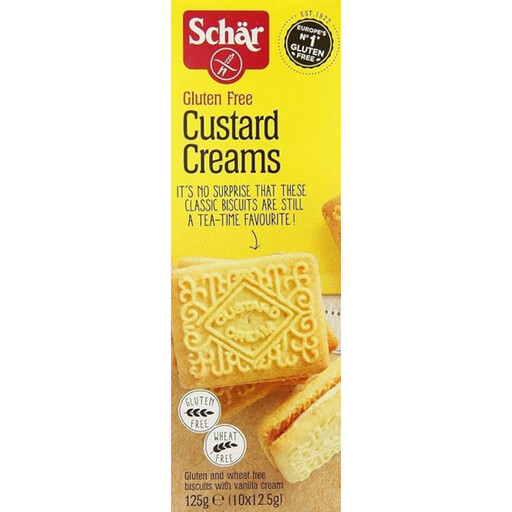
Schar Gluten Free Custard Creams 125g
For a sale requesting gluten-free custard creams, this named 125g pack offers that labelled biscuit type. Check its current ingredients and allergens against the school's arrangements; its gluten-free name does not establish that it is milk-free.
View on Joybuy
Frequently asked questions
Can I bring custard creams to a school bake sale?
Check with the school first. Conventional products such as the cited McVitie's, Waitrose and Sainsbury's packs contain milk and wheat, so whether they fit depends on the school's allergy arrangements. Keep the chosen pack's allergen information available at the sale.
Do custard creams always contain milk?
No. The cited McVitie's, Waitrose and Sainsbury's conventional products list milk-derived whey, whereas Morrisons labels its Free From Custard Creams milk-free. Check the current pack rather than assuming either applies to all custard creams.
Are custard creams gluten-free?
Do not assume so from the biscuit name. The cited conventional products list wheat ingredients, while Morrisons labels its named Free From Custard Creams free from cereals containing gluten. If gluten-free biscuits are required, check that claim and the ingredients on the exact pack.
How should standard and free-from biscuits be set out?
Keep each product's packaging available for ingredient checks. When both types are offered, Anaphylaxis UK recommends placing allergy-friendly items in a separate area; use separate serving utensils so the options do not become mixed.
Is a custard cream the same as a digestive biscuit?
No. They are different biscuit types. If the organiser asked for digestives, confirm before bringing custard creams instead, and check the ingredients of whichever biscuit you choose.


