Sugar-conscious biscuit buyers
If you are adding ready-made custard creams to a bake, compare exact packs per 100g and then consider the quantity your recipe uses. A lower figure than another pack is not, on its own, a reduced-sugars claim.


If you need ready-made custard creams for a bake, compare sugars per 100g on the exact packs, then consider how many biscuits you will use. Sainsbury’s lists 26.5g sugars per 100g for its standard pack, against Tesco’s 28.3g; that difference does not establish a formal reduced-sugars claim. Making your own lets you choose the biscuit and filling ingredients, but a lower-sugar finished biscuit cannot be established without calculating the recipe and its yield.
If you are adding ready-made custard creams to a bake, compare exact packs per 100g and then consider the quantity your recipe uses. A lower figure than another pack is not, on its own, a reduced-sugars claim.
Making both the biscuits and the filling lets you choose their ingredients. To assess sugars per finished biscuit, you also need to account for the ingredients used and the finished yield.
Check the exact biscuit and every other ingredient in the bake. Tesco and Asda’s checked standard custard creams list wheat and milk; Sainsbury’s lists its separate Free From custard creams as gluten-free and milk-free.
Start with comparable figures for the exact biscuits, then consider the amount going into the bake and any ingredient requirements.
Choose this route: When you want to use finished custard creams and can compare their current nutrition labels.
Trade-off: You can compare declared sugars, but a comparatively lower figure does not make a pack a reduced-sugars product.
Choose this route: When selecting the ingredients for both parts matters more than using finished biscuits.
Trade-off: Prue Leith’s published custard-cream recipe uses sugar in both parts; a changed recipe needs its own ingredients and finished yield assessed before any sugar comparison.
| Priority | What to check | Your needs |
|---|---|---|
| Sugars in the bake | Compare the exact packs in grams of sugars per 100g. Check sugars per biscuit and the number going into the recipe; include the filling and other bake ingredients. | I want to know how much sugar the biscuits contribute to the quantity I am making, not just which pack has a lower per-100g figure. |
| Sugar wording | Keep a comparison between named packs separate from a formal reduced-sugars claim. Check the exact variant’s label; a sugars figure alone does not establish its energy content. | If I pick a pack with less sugar than another, I do not want to mistake that comparison for a claim about every custard cream from the brand. |
| Ingredients and allergens | Read the current pack’s ingredient and allergen information, including any precautionary statement. Check the other ingredients added to the bake. | Everyone eating the finished bake needs ingredients that suit their requirements. A free-from biscuit addresses only the characteristics stated for that product. |
| Preparation | For ready-made biscuits, check the pack’s nutrition and storage instructions. For homemade custard creams, account for making both the biscuits and the filling. | Sometimes I need finished biscuits for a bake; at other times, choosing both sets of ingredients is worth the extra preparation. |
Ordering a few packs by sugars per 100g shows a difference between those packs, not whether any one qualifies for a formal claim. The NHS describes more than 22.5g total sugars per 100g of food as high; even the lower figures in the checked comparison exceed that guide.
Describe a difference only between the specified, current labels. Check a product’s actual claim separately rather than deriving one from the comparison.
Sainsbury’s lists 24.9g sugars per 100g for its Free From custard creams, against 26.5g for its standard pack. Its stated Free From biscuit contains 3.5g sugars, however, against 3.3g for a stated standard biscuit.
Use per 100g to compare the packs, then check the amount per biscuit for the quantity you plan to use. Choose a free-from formulation for the dietary characteristics its label states.
Prue Leith’s published custard-cream recipe includes sugar in both the biscuit and the filling. Ingredients added elsewhere in a bake also contribute to its finished composition.
Account for the complete recipe and finished yield before comparing a homemade version with a packaged biscuit.
Its standard and Free From custard creams are separate formulations worth comparing by both pack and biscuit.
Its standard 400g custard creams provide a ready-made pack for comparison.
Its standard 400g vanilla-filled custard creams offer another exact-pack comparison.
Its standard 300g custard creams provide a further named-pack sugar comparison.
M&S describes its Extra Cream custard creams as having extra vanilla cream.
Its Tasties 300g custard creams are a distinct pack to compare by its own label.
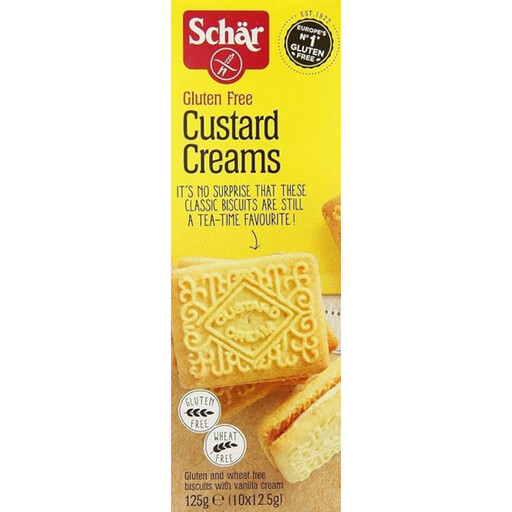
This Joybuy option is a gluten-free, ready-made custard cream for a bake. Check its current pack alongside the other ingredients you plan to use.
 No image available
A 125g pack of gluten-free, ready-made custard creams for a bake; check the current label for sugars and allergens, and check any other ingredients you will add.
Use per 100g to compare exact packs on the same basis, then look at sugars per biscuit or the quantity going into your bake. Sainsbury’s standard and Free From custard creams show why both measures matter: the Free From pack lists fewer sugars per 100g but more per stated biscuit.
You can choose the ingredients, but a substitution does not by itself establish the sugar content of the finished biscuits or how the changed recipe will bake. Prue Leith’s published recipe uses sugar in both biscuit and filling; account for all ingredients and the finished yield when making a comparison.
Not necessarily on every measure. Sainsbury’s lists 24.9g sugars per 100g and 3.5g per biscuit for its Free From pack, against 26.5g per 100g and 3.3g per biscuit for its standard pack. Check the dietary characteristics and serving information of the exact product.
Read the exact biscuit pack’s ingredients and allergen information, including any precautionary statement, and check every additional baking ingredient. Tesco and Asda’s checked standard custard creams list wheat and milk; the Food Standards Agency explains that may-contain statements communicate possible unintended allergen presence.
Follow the instructions on the pack you use. Sainsbury’s listing for its standard custard creams says to store them in an airtight container once opened.