Biscuit eaters planning a workout
If you fancy a custard cream before exercise, the useful question is whether you need a snack and how many biscuits you would eat. Check that portion’s carbohydrate and fat rather than judging the whole pack.


The custard creams examined here contain sugars, including those labelled gluten-free or milk-free; those labels describe different properties. Before exercise, decide whether you need a snack, then check the portion’s total carbohydrate, sugars and fat. If exercise-related low blood glucose is a concern, follow your individual plan rather than choosing a biscuit by its sugar claim alone.
If you fancy a custard cream before exercise, the useful question is whether you need a snack and how many biscuits you would eat. Check that portion’s carbohydrate and fat rather than judging the whole pack.
Gluten-free, milk-free and sugar-free are different claims. Compare the sugars figures on a common per-100-g basis, then look at the amount in your intended portion.
If you use medication that can cause low blood glucose, your snack decision needs to follow your individual exercise plan. Cambridge University Hospitals NHS Foundation Trust advises considering glucose readings, medication and activity rather than relying on a biscuit’s sugar description.
Start with the reason for eating before exercise; then compare the relevant label claims and the portion you would actually have.
| Priority | What to check | Your needs |
|---|---|---|
| Sugar claims | Read exactly what a product says it is free from. Compare sugars per 100 g on the current pack; a gluten-free or milk-free declaration is not a sugar-free claim. | I’m limiting sugar, so I need the sugars figure rather than an assumption based on a ‘free from’ label. |
| Allergens | Check the named allergen declaration and ingredients for the exact recipe. Tesco’s examined Free From custard creams are labelled gluten-free and milk-free; the examined Schär product is described as gluten-free and lactose-free. | If I need to avoid an ingredient, I’ll check whether the particular pack meets that need separately from its sugar content. |
| Snack purpose | Consider whether you need food before this activity and what you have already eaten. Compare carbohydrate, protein and fat in the portion with the reason you are having a snack. | I want to decide whether a biscuit fits the snack I have planned, rather than assuming exercise calls for an extra snack. |
| Portion size | Use per-100-g figures to compare recipes of different biscuit sizes. For what you will eat, check the per-biscuit figures and count every biscuit in the portion. | Two biscuits change the amount I’m eating: I need to look beyond the figure for a single biscuit. |
| Total carbohydrate | Read total carbohydrate as well as sugars; they are separate lines on a nutrition label. The examined Asda conventional custard creams list 8.1 g carbohydrate and 3.4 g sugars per biscuit. | When carbohydrate intake matters to me, the sugars figure alone does not describe the whole biscuit. |
| Blood glucose plan | If exercise-related low blood glucose is relevant, use your individual advice on glucose readings, medication and activity. Do not assume a cream-filled biscuit serves the same purpose as advised fast-acting carbohydrate. | I need to follow my own exercise and hypo-management plan, not treat a ‘sugar-free’ label as a safeguard. |
Tesco’s examined Free From custard creams list 19.9 g sugars per 100 g, while Asda’s listing for the examined Schär biscuits gives 23 g per 100 g. Their free-from descriptions address other ingredients.
Identify the ingredient named in the claim, then read sugars and total carbohydrate on the same pack.
A per-biscuit value and a per-100-g value answer different questions. Biscuit sizes and the number eaten can also differ between packs.
Use per 100 g to compare recipes, then calculate your planned portion from the pack’s per-biscuit information.
NHS hospital guidance distinguishes decisions about planned exercise snacks from the individual management of low blood glucose. A custard cream should not be assumed equivalent to advised fast-acting carbohydrate.
If hypoglycaemia is relevant to you, follow your own clinical advice for exercise and treatment rather than substituting a biscuit.
These examples show why the precise recipe and nutrition label matter more than the brand name alone.
Asda lists both conventional custard creams and a separate Free From recipe.
Sainsbury's lists conventional and Free From custard creams as distinct products.
The examined Tesco Free From Custard Creams 125g carry gluten-free and milk-free declarations.
The examined gluten-free custard creams come in five packs of two biscuits.
The examined Extra Cream Custard Creams 165 g are a distinct, extra-filled variant.
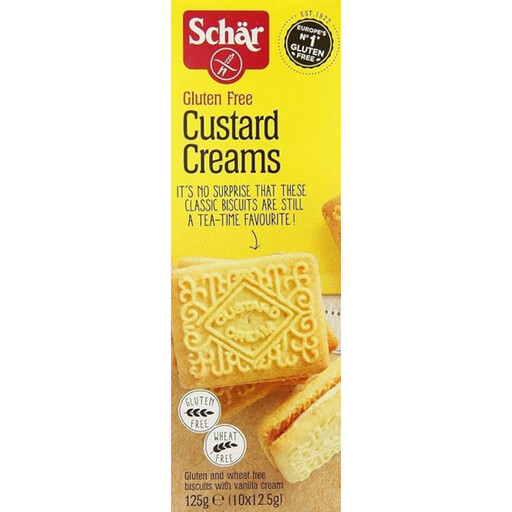
This gluten-free custard cream is an option if you want this type of biscuit before exercise; check its sugar figures and your intended portion rather than treating ‘free from’ as a pre-workout or sugar-free claim.
 No image available
If you want a gluten-free custard cream before exercise, count the biscuits in your planned portion rather than relying on the Free From description. This product is described as gluten-free and lactose-free; the examined product information lists 23 g sugars per 100 g and 9.2 g carbohydrate per biscuit. The pack contains five two-biscuit portions. Check the current ingredients and allergen information against your needs.
No. Tesco’s examined Free From custard creams list 19.9 g sugars per 100 g, and Asda’s listing for the examined Schär product gives 23 g per 100 g. Check sugars and total carbohydrate separately from any allergen declaration.
Not necessarily. Consider whether you need a snack given what you have already eaten, then check whether the portion’s carbohydrate and fat fit your reason for eating it. A packaged biscuit does not need preparing, but that alone does not make it suitable for a particular exercise plan.
Follow your individual exercise and hypo-management advice rather than relying on a sugar-free claim or substituting a custard cream for advised treatment. Cambridge University Hospitals NHS Foundation Trust links pre-exercise decisions to glucose readings, medication and activity.
Follow the directions on your pack. The examined Asda conventional custard creams say to keep the biscuits cool and dry and use an airtight container once opened.