Bakers using biscuit crumbs or layers
If custard creams form a cheesecake base, cake filling or traybake layer, the weight of biscuit you use is more useful than a per-biscuit figure when comparing its sugar contribution.


For a cake that uses custard creams as crumbs or a layer, compare sugars per 100g on the exact biscuit pack; a lower figure than another biscuit does not, by itself, establish a “reduced sugars” claim. Among four reviewed listings, Sainsbury’s declares 26.5g per 100g, Asda 29g, Joybuy’s McVitie’s Tasties listing 30.6g and M&S Extra Cream 40.2g. That limited comparison helps with the biscuit choice, but the amount used and the cake’s other ingredients also matter.
If custard creams form a cheesecake base, cake filling or traybake layer, the weight of biscuit you use is more useful than a per-biscuit figure when comparing its sugar contribution.
A standard custard cream can have a lower declared sugar figure than another without carrying a substantiated “reduced sugars” claim. Check what the exact pack says rather than treating the two descriptions as interchangeable.
Read the ingredients and allergen statements on the pack you will use, especially when serving someone with a food allergy. The reviewed standard biscuits include wheat and milk, and some list possible traces of other allergens.
Start with the biscuit quantity your recipe needs, then compare like-for-like label values and check whether any claim on the pack matches what you are seeking.
| Priority | What to check | Your needs |
|---|---|---|
| Declared sugars | Compare sugars per 100g on the exact packs, rather than mixing per-biscuit and per-100g values. For the four reviewed listings, Sainsbury’s declares 26.5g, Asda 29g, Joybuy’s McVitie’s Tasties listing 30.6g and M&S Extra Cream 40.2g per 100g. | I’m making a substantial crumb base or biscuit layer and want to compare the amount of sugar declared for the biscuit ingredient. |
| Reduced-sugars claim | Look for an explicit claim on the exact pack and check the comparison behind it. Campden BRI distinguishes a reduced-sugars claim from simply finding a lower sugar figure on a different biscuit. | If I specifically want a product labelled “reduced sugars”, choosing the lowest figure from a few standard packs will not answer that question. |
| Recipe quantity | Weigh biscuits used for crumbs or filling; use per-biscuit values when the recipe calls for a count of whole biscuits. Consider the cake’s other ingredients separately. | For a weighed base, I need to know how much biscuit goes in. For a few biscuits used as decoration, a count may be easier to work with. |
| Ingredients and allergens | Read the physical pack’s ingredient list and any may-contain statement before baking. Check again if you buy the product another time, as Tesco notes that food formulations and label information can change. | I’m serving the cake to someone with an allergy or ingredient restriction, so the particular pack matters more than the biscuit’s familiar name. |
A comparison between standard custard creams tells you which of those packs declares less sugar; it does not establish that one qualifies for a reduced-sugars claim.
If the claim matters to your purchase, check the wording on the exact pack and the comparable product behind it. Otherwise, describe the choice in terms of the specific sugar values compared.
Biscuits can differ in size, so a per-biscuit value does not give a like-for-like comparison for a base made from a measured weight of crumbs.
Compare sugars per 100g and weigh the biscuits added to the recipe. Use per-biscuit figures when you are counting whole biscuits for a topping or decoration.
M&S describes its Extra Cream biscuit as having more vanilla cream and declares 40.2g sugars per 100g. Sainsbury’s declares 26.5g per 100g for its reviewed standard custard cream.
If the biscuit makes up a substantial part of the cake, compare the per-100g values before choosing a variant for its filling or flavour.
The reviewed biscuits include wheat and milk statements, while some also have may-contain warnings. The pack you buy is the information to use when preparing food for someone with an allergy.
Read its ingredients and allergen labelling immediately before baking, even if you have bought the same product before.
These references concern the specified custard cream products, not every biscuit sold under each brand.
A standard 200g pack to compare when sugar per 100g is central to the biscuit choice.
A standard 400g pack with both per-100g and per-biscuit sugar declarations.
A custard-flavoured cream filling between biscuits; check this specific variant rather than assuming other McVitie’s products have the same values.
A variant M&S describes as having more vanilla cream, for recipes where that filling is part of the choice.
Tesco describes its product as a sandwich biscuit with a vanilla-flavour filling.
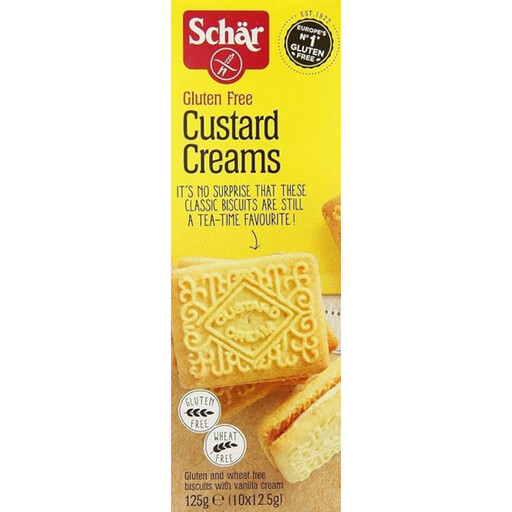
This Joybuy option is a gluten-free custard cream biscuit for recipes using biscuit crumbs, layers or decoration. Compare the exact pack’s sugar declaration and ingredients with the needs of your recipe.
 No image available
For a cake made with custard cream crumbs or decoration, this is a gluten-free 125g biscuit option. Check the pack’s sugars per 100g, ingredients and suitability for your recipe before using it.
No. A lower declared figure than another standard biscuit does not, on its own, substantiate a reduced-sugars claim. If you need a product carrying that claim, check the exact pack and the comparison behind its wording.
Sainsbury’s Custard Creams declares 26.5g sugars per 100g, compared with 29g for Asda, 30.6g on Joybuy’s McVitie’s Tasties listing and 40.2g for M&S Extra Cream. Those are figures for four specified listings, not a comparison of every custard cream sold in the UK.
Read the ingredients and allergen statements on the exact biscuit pack before baking. The reviewed Sainsbury’s, Asda and McVitie’s products list wheat and milk; Asda also lists possible rye, barley, oats and sesame, while McVitie’s lists possible sesame. M&S Extra Cream lists wheat, milk and soya.