Lower-sugar comparers
If sugar content matters to you, compare the actual packs in g per 100g. Check the per-biscuit figure as well when deciding how many to serve; a free-from label is not a sugar claim.


For car boot sale refreshments, compare sugars per 100g on the pack you will serve, then check sugars per biscuit and how many biscuits you need. Tesco lists 19.9g sugars per 100g for one 125g Free From product, but 25.2g for another similarly named listing, so the lower figure should not be assumed for every pack. Larger conventional packs may suit sharing, while a free-from option addresses a separate dietary requirement.
If sugar content matters to you, compare the actual packs in g per 100g. Check the per-biscuit figure as well when deciding how many to serve; a free-from label is not a sugar claim.
For a group, pack size and any stated biscuit count help you plan quantities. Keep the original packaging available for ingredients and allergen information, particularly if biscuits will be offered loose.
If guests avoid gluten or milk, look for those specific statements on the pack you will serve. Check its sugar figures separately if you are also comparing sugar content.
Choose for the requirements of your guests first, then compare sugar figures on the same weight basis and work out how many packs to bring.
| Priority | What to check | Your needs |
|---|---|---|
| Sugar content | Compare sugars in g per 100g for the exact packs, then check g per biscuit and biscuit weight. Tesco’s two similarly named 125g Free From listings give different figures: 19.9g and 25.2g sugars per 100g. | I want to compare sugar content without assuming that a free-from product, or the lowest figure in a shortlist, carries a substantiated reduced-sugars claim. |
| Quantity | Check pack weight and any stated biscuit count. The products discussed include 125g free-from packs and conventional packs of 200g, 300g and 400g; Tesco’s Crawford’s listing describes approximately 26 biscuits in its 300g pack. | There need to be enough biscuits to share, so I’ll plan the number of packs around the guests expected rather than treating pack weight as a biscuit count. |
| Dietary requirements | Read the supplied pack’s gluten and milk statements, ingredients and allergen information. Check sugar separately; the two kinds of information answer different questions. | Some guests may need a specifically labelled option, and I want them to be able to inspect the original packaging. |
| Serving and storage | Follow the pack’s storage directions and check how to keep biscuits once opened. Confirm availability before relying on a particular product for the event. | I’ll need a way to keep opened biscuits as directed during the sale and a confirmed supply of the packs I plan to serve. |
A lower sugars-per-100g figure within a shortlist does not, by itself, substantiate a regulated comparative claim. The UK-published legislation sets conditions for a reduced-nutrient claim, including comparison with a similar product.
Describe what the pack actually lists, and use “reduced sugars” only where that claim is substantiated for the product.
Tesco’s two 125g Free From custard cream listings give 19.9g and 25.2g sugars per 100g respectively. A decision based on the lower figure depends on receiving the corresponding product.
Read the nutrition table on the pack supplied before using either online figure to choose or describe it.
A dietary-exclusion statement does not tell you the product’s sugar content, and a general free-from description should not replace a check for a guest’s specific requirement.
Check the exact pack’s allergen information alongside its sugars per 100g and per biscuit.
These examples describe particular listed products, not every custard cream sold under each brand.
Tesco lists both a conventional 400g pack and 125g Free From custard creams.
Sainsbury’s lists conventional and Free From custard creams for different serving requirements.
ASDA’s listed 125g Free From custard creams offer a product to check when guests need the stated gluten- and milk-free attributes.
The listed conventional custard creams come in a 300g pack.
M&S Extra Cream Custard Creams are a filling-style choice rather than a lower-sugar selection.
McVitie’s Tasties custard creams are listed by Morrisons as a conventional 300g product.
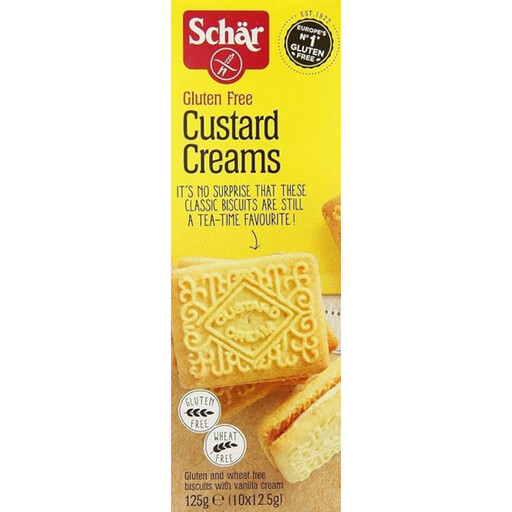
This gluten-free custard cream pack is an option to consider for guests with that requirement. Compare the supplied pack’s nutrition and allergen information before choosing it for the sale.
 No image available
A 125g gluten-free custard cream option for refreshments; check the supplied pack’s sugars per 100g and allergen information before serving.
No. Free-from wording describes the stated dietary exclusions, while sugar content must be checked separately on the product’s nutrition label. A lower figure in this selection alone does not substantiate a regulated reduced-sugars claim.
Follow the directions on each pack. The checked conventional Tesco and Sainsbury’s packs say to store biscuits in a cool, dry place and use an airtight container after opening. Keep the original packaging available so guests can check ingredients and allergens.
It could. Food Standards Agency guidance on food-business registration includes businesses selling food from temporary stalls. UK Government event guidance for England, Wales and Northern Ireland says a local authority may decide registration is not needed for very limited, infrequent activity. Ask your local authority about your own arrangements rather than assuming an exemption, particularly in Scotland, which that event-specific guidance does not cover.
Keep the manufacturer’s packaging so its ingredients and allergen information remain available. UK Government event guidance distinguishes loose food, prepacked food and food prepacked for direct sale; the applicable information duties can differ, so do not assume repacking leaves the original requirements unchanged.