Shared-table organisers
You are putting biscuits at one refreshment point and need to plan how many packets to open and when to replenish them.


For one shared refreshment table, compare the biscuit count or stated servings for the exact custard cream packet as well as its weight. Smaller packets can be opened as separate breaks require them, while a separately identified free-from option may be needed for attendees whose requirements are not met by standard biscuits; check its delivered label and keep allergen information available when serving.
You are putting biscuits at one refreshment point and need to plan how many packets to open and when to replenish them.
You are serving biscuits at different times or locations and want to open packets as each break requires them.
You need accurate ingredient information and a separately assessed biscuit choice for attendees whose requirements are not met by the standard selection.
Plan for the number of attendees and breaks before choosing a packet size. Then check how the biscuits will be stored, identified and served.
| Priority | What to check | Your needs |
|---|---|---|
| Quantity | Check the exact packet’s weight and any stated biscuit count or servings. Asda suggests 34 servings for its 400g packet; Tesco lists a 400g packet, while Tesco’s Crawford’s listing gives approximately 26 biscuits in a 300g packet. Servings and biscuits are different measures. | I need to plan for the people and breaks expected, without treating packet weight as a guaranteed number of portions. |
| Opening and storage | Consider how many packets must be opened at each location. The Tesco, Crawford’s and Sainsbury’s listings direct customers to store opened biscuits in an airtight container; follow the delivered packet’s instructions. | For breaks spread across the day, I would rather open biscuits as needed than put every packet out at once. |
| Dietary choice | Read the delivered label for the exact product. Tesco and Asda list wheat and milk in their standard custard creams; Morrisons lists a separate 125g product labelled free from gluten and milk. Check any alternative against each attendee’s requirements. | I need a clearly identified separate choice where the ordinary biscuits do not meet an attendee’s dietary requirements. |
| Serving information | Keep the relevant packet information accessible when biscuits are served loose, and plan how standard and free-from biscuits will be kept identifiable and separately handled. | Guests should be able to find out which biscuits they are being offered, even after the packets have been opened. |
Asda suggests 34 servings for its 400g custard creams, whereas Tesco’s Crawford’s listing gives approximately 26 biscuits for a 300g packet. A serving is not necessarily one biscuit.
Decide how many biscuits you intend to offer per attendee, then use the count or serving measure supplied for the exact packet when planning each break.
The checked Tesco and Asda standard custard creams contain wheat and milk. Once biscuits are removed from their packets, guests still need accurate information about what is being served.
Keep delivered-pack ingredient information available and arrange separate, clearly identified handling for any free-from choice.
These listings illustrate packet formats and product-specific details to check; a brand name alone does not establish dietary suitability.
Tesco lists its own-label custard creams in a 400g packet for a shared table.
Asda lists a 400g own-label custard cream packet.
Tesco’s listing describes a 300g Crawford’s packet containing approximately 26 biscuits.
Iceland lists McVitie’s Tasties Custard Cream Biscuits in a 300g packet.
Sainsbury’s lists its own-label custard creams in a 200g packet.
M&S lists Extra Cream Custard Creams as a 165g variation; the extra-cream description is the retailer’s own.
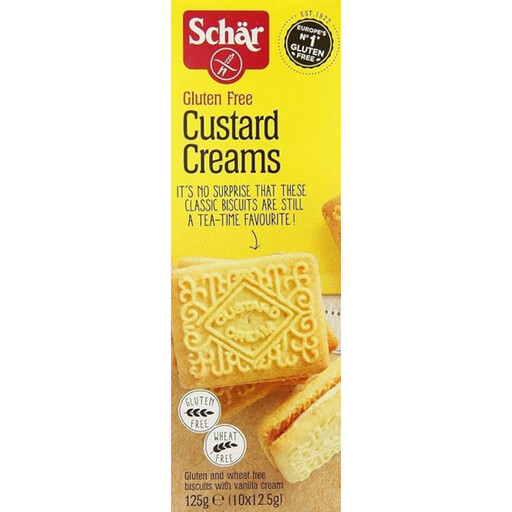
This 125g gluten-free custard cream packet is an option to assess for a separately served dietary choice, rather than a larger shared-table packet.
 No image available
Consider this packet for a separate biscuit choice at a conference, rather than as the main sharing packet. The Sainsbury’s listing for Schär’s 125g custard creams describes five portion packs and gluten-free, lactose-free labelling. Check the delivered ingredients against each attendee’s requirements before serving.
Start with the expected attendees, the number of breaks and how many biscuits you intend to offer each person. Then check the exact product’s measure: Asda suggests 34 servings for its 400g packet, while Tesco’s Crawford’s listing gives approximately 26 biscuits for its 300g packet. Do not count a stated serving and an individual biscuit as equivalent without checking the product.
Follow the delivered packet’s storage directions. The checked Tesco, Crawford’s and Sainsbury’s listings instruct customers to keep opened biscuits in an airtight container, so plan for that if one packet will be used across several breaks.
Do not assume they can: the checked Tesco and Asda standard products list both wheat and milk ingredients. Assess a separately identified product against the guest’s requirements and its delivered label, and keep it separately handled when serving.
Food businesses must provide allergen information for non-prepacked food as well as prepacked food. Food Standards Agency guidance covers England, Wales and Northern Ireland, while Food Standards Scotland confirms the obligation in Scotland; both address managing allergens during preparation and service. Keep information for the biscuits actually served available to guests and plan their handling accordingly.