Christmas bakers comparing sugar
If custard creams will be crushed into a base or added to a dessert, their sugar figure matters alongside any icing, chocolate or other sweet ingredients in the recipe.


If reduced sugar is essential to your Christmas bake, do not treat the lowest sugar figure among standard custard creams as proof of a reduced-sugar claim: check the claim and the sugars per 100g on the current pack. Among four standard products with comparable figures from Sainsbury's, Tesco, Asda and Crawfords, Sainsbury's declares the lowest sugars at 26.5g per 100g, but its per-biscuit sugar indicator is still marked high.
If custard creams will be crushed into a base or added to a dessert, their sugar figure matters alongside any icing, chocolate or other sweet ingredients in the recipe.
Sugars per 100g allow a like-for-like comparison between similar biscuits. The per-biscuit figure and traffic-light label help put the amount used in a recipe into context.
The conventional custard creams described by Sainsbury's, Tesco, Asda, Crawfords and Morrisons contain wheat and milk. Some carry additional may-contain warnings, so check the exact pack before adding biscuits to a shared dessert.
Start with the sugar figure on a consistent weight basis, then check any reduced-sugar claim, the quantity your recipe uses and the ingredients on the pack.
| Priority | What to check | When it matters to me |
|---|---|---|
| Sugar comparison | Compare sugars per 100g between similar biscuits. Then check sugars per biscuit and the number your recipe uses; the two figures answer different questions. | I want to compare biscuits fairly before adding other sweet ingredients. In the Food Standards Agency and Ipsos Northern Ireland's 2024 survey of 611 Northern Ireland adults, 49% said they actively used traffic-light labels when shopping for food; that measures label use, not preference for lower-sugar biscuits. |
| Reduced-sugar claim | Look for an explicit claim on the current product label and read it alongside the nutrition declaration. A lower figure than another standard biscuit does not itself establish such a claim. | If I need to describe a Christmas bake as using reduced-sugar biscuits, I need to check what the chosen pack actually claims. In the same 2024 Northern Ireland survey, 35% identified nutritional claims on the back of packaging as their primary source of nutritional information; that is not a reduced-sugar purchase rate. |
| Recipe quantity | Check the per-biscuit figure when using whole biscuits. For a crushed base or topping, check how much of the packet the recipe calls for. | A few biscuits for decoration and a biscuit base use different amounts, so I want the sugar information to reflect the quantity going into my bake. |
| Ingredients and allergens | Read the exact pack's ingredient list and may-contain statements. The reviewed conventional products contain wheat and milk, with additional warnings on some packs. | When serving guests, I need to check the biscuit I actually use rather than assume that similar-looking custard creams have the same ingredients. |
Sainsbury's lists 26.5g sugars per 100g, the lowest of the four compared standard products, yet its per-biscuit sugar indicator is marked high. A relative comparison does not establish a reduced-sugar claim.
Use “lower than” only with a named comparison. If a reduced-sugar product is required, check for an explicit claim on the current pack.
Biscuits can differ in weight, so per-biscuit figures alone are not a consistent way to compare products.
Compare sugars per 100g first. Use the per-biscuit figure to work out the contribution of whole biscuits added to the recipe.
The reviewed conventional biscuits contain wheat and milk, and some have sesame or other cereal may-contain warnings. A biscuit added to a base or topping becomes an ingredient in the finished dessert.
Check the ingredient and allergen information on every pack used, including any substitute biscuit.
M&S Extra Cream Custard Creams lists 40.2g sugars per 100g, above the figures declared for the four compared standard products.
If reducing sugar is the priority, compare the nutrition declaration before choosing an extra-cream variation.
These named biscuits provide label information for comparison; inclusion here does not establish that a product is reduced sugar or available at Joybuy.
Its standard 200g custard creams have a declared sugar figure of 26.5g per 100g.
Tesco's standard 400g custard cream biscuits list 28.3g sugars per 100g.
Asda's standard 400g custard creams list 29g sugars per 100g.
Crawfords custard creams are a conventional 300g vanilla-cream sandwich biscuit.
McVitie's Tasties Custard Creams are a conventional custard-flavoured sandwich biscuit.
M&S Extra Cream Custard Creams are a 165g variation with extra vanilla cream.
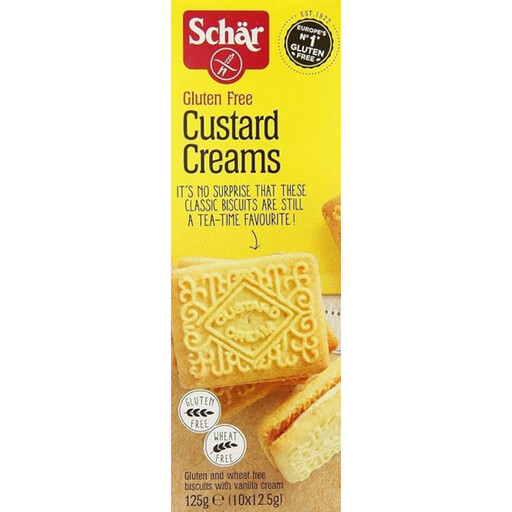
This Joybuy option is a gluten-free custard cream for Christmas baking. Check its current sugar declaration and ingredient information if either affects your choice.
 No image available
For a Christmas recipe using custard creams, compare the pack's sugars per 100g with other biscuits and check its ingredients for your guests. This is the 125g gluten-free variant; gluten-free does not itself establish a reduced-sugar claim.
Sainsbury's lists 26.5g sugars per 100g, below Tesco's 28.3g, Asda's 29g and Crawfords' 30.7g in their respective product declarations. This is a comparison of those four standard products, not evidence that Sainsbury's makes a reduced-sugar claim.
Use sugars per 100g to compare similar custard creams on the same weight basis. Then use the per-biscuit figure and the number going into your Christmas bake to assess the contribution of whole biscuits.
Do not assume so: the conventional custard creams described by Sainsbury's, Tesco, Asda, Crawfords and Morrisons list wheat and milk, while some have additional may-contain warnings. Check the exact pack and any substitute biscuit before preparing a shared dessert. GOV.UK says that listed allergens in prepacked food must be clearly labelled within the ingredients list.