Hosts planning a small chocolate-focused spread
Tesco, ASDA and M&S each describe a milk-chocolate-coated custard cream. These are options when a chocolate coating matters more than a plain biscuit, but they do not meet a request for dark chocolate.


If dark chocolate is essential, choose a biscuit whose current label explicitly says dark chocolate: the chocolate-coated custard creams described by Tesco, ASDA and M&S are milk chocolate. For a coffee morning, a coated custard cream suits a chocolate-focused spread, while a larger plain pack offers a stated serving count for planning; check the pack’s ingredients and allergen information before serving either.
Tesco, ASDA and M&S each describe a milk-chocolate-coated custard cream. These are options when a chocolate coating matters more than a plain biscuit, but they do not meet a request for dark chocolate.
Stated serving counts can help with planning: ASDA suggests 34 servings for its 400 g plain pack, while Sainsbury’s lists approximately 16 servings for its 200 g plain pack. Check the pack size and serving information when deciding how many to buy.
The listed plain ASDA and Sainsbury’s custard creams contain wheat and milk; ASDA’s coated version also lists soya. Check the current packet, including any precautionary allergen statements, rather than assuming that a plain biscuit suits every guest.
Decide whether dark chocolate is a firm requirement, then compare the biscuit format, servings and ingredients of the packs you are considering.
| Priority | What to check | Your needs |
|---|---|---|
| Chocolate type | Read the chocolate description on the current pack. Tesco and ASDA specify 52% milk chocolate in their coated custard creams; M&S also specifies 52% milk chocolate. A cocoa-solids figure for milk chocolate does not make the coating dark chocolate. | If I’m serving guests who specifically want dark chocolate, I’ll choose a biscuit explicitly labelled dark chocolate rather than judge a custard cream by its colour. |
| Pack planning | Compare pack weight and stated servings for the named product. ASDA suggests 34 servings for its 400 g plain custard creams; Sainsbury’s lists approximately 16 for its 200 g pack. | For a larger gathering, I want to work out how many packs will cover the guests, rather than assume a coated and a plain pack serve the same number. |
| Portion information | Check nutrition figures per biscuit or per serving, and compare the stated serving sizes. Sainsbury’s lists 59 kcal, 3.3 g sugars and 1.2 g saturates per biscuit for its 200 g plain pack. | I’d like to know what one biscuit represents on the label before choosing what to put out. |
| Allergens | Read the current ingredients list and any may-contain statement. ASDA lists wheat and milk in its plain custard creams, with possible rye, barley, oats and sesame; its coated version lists wheat, milk and soya. | Guests with allergies need the information for the actual biscuits being served, including any precautionary statements relevant to them. |
Tesco, ASDA and M&S describe their listed coated custard creams as milk chocolate. A dark-looking coating could therefore lead to the wrong choice for a guest who specifically requested dark chocolate.
Use the chocolate type printed on the current pack. If dark chocolate is non-negotiable, choose a product that explicitly identifies it.
Pack weights and stated servings differ. ASDA suggests 34 servings for its 400 g plain pack, while Sainsbury’s lists approximately 16 for its 200 g plain pack.
Check the serving information and work out the number of packs needed for your guest list.
The listed plain ASDA and Sainsbury’s products contain wheat and milk. ASDA’s plain pack also carries may-contain information for rye, barley, oats and sesame.
Keep the current packet accessible and ask guests with allergies which ingredient and precautionary information they need.
Product information can change, so an earlier listing may not describe the packet on the table.
Check that packet’s ingredients, allergen declaration, best-before date and storage instructions before serving.
These named products illustrate different custard-cream formats; a brand’s inclusion does not mean every biscuit in its range has the same ingredients.
M&S describes its chocolate-coated custard cream as having more chocolate than biscuit.
Tesco lists a vanilla-filled, milk-chocolate-coated custard cream alongside its plain custard-cream options.
ASDA lists both a 400 g plain custard-cream pack and a 162 g milk-chocolate-coated pack.
Sainsbury’s 200 g plain custard creams offer a conventional, uncoated option for a coffee-morning table.
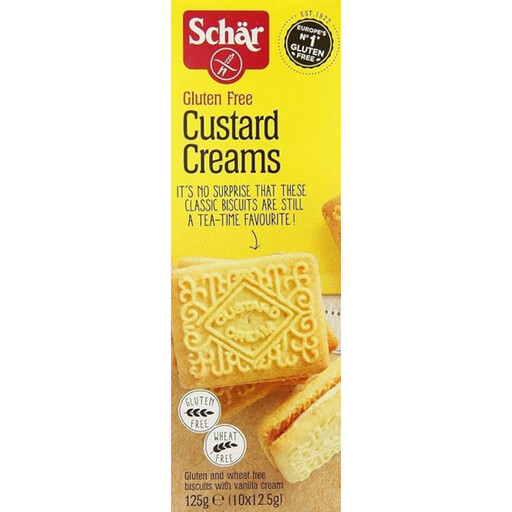
This plain custard-cream option is relevant if you want an uncoated biscuit for the coffee morning. It is not a dark- or milk-chocolate-coated custard cream.
 No image available
A plain custard cream to consider when an uncoated biscuit fits your coffee-morning spread. The pack is 125g; check its current ingredients and allergen information against each guest’s requirements before serving.
Not necessarily. Tesco, ASDA and M&S identify their listed coated custard creams as milk-chocolate products. If dark chocolate matters for your coffee morning, check that the particular biscuit’s current label explicitly says dark chocolate.
Start with the pack’s stated servings and the number of guests. ASDA suggests 34 servings for its 400 g plain custard creams, while Sainsbury’s lists approximately 16 for its 200 g plain pack; confirm the details on the packs you buy.
Read the ingredients and any precautionary allergen statement on the current packet. GOV.UK says that any of the 14 regulated allergens present as ingredients in prepacked food must be clearly labelled in the ingredients list. The named plain ASDA and Sainsbury’s custard creams contain wheat and milk, so do not assume that an uncoated biscuit suits every guest.
Use the current physical packet when checking the biscuits you will serve, because product information can change. Keep the packet available so guests can see the ingredients and any may-contain statement, and ask what information they need rather than deciding suitability for them.