Cyclists comparing sugar
If you want an occasional custard cream, compare sugars per 100g across packs and sugars in the number of biscuits you plan to eat. Keep the carbohydrate figure separate when planning food for a ride.


To choose a custard cream while limiting sugar, compare sugars per 100g, then check the amount in the portion you intend to eat. Schär has the lowest listed figure among the five variants compared here, at 23g per 100g, but that is above the NHS high-sugar threshold; a relatively lower figure is not itself a reduced-sugars claim. For a longer ride, consider carbohydrate and access to food separately from the sugar comparison.
If you want an occasional custard cream, compare sugars per 100g across packs and sugars in the number of biscuits you plan to eat. Keep the carbohydrate figure separate when planning food for a ride.
A sugar comparison alone will not tell you how much carbohydrate a portion contains or when you can conveniently access your food. British Cycling advises planning where food goes and choosing a suitable moment to eat on a ride.
Check the exact pack’s ingredients and allergen information before comparing its nutrition figures. A free-from description addresses specified ingredients, not whether the biscuit is low in sugar.
Check dietary suitability first where it matters, then compare sugars on the same basis and work out what your intended portion contributes.
| Priority | What to check | Your needs |
|---|---|---|
| Sugar comparison | Compare sugars per 100g across the exact variants. The five listed products here range from 23g to 29g per 100g, according to ASDA and Sainsbury’s product information. Check sugars per biscuit for your intended portion; do not treat a lower figure alone as a reduced-sugars claim. | I want to compare like with like, then see how much sugar is in the number of biscuits I would actually eat. |
| Ride planning | Check carbohydrate per biscuit separately from sugars. British Cycling’s indoor-cycling guidance calls for additional fuel during sessions longer than 90 minutes; also plan when you can access food. | For a longer ride, I need to know what my planned portion contributes and where I can stop or find a suitable moment to eat. |
| Dietary suitability | Read the exact pack’s ingredients and allergen information. Compare the free-from designation and nutrition figures as separate attributes; free-from does not mean low sugar. | If I need to avoid particular ingredients, the biscuit must meet that requirement before its sugar figure becomes a useful comparison. |
| Pack and portion | Check pack weight, biscuits per serving and how the biscuits are packed. ASDA lists Schär’s 125g variant as five 25g packs; packaging does not establish that eating while moving is safe. | I want portions that fit what I intend to carry, without assuming a portion pack settles when or where I can eat. |
Schär’s listed 23g sugars per 100g is the lowest of these five variants, yet it exceeds the NHS threshold of more than 22.5g per 100g for a high-sugar food. Its place in this limited comparison does not establish a reduced-sugars claim.
Use the stated per-100g and per-biscuit figures to describe the difference, rather than applying claim wording to the product.
A sugars-per-100g comparison does not show the carbohydrate in the portion you will carry or whether you can access it at a suitable point. British Cycling addresses longer-session fuelling and planning food access as separate considerations.
Check carbohydrate for your intended serving and decide in advance when and where you can eat.
Sainsbury’s Free From custard creams list 24.9g sugars per 100g, while its conventional custard creams list 26.5g. Those figures do not make the two recipes interchangeable for someone who needs to avoid an ingredient.
Establish suitability from the exact product’s ingredients and allergen information first; compare sugar and portions among suitable options afterwards.
These product lines offer different pack formats or dietary descriptions. Compare exact variants rather than treating a brand name as a sugar or allergen guarantee.
ASDA lists a gluten-free 125g custard cream variant in five 25g packs.
Sainsbury’s lists a conventional 200g custard cream and a separate Free From 125g variant.
ASDA lists conventional 400g custard creams and a Free From 125g variant.
Joybuy’s listing for McVitie’s Tasties Custard Creams 300g gives 30.6g sugars per 100g and marks that product as no longer available.
Tesco lists a 400g pack of vanilla-flavour custard cream sandwich biscuits.
Tesco lists Crawford’s Custard Creams 300g as sandwich biscuits with a vanilla-flavour cream filling.
M&S describes its 165g Extra Cream Custard Creams as containing additional vanilla cream and custard powder.
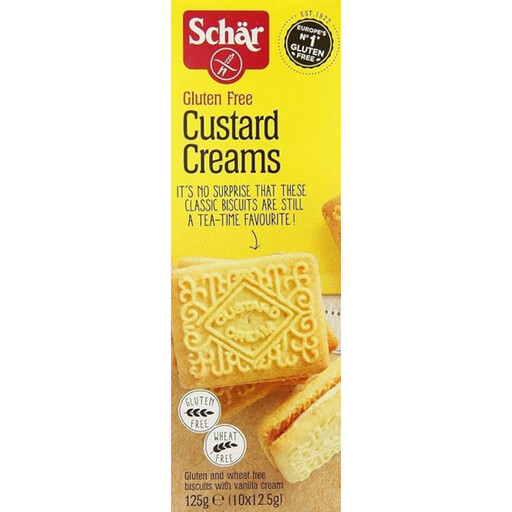
This gluten-free custard cream is relevant to comparing sugar figures and planning portions for a ride. Check the exact pack’s ingredients if you need to avoid particular foods.
 No image available
The five 25g packs offer a way to plan how many biscuits to carry. ASDA’s listing for this 125g variant gives 23g sugars and 73g carbohydrate per 100g, with 2.8g sugars and 9.2g carbohydrate per biscuit. The per-100g sugar figure exceeds the NHS high-sugar threshold; check the pack’s ingredients for dietary suitability and plan a suitable moment to eat.
No. Free-from describes specified dietary attributes, while a lower figure only compares the products measured. The NHS describes foods with more than 22.5g total sugars per 100g as high in sugar; all five custard cream variants compared here exceed that level.
Check carbohydrate when planning what a biscuit portion contributes to ride food, and sugars when comparing sugar content; they are separate entries on the nutrition label. British Cycling’s indoor-cycling guidance calls for additional fuel during sessions longer than 90 minutes, rather than specifying a biscuit serving.
Not necessarily. A portion pack helps divide what you carry, but it does not establish a safe time or place to eat. British Cycling advises planning where food goes and choosing an appropriate moment on the road or trail to eat it.
Check the exact product’s ingredients and allergen information, including on the delivered pack, before considering its sugar ranking. A conventional custard cream and a free-from variant can have different ingredient requirements; the brand name alone does not establish suitability.
A lower per-100g figure in this five-product comparison does not, by itself, establish a reduced-sugars claim. Describe Schär’s listed 23g sugars per 100g as the lowest figure among these five variants, rather than applying claim wording to the biscuit.