For one custard-cream treat, compare the total carbohydrate in the number of biscuits you plan to eat rather than relying on a ‘diabetic’ or gluten-free description; Diabetes UK advises paying attention to carbohydrate and portion size. A smaller packet can help you plan a portion, but it is not a single bar, and packet size does not tell you the carbohydrate per biscuit.
Who is this for?
Shoppers counting carbohydrate
If you are considering an occasional custard cream while managing diabetes, the useful figure is the carbohydrate in the portion you actually eat. Diabetes UK advises considering total carbohydrate and portion size, rather than treating a biscuit as suitable for everyone.
Shoppers looking for one treat
If you mean one biscuit or one wrapped serving when you ask for a ‘single bar’, check the pack format. The listed custard-cream examples are packets containing multiple biscuits, even when the packet is relatively small.
What should you check?
Decide what counts as your portion, then compare carbohydrate figures on the same serving basis and check whether the pack format suits that plan.
| Priority |
What to check |
Your needs |
| Carbohydrate per portion |
Check total carbohydrate per biscuit and the label’s serving definition. For more than one biscuit, use that product’s figure for the number eaten; do not substitute its sugars figure. |
I want to know the carbohydrate in the portion I plan to eat. Diabetes UK explains that the total carbohydrate consumed matters when managing blood glucose. |
| Packet or single serving |
Check the pack weight, stated serving count and whether biscuits are individually wrapped. Sainsbury’s lists approximately 16 servings in its 200g custard-cream packet. |
A smaller packet may suit me if I want fewer biscuits left after one treat, but I would not mistake the whole packet for one serving or a single bar. |
| Labels and ingredients |
Compare carbohydrate figures on the same per-biscuit or per-100g basis. Check the exact product’s ingredients and allergen statement if those details matter to you. |
I do not want ‘extra cream’, ‘gluten free’ or a diabetes-related description to stand in for the nutrition information on the biscuit I am choosing. |
Common buying mistakes
-
Using sugars as the total carbohydrate figure
Tesco lists 3.4g sugars but 8.4g total carbohydrate per biscuit for its checked 400g custard-cream packet. The two figures answer different questions.
Read the total carbohydrate line for the number of biscuits you intend to eat, and read sugars separately.
-
Assuming a small packet is a single bar
Sainsbury’s lists approximately 16 servings in its 200g packet, while Ocado describes the checked M&S extra-cream packet as containing 12 biscuits. Neither description makes the packet one portion.
Check whether you are buying one biscuit, a wrapped serving or a packet, then use the nutrition information for the portion you choose.
-
Treating a dietary description as a carbohydrate figure
Diabetes UK does not recommend foods labelled ‘diabetic’ as offering a special benefit. An extra-filling or gluten-free description likewise does not state the carbohydrate in your portion.
Read the current nutrition label and, where relevant, the ingredients and allergen information for the exact product.
Brand and product references
ASDA
The checked ASDA own-label custard creams come in a 400g packet.
- ASDA lists 8.1g carbohydrate and 3.4g sugars per biscuit.
- The packet provides approximately 34 servings, so it is not a one-portion purchase.
Crawford’s
The checked Crawford’s custard creams are a 300g packet listed by Tesco.
- Tesco lists 8.1g carbohydrate per 11.9g biscuit.
- Tesco gives approximately 26 biscuits per packet; it is not an individual serving.
Tesco
The checked Tesco own-label custard creams are a 400g packet.
- Tesco lists 8.4g carbohydrate and 3.4g sugars per biscuit.
- Check the current packet label, as Tesco notes that product details can change.
Sainsbury’s
The checked Sainsbury’s own-label custard creams come in a 200g packet.
- Sainsbury’s lists 8.6g carbohydrate per biscuit.
- The packet contains approximately 16 servings, not one individually wrapped biscuit.
M&S
Ocado describes the checked M&S Extra Cream Custard Creams as a 165g packet of 12 biscuits with 33% filling.
- Ocado lists 68.2g carbohydrate and 40.2g sugars per 100g.
- Those per-100g figures should not be read as amounts per biscuit; the extra-cream description does not establish diabetes suitability.
McVitie’s
The checked McVitie’s Tasties Custard Creams listing describes a 300g packet.
- Joybuy lists 68.4g carbohydrate per 100g for that product.
- Use the current pack’s serving information to work out a biscuit portion rather than treating the per-100g figure as a per-biscuit amount.
Joybuy custard creams
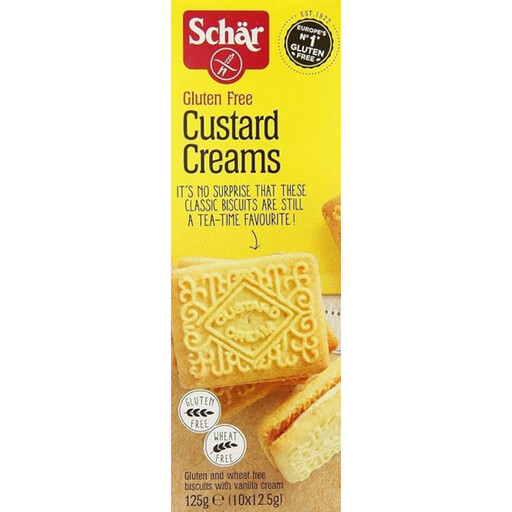
This 125g gluten-free custard-cream packet is an option if you are considering a smaller pack. Check its label for the carbohydrate in your chosen number of biscuits; the packet is not an individually sold single bar.
 No image available
Schar Gluten Free Custard Creams 125g
A 125g packet to consider if pack size matters when planning one biscuit portion. Gluten free describes the product variant, not its carbohydrate content; check the current label for the amount in the biscuits you intend to eat.
View on Joybuy
Frequently asked questions
Does diabetes mean I must avoid custard creams altogether?
Diabetes UK does not say that an occasional treat must be ruled out. It advises paying attention to the carbohydrate and portion you eat in the context of your own diabetes management.
Should I use a custard cream as the first treatment for a hypo?
Do not rely on a custard cream as the initial fast-acting treatment. NHS guidance calls for something that raises blood glucose quickly and mentions biscuits only after symptoms have improved and blood glucose is above 4 mmol/L.
How should I store custard creams after opening the packet?
Follow the instructions on your packet. The checked Sainsbury’s and Tesco listings advise keeping opened biscuits in an airtight container; this is a storage instruction, not a way to change their carbohydrate content.
What allergen information should I check when ordering?
Check the ingredients, allergen statement and any precautionary wording for the exact custard creams you intend to buy. These details differ between the listed products, so a brand name or an ‘extra cream’ description is not a substitute for the product label.


