Easter hosts serving guests with different diets
If you are putting biscuits out for several people, keep standard wheat-and-milk custard creams distinct from packs explicitly labelled for guests who need to avoid those ingredients.


For an Easter biscuit table, choose standard custard creams only if the people eating them can have the wheat and milk ingredients declared on those packs. Tesco and Sainsbury’s each list a Free From custard cream labelled gluten free, milk free and suitable for vegans; an extra-cream biscuit is a separate choice for guests who want that style and can eat its declared ingredients. A free-from label does not establish suitability for IBS or make a biscuit lower in sugar, so check the exact packet for each guest’s requirements.
If you are putting biscuits out for several people, keep standard wheat-and-milk custard creams distinct from packs explicitly labelled for guests who need to avoid those ingredients.
Look for the required claim on the particular product, not just a familiar brand or a similar-looking filling. Tesco and Sainsbury’s list Free From versions separately from standard custard creams.
A gluten-free claim does not establish whether a biscuit fits an individual plan for digestive symptoms. The NHS says no single diet works for everyone with IBS; follow the advice relevant to your condition.
For a shared Easter selection, establish any ingredient exclusions before comparing biscuit style, portions and nutrition.
| Priority | What to check | Your needs |
|---|---|---|
| Gluten and milk | Read the exact pack’s ingredients and allergen information. Tesco and Sainsbury’s Free From custard creams are each labelled gluten free and milk free; standard varieties can contain wheat and milk. | I’m serving someone who needs to avoid gluten or milk, so I need the relevant claim on their biscuit’s pack. |
| Lactose and wheat | Check the wording of each exclusion rather than treating different claims as interchangeable. ASDA’s Schär listing says wheat free and lactose free; check the physical pack if milk avoidance is required. | A guest has specified what they need to avoid, and I want to match that requirement rather than assume lactose free means milk free. |
| Digestive symptoms | Compare ingredients with any individual dietary advice. The NHS says there is no single diet that works for everyone with IBS; a gluten-free label alone does not determine suitability. | If I’m choosing around digestive symptoms or a clinical diet, I need more than a general free-from claim. |
| Portions and nutrition | Compare the stated serving size and per-biscuit or per-100 g figures on the same basis. Free-from and extra-cream describe different product features, not a lower-sugar result. | For an Easter spread with other treats, I want to know the portion being served and what its nutrition panel says. |
| The pack received | Check its product name, ingredients, allergen information and any precautionary statement, particularly after a substitution. Standard and Free From versions from one retailer are distinct products. | I need to be sure the biscuits I actually serve meet my guests’ requirements. |
Standard custard creams can contain milk ingredients. The McVitie’s product described by Bestway Wholesale declares milk and wheat.
For a milk-free guest, choose a product explicitly labelled milk free, such as the listed Tesco or Sainsbury’s Free From biscuits, and check the packet received.
A gluten-free or vegan claim identifies a stated product characteristic; it does not tell you whether that biscuit has less sugar, fewer calories or less saturated fat than another.
Use the claim for the required exclusion, then compare nutrition panels using the same serving or per-100 g basis.
The NHS says no single diet works for everyone with IBS. Its coeliac diagnosis guidance also says not to start a gluten-free diet before specialist confirmation, because removing gluten can affect testing.
Use the label to identify ingredients and follow clinical advice for symptoms, testing or an individual dietary plan.
A substitution can put a standard product in place of a Free From version, changing the ingredients relevant to a guest.
Read the name and allergen information on the exact pack before serving it.
These examples illustrate different standard, Free From and extra-cream products; a brand name alone does not establish what a particular pack contains.
A conventional custard cream for a biscuit selection without wheat or milk exclusions.
A conventional 300 g custard cream, rather than a product labelled free from.
A Free From custard cream for shoppers checking gluten, milk and vegan requirements.
Separate standard and Free From custard cream products call for a pack-specific choice.
ASDA lists Schär gluten-free custard creams and, separately, an assortment containing standard custard creams.
An extra-cream custard cream for shoppers choosing a thicker vanilla-cream filling rather than a Free From specification.
This option is a gluten-free Schär custard cream for an Easter biscuit selection. Its wheat-free and lactose-free claims need to be checked against each guest’s particular requirements.
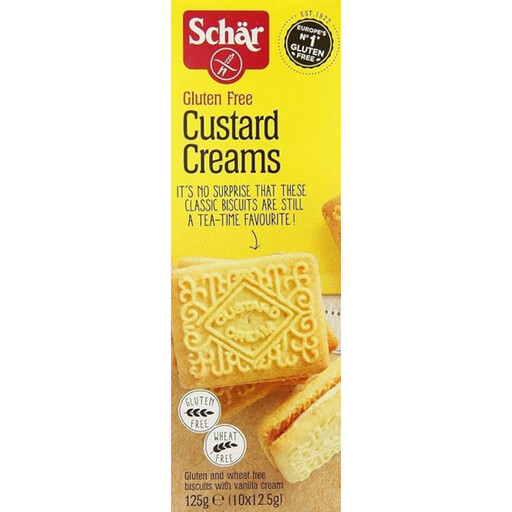 No image available
A custard-cream option for a guest seeking a gluten-free biscuit. ASDA’s listing for this Schär product also states wheat free, lactose free and suitable for vegans. Check the physical pack if the guest needs to avoid milk: a lactose-free claim is not the same as a milk-free claim.
Do not assume so: the listed standard McVitie’s and Crawford’s products declare wheat, and the ASDA biscuit assortment also declares wheat. Choose a biscuit explicitly labelled gluten free for that requirement and check the pack you serve.
Tesco and Sainsbury’s each list Free From custard creams labelled milk free and suitable for vegans, as well as gluten free. Confirm those claims on the current pack; do not treat a different product’s lactose-free label as a milk-free claim.
No. A gluten-free label identifies that product claim, while the NHS says no single diet works for everyone with IBS. Follow the person’s individual dietary advice and check the biscuit’s ingredients against it.
The NHS advises against starting a gluten-free diet before a specialist confirms a coeliac diagnosis, because removing gluten can affect test accuracy. Follow the healthcare professional’s instructions during testing rather than changing biscuits on the basis of a suspected condition.
Check the exact product name, ingredients, allergen information and any precautionary statement. UK Food Standards Agency guidance says food businesses must tell customers when listed allergens are ingredients; the physical pack also helps you distinguish a standard biscuit from its Free From counterpart.