Group ride organisers
If several riders want biscuits, compare the number of portions with what the group can carry. Ask about food restrictions before dividing up a packet, and plan other food and drink for the ride.


For a group ride where riders already tolerate biscuits, compare custard cream packs by carbohydrate per biscuit, the portions you can carry and the ingredients—not pack weight alone. A larger packet can be convenient to share, but it is not a complete ride-food plan; try the biscuits during training and bring a drink separately.
If several riders want biscuits, compare the number of portions with what the group can carry. Ask about food restrictions before dividing up a packet, and plan other food and drink for the ride.
British Cycling advises using training rides to learn which foods you can comfortably eat on the bike. Try a custard cream at the pace you expect to ride rather than relying on it for the first time at an event.
Check the packet’s ingredients and allergen information before sharing. The Tesco, Asda and Crawford’s standard custard creams listed here contain wheat and milk; do not assume another recipe has the same ingredients.
Start with the food each rider can eat and carry, then use the exact packet’s nutrition and portion information to work out its place alongside other ride provisions.
| Priority | What to check | Your needs |
|---|---|---|
| Carbohydrate per biscuit | Read the figure for one biscuit on the exact pack and consider what other food you will bring. Tesco lists 8.4g per biscuit for its 400g pack; Asda lists 8.1g for its 400g pack. British Cycling notes that ride-food needs vary with the rider and intensity. | I want to know what a portion contributes without treating the whole sharing pack as one rider’s food supply. |
| Portions and storage | Compare pack weight with the stated biscuit or serving count. Asda suggests 34 servings for its 400g pack. If biscuits will remain after opening, check storage directions; Tesco calls for an airtight container. | There need to be enough biscuits to divide among the group, without leaving me with more opened food than I can conveniently carry or store. |
| Eating on the bike | Try the food during training at your intended riding pace. British Cycling notes that riders differ in whether they prefer real food such as biscuits or alternatives such as gels and drinks. | Biscuits appeal to me, but I need to know whether I can comfortably eat them while riding. If not, I would take food I have already tried. |
| Ingredients | Read the delivered pack’s ingredients and precautionary allergen statements before sharing. The listed standard Tesco, Asda and Crawford’s recipes contain wheat and milk. | Someone in the group may need to avoid an ingredient, so I cannot choose for everyone from the product name alone. |
| Recipe and pack size | Distinguish a standard 300–400g sharing pack from a smaller or different recipe. Sainsbury’s lists a 200g standard pack; M&S lists 165g Extra Cream Custard Creams. Compare nutrition per 100g when considering different recipes. | A smaller packet may be enough for our group, or we may want a particular filling; neither choice establishes a cycling advantage. |
Pack weight and suggested servings describe how many biscuits are available to share, not what an individual rider will eat or tolerate. British Cycling’s ride guidance takes account of factors including riding intensity.
Use the actual label’s carbohydrate per biscuit when planning portions, consider your other food, and bring a drink separately.
The standard Tesco, Asda and Crawford’s recipes listed here contain wheat and milk. A familiar product name does not establish that another pack meets someone’s dietary restrictions.
Ask riders about restrictions and read the packet that will actually be shared, including its precautionary allergen information.
M&S Extra Cream Custard Creams are a 165g product with a different filling from the standard 400g packs. Weight alone does not compare their portions or nutritional composition.
Check the per-100g label figures on the recipes you are considering, then compare portions and total pack weight for your group.
These named packs provide useful comparisons of size, portions and ingredients; they are not a list of products available through Joybuy.
Tesco lists a 400g standard custard cream pack.
Asda lists a 400g standard pack with a suggested 34 servings.
A Tesco listing describes a 300g pack of Crawford’s custard creams, smaller than the 400g packs above.
A Bestway Wholesale listing describes a 300g McVitie’s Custard Creams pack.
Sainsbury’s lists a 200g standard pack for a group considering fewer biscuits.
M&S lists 165g Extra Cream Custard Creams for those considering a different filling and a smaller pack.
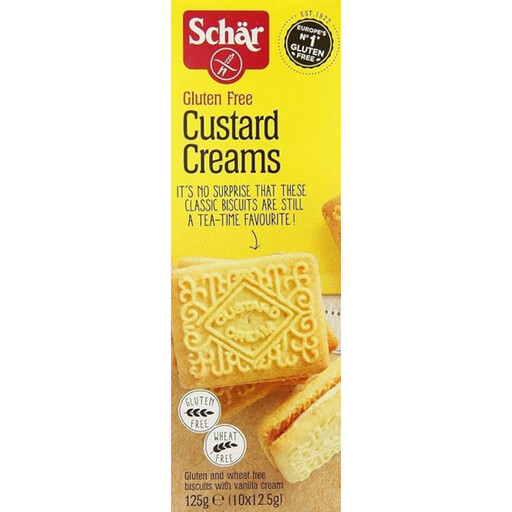
This 125g custard cream pack is an option to consider when a smaller supply suits the group; compare its portions and ingredients with a larger sharing pack before choosing.
 No image available
The 125g pack is smaller than the 300–400g sharing packs discussed above. Its name identifies it as gluten-free; check the actual packet’s ingredients, allergen information and per-biscuit nutrition before sharing it.
Use the actual packet’s carbohydrate figure per biscuit and the number you plan to eat, alongside your other food. For example, two biscuits at the 8.4g-per-biscuit figure on Tesco’s listed recipe provide 16.8g carbohydrate. That calculation is not an individual ride-food prescription; British Cycling notes that needs vary with the rider and ride intensity.
Follow the directions on the pack you buy. The Tesco and Morrisons custard cream listings call for a cool, dry place and an airtight container after opening, which matters if biscuits will be left over after the ride.
No: plan a drink separately from the biscuits. British Cycling discusses food and hydration as distinct parts of ride preparation and advises trying foods during training to learn what works for you on the bike.
Ask which ingredients they need to avoid and read the actual packet’s ingredients and precautionary allergen information before sharing. The listed standard Tesco, Asda and Crawford’s packs contain wheat and milk; that does not establish the ingredients of every custard cream recipe.