Families sharing snacks at home
If several people will eat biscuits on different days of half term, consider how much of an opened pack you expect to use. Tesco and Asda list 400g standard packs; Sainsbury’s lists a smaller 200g pack.


For several people sharing custard creams over half term, a 400g standard pack gives you more biscuits to use across snack occasions; a smaller pack makes more sense when fewer people will share or you want less left open. If someone needs a free-from biscuit, choose a product labelled for their particular requirement and check the current allergen information rather than relying on pack size.
If several people will eat biscuits on different days of half term, consider how much of an opened pack you expect to use. Tesco and Asda list 400g standard packs; Sainsbury’s lists a smaller 200g pack.
Standard custard creams in these retailer examples contain wheat and milk. Check the exact free-from claim and allergen statement for the person who will eat the biscuits; different free-from labels cover different requirements.
Pack weight alone does not show what one biscuit contains. Tesco marks the sugars and saturates in one of its standard custard creams as high on its product nutrition information, so compare the current per-biscuit labels as well as pack sizes.
Start with the number of people and snack occasions, then check dietary requirements before comparing portions and storage instructions.
| Priority | What to check | Your needs |
|---|---|---|
| Pack size | Compare pack weight with the number of occasions you plan to share it. Asda suggests 34 servings for its 400g pack; Sainsbury’s gives approximately 16 for its 200g pack. | Several of us will share biscuits over the break, or a smaller pack will be enough for the occasions we have planned. |
| Allergens | Read the current ingredients, allergen statement and any may-contain warnings. Asda’s standard custard creams contain wheat and milk; its separate Free From 125g product states that it is free from gluten-containing cereals and milk. | Someone sharing needs a biscuit labelled for their particular dietary requirement, not just a product with a different pack size. |
| Nutrition per biscuit | Compare the same serving basis on each label. Tesco lists 3.4g sugars and 1.5g saturates per biscuit for its 400g standard pack, with both marked high in its product information. | I want to know what a biscuit contains before deciding how many to put out. |
| Opened-pack storage | Check the pack’s storage directions. Sainsbury’s advises keeping its custard creams in a cool, dry place and using an airtight container after opening. | A larger pack may stay open across several snack occasions, so I need a way to store what remains. |
Standard products listed by Tesco and Asda contain wheat and milk. Other packs can have additional may-contain or manufacturing warnings that matter to the person eating them.
Check the current physical pack before serving, and match any free-from claim to the exact requirement.
A 400g pack leaves more biscuits to store if only a few people will share it.
Estimate the snack occasions first, then choose between a larger sharing pack and a smaller pack. Follow the opened-pack storage instructions.
Asda’s Free From custard creams are labelled for specific ingredient exclusions, while the retailer also marks sugars and saturates per biscuit as high.
Use the free-from label to check dietary suitability, and read the nutrition information separately.
England’s school-food requirements and its retail rules on promotions of products high in fat, sugar or salt cover different activities. Neither turns a family’s half-term snack purchase into a school-meal decision.
For food provided by a state-funded school in England, ask the school or caterer to check its applicable requirements; do not apply England guidance to the rest of the UK.
Tesco lists standard Custard Cream Biscuits in a 400g pack.
Asda lists a standard 400g pack and a separate Free From 125g custard cream pack.
Sainsbury’s lists standard Custard Creams in a 200g pack, with approximately 16 servings.
Morrisons lists McVitie’s Tasties Custard Creams as a 300g standard biscuit pack.
Tesco describes Crawford’s 300g custard creams as sandwich biscuits with vanilla-flavour cream filling.
M&S lists Extra Cream Custard Creams in a 165g pack, describing an extra vanilla-cream filling and real custard powder.
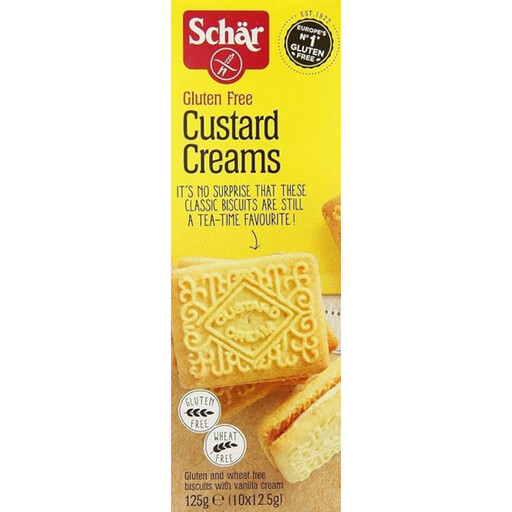
This smaller custard cream pack is an option for gluten-free biscuit sharing rather than a 400g standard sharing pack.
 No image available
For someone seeking gluten-free custard creams, this 125g pack is smaller than the 400g standard packs listed by Tesco and Asda. Check the current label for any other dietary requirements before sharing.
A 400g pack is worth considering if several people will share it on multiple occasions; Asda suggests 34 servings for its standard 400g custard creams. For fewer occasions, Sainsbury’s lists a 200g pack with approximately 16 servings.
The standard Tesco, Asda, Sainsbury’s and McVitie’s examples list wheat and milk, so do not use those products for someone avoiding either ingredient. Asda’s separate Free From product states that it is free from gluten-containing cereals and milk; check the current pack against the individual’s requirements.
Follow the directions on the pack you buy. Tesco and Sainsbury’s advise an airtight container after opening, alongside cool, dry storage.
No: a free-from label identifies particular ingredients or allergens, not a sugar comparison. Asda lists 3.5g sugars and 1.8g saturates per biscuit for its Free From custard creams and marks both nutrients as high.
England’s school-food requirements concern food and drink provided in state-funded schools, according to the Department for Education; they do not make a family’s home half-term snack a school meal. For school-provided food in England, the school or caterer should check the applicable requirements. The Department of Health and Social Care’s separate guidance on retail promotions of products high in fat, sugar or salt concerns businesses selling to England, not a general ban on families buying biscuits.