Hosts offering a sugar-free choice
An ordinary custard cream and a biscuit labelled sugar-free answer different requests. Compare the sugars declaration per 100g on the exact packs you plan to serve.


Put out ordinary custard creams for guests who want them, but do not describe them as sugar-free: the named McVitie’s, Crawford’s and Sainsbury’s products list sugars above the sugar-free claim threshold published by legislation.gov.uk. If a guest needs a sugar-free option, check a separate biscuit’s current per-100g label; check ingredients for specific allergies and total carbohydrate where that matters to the guest.
An ordinary custard cream and a biscuit labelled sugar-free answer different requests. Compare the sugars declaration per 100g on the exact packs you plan to serve.
Check the ingredients and allergen wording for each biscuit. A gluten-free or milk-free description addresses only the restrictions it names; it does not establish that the biscuit is sugar-free.
The sugars figure is not the total-carbohydrate figure. Keep the packet available so guests who use carbohydrate and serving information can read the figures for the biscuit being offered.
Decide which guests need a separate option, then check the exact product label before planning how many packs to open.
Choose when: Guests want the familiar filled biscuit and have no conflicting sugar or ingredient requirements.
Bear in mind: The checked ordinary products are not sugar-free, and their ingredient labels need checking for guests with allergies.
Choose when: A product’s stated gluten-free or milk-free status matches a guest’s specific restriction.
Bear in mind: Free-from does not mean sugar-free; Tesco’s Free From Custard Creams list 19.9g sugars per 100g.
Choose when: A guest specifically requests a sugar-free biscuit and the current product label supports that description.
Bear in mind: The alternative need not be a custard cream; check its allergens and total carbohydrate separately.
| Priority | What to check | Your needs |
|---|---|---|
| Sugar-free status | Read sugars per 100g on the exact pack. The sugar-free claim condition published by legislation.gov.uk is no more than 0.5g sugars per 100g of food; a free-from claim answers a different question. | Some guests want a specifically sugar-free biscuit, so I need to check that claim rather than assume any custard cream qualifies. |
| Ingredients | Check the full ingredients and allergen wording for each product. Tesco describes its Free From Custard Creams as gluten-free and milk-free; those descriptions do not address every restriction. | For a guest avoiding a particular ingredient, I need a packet whose labelling addresses that ingredient. |
| Carbohydrate | Compare total carbohydrate and the stated serving size, not just sugars. Tesco lists 75.2g carbohydrate and 19.9g sugars per 100g for its Free From Custard Creams. | When carbohydrate information matters to a guest, I want the figures for the biscuit and portion actually served. |
| Party quantities | Check whether the pack gives a biscuit count or a serving definition. Tesco states a typical 26 biscuits for its 300g Crawford’s pack; Sainsbury’s states approximately 16 servings for its 200g pack. These are not interchangeable measures. | I need enough biscuits for sharing without treating pack weight as a biscuit count. |
The named McVitie’s, Crawford’s and Sainsbury’s ordinary products list 30.6g, 30.7g and 26.5g sugars per 100g respectively. Those product-specific figures are above the sugar-free claim condition published by legislation.gov.uk.
Read the declaration on the product you buy before describing it as sugar-free to guests.
Tesco labels its Free From Custard Creams gluten-free and milk-free, but lists 19.9g sugars per 100g.
Match the free-from wording to the guest’s actual restriction, then check sugars and other allergens separately.
A biscuit count and a serving count describe different things. Tesco gives a typical biscuit count for its Crawford’s pack, while Sainsbury’s gives approximate servings for its ordinary custard creams.
Check the selected pack’s count or serving definition before deciding how many packs to put out.
These named products illustrate why sugar, ingredients and pack format need checking by product line rather than by brand alone.
Tasties Custard Creams 300g are an ordinary filled-biscuit example.
The 300g Custard Creams pack provides a stated count for party planning.
Free From Custard Creams 125g are labelled for specified gluten- and milk-free needs.
Its ordinary Custard Creams 200g and Free From Custard Creams 125g have different stated ingredients and nutrition.
Extra Cream Custard Creams 165g are a named variation on the filled biscuit.
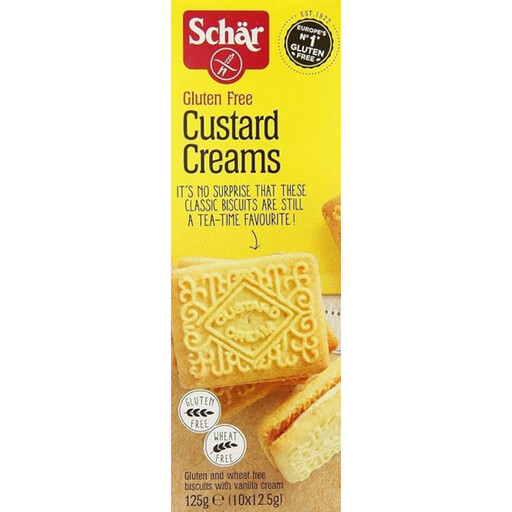
These options cover a gluten-free custard cream and two biscuits labelled for a zero-sugar choice. The sandwich biscuits and digestives are alternatives to, not versions of, custard creams; check each current packet against the guest’s requirements.
 No image available
A 125g custard-cream pack labelled gluten-free. Check its sugars declaration and full allergen wording separately before serving it to guests with other requirements.
 No image available
A 97g sandwich-biscuit alternative, not a custard cream. For a guest requesting sugar-free biscuits, check the current sugars-per-100g declaration rather than relying on the product name alone; check allergens separately.
 No image available
A 400g digestive-biscuit option rather than a cream-filled biscuit. Check the current sugars-per-100g declaration to assess the sugar-free wording, and read the ingredients if guests have restrictions.
No. The wording identifies the particular ingredients or allergens named, not the biscuit’s sugar content. Tesco describes its Free From Custard Creams as gluten-free and milk-free but lists 19.9g sugars per 100g, so check the nutrition declaration separately.
Follow the instructions on the chosen packet. For its ordinary Custard Creams 200g, Sainsbury’s advises an airtight container after opening for best quality.
No. Sugars and total carbohydrate are separate nutrition figures. If a guest needs carbohydrate information, make the packet’s total-carbohydrate and serving details available so they can assess the product against their own requirements.
England’s Department for Education describes its school-food guidance as applying to food and drink provided in specified state-funded school settings, not private parties generally. If the event involves school-provided food, check the standards and policies applicable to that setting rather than assuming private-party arrangements apply.