The buyer keeping custard creams
If the familiar filled biscuit is the point of the tin, compare the sugar figures on the packs without treating the lowest figure as a reduced-sugar claim.


If custard creams are essential for the office tin, compare the sugars listed per 100 g and per biscuit, but do not describe a lower figure as a reduced-sugar claim. If a biscuit labelled as reduced sugar matters more than the cream filling, McVitie’s Rich Tea The Light One is a different biscuit type to consider; keep each shared biscuit’s packaging available for ingredient and allergen checks.
If the familiar filled biscuit is the point of the tin, compare the sugar figures on the packs without treating the lowest figure as a reduced-sugar claim.
If a labelled reduced-sugar option matters more than the filling, consider a different biscuit type and make that change clear to colleagues.
Keep a separately identifiable option where colleagues need particular ingredient or allergen information. A free-from description answers a different question from sugar content.
Start with the biscuit type, then compare pack labels on the same weight basis and check what will remain identifiable once the biscuits are shared.
| Priority | What to check | Your needs |
|---|---|---|
| Sugar figures | Compare sugars per 100 g across custard-cream packs, then use each pack’s per-biscuit figure for its stated biscuit size. A lower figure alone does not establish a reduced-sugar claim. | I want to compare familiar biscuits fairly and know what a biscuit from this pack contributes. |
| Biscuit type | Check whether the option is a filled custard cream or another style. Tesco’s listing describes McVitie’s Rich Tea The Light One as reduced sugar, with the maker’s comparison made against a typical semi-sweet biscuit—not a custard cream. | The cream filling may be the reason I am buying custard creams. If I can change biscuit type, the labelled Rich Tea is another option to consider. |
| Ingredients | Read the ingredient and allergen information on each actual pack. Keep different varieties and their labels identifiable when filling a communal tin. | Colleagues need to be able to tell which biscuit is which before choosing one. |
| Storage | Follow the pack’s instructions after opening. Sainsbury’s and Tesco specify airtight storage for their standard custard creams. | If the tin will be used over several days, I need a way to keep the biscuits and their packaging information together. |
The sugar figures on these standard packs allow a comparison among those products; they do not, by themselves, substantiate a reduced-sugar claim. The NHS food-label guide places foods with more than 22.5 g total sugars per 100 g in its high-sugars category, and each of the five standard custard creams compared here exceeds that figure.
Describe a product’s stated sugar figure and the specific packs being compared instead of giving it a claim the comparison cannot establish.
Sainsbury’s Free From Custard Creams address specified dietary requirements, while the reduced-sugar McVitie’s Rich Tea is not a custard cream. Neither label makes the products interchangeable.
Decide whether biscuit type, a particular dietary requirement or a labelled sugar comparison takes priority, and identify separate options clearly.
Standard custard-cream listings from Tesco and Asda declare wheat and milk. Once biscuits are loose, appearance alone is not a dependable way to identify their ingredients.
Check the received packs and keep their ingredient and allergen information accessible to everyone using the tin.
These figures describe the named packs, not every biscuit sold by each brand; compare the label on the pack you buy.
Standard and Free From custard creams address different requirements.
Its standard custard creams come in a 400 g pack for a shared tin.
Its 400 g standard custard creams offer another like-for-like pack-label comparison.
The named custard creams are a vanilla-filled 300 g option.
Extra Cream Custard Creams emphasise the filling rather than a sugar-reduction claim.
Rich Tea The Light One is relevant if changing from custard creams is acceptable.
These options cover biscuits that change the flavour or style of the office tin, plus a gluten-free custard cream. A ‘no added sugar’ name, a ‘zero sugar’ name and a gluten-free name describe different things; check the individual pack against the requirement you are buying for.
 No image available
The cookies-and-cream variety offers a filled-biscuit format for the tin, but it is not a traditional custard cream. Its name says ‘no added sugar’; check the pack’s nutrition and ingredient information if the precise sugar figure or an allergen matters.
 No image available
This is a sandwich cookie rather than a vanilla custard cream. Check what the ‘Zero Sugar’ product name means on the pack, along with its nutrition and allergen information, before adding it to a shared tin.
 No image available
Dark chocolate and ginger oaties are a change of biscuit type and flavour from custard creams. Check the pack’s sugar declaration and ingredients rather than treating ‘Zero’ in the range name as a per-100 g nutrition figure.
 No image available
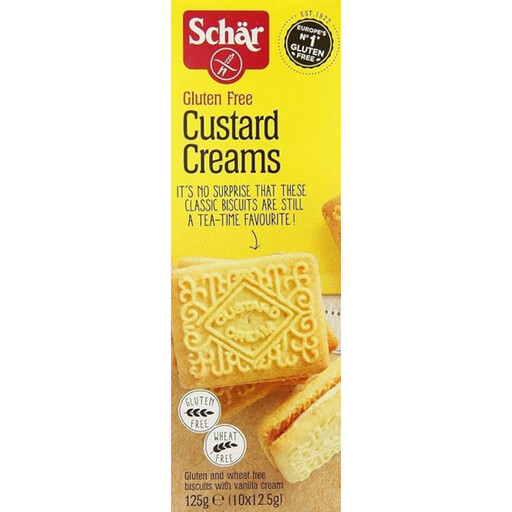
This option retains the custard-cream name while addressing a gluten-free requirement. Gluten-free does not mean reduced sugar; check the received pack’s nutrition and full allergen information before sharing it.
No. Being lower than another selected pack does not, on its own, substantiate that comparative claim. The standard custard-cream listings compared here give sugar figures, but do not establish a reduced-sugar claim for those products.
Use sugars per 100 g for a common weight basis, then the stated per-biscuit figure when considering how many biscuits to put out. Biscuit sizes differ, so the two figures answer different questions.
Not because they are free from a specified ingredient. Sainsbury’s lists 24.9 g sugars per 100 g for its Free From Custard Creams; that figure alone does not establish a reduced-sugar claim.
Follow the instructions on the pack you buy. Tesco and Sainsbury’s standard custard-cream listings specify airtight storage after opening; keep their packaging or label information accessible so colleagues can identify ingredients and allergens.
It can be an alternative if colleagues are happy to change biscuit type, but it does not retain the custard-cream filling. McVitie’s ‘30% less sugar’ statement for Rich Tea The Light One compares it with a typical semi-sweet biscuit, not with custard creams.