Hosts comparing conventional custard creams
If you want custard creams on the tea table but would prefer a lower listed sugar figure, compare products per 100g. A lower figure within this group does not establish a reduced-sugar claim.


A custard cream with less sugar than another is not necessarily a reduced-sugar product. Among five conventional products compared using their listed sugars per 100g, Sainsbury's Custard Creams had the lowest figure at 26.5g, still above the NHS high-sugars threshold of 22.5g per 100g for solid foods. If a reduced-sugar claim is essential, check the claim on the exact pack of an alternative biscuit; check its ingredients and allergens before serving it to guests.
If you want custard creams on the tea table but would prefer a lower listed sugar figure, compare products per 100g. A lower figure within this group does not establish a reduced-sugar claim.
If the claim is a condition of purchase, check it on the exact pack. A different biscuit type may meet your brief, but do not treat a ‘no added sugar’ or ‘zero sugar’ product name as the same claim.
The conventional custard creams compared here list wheat and milk; some carry additional ‘may contain’ statements. Read the current pack for each biscuit you intend to serve.
Decide whether you need a reduced-sugar claim or simply want to compare conventional custard creams, then check the exact product you plan to serve.
| Priority | What to check | Your needs |
|---|---|---|
| Sugar information | Compare listed sugars per 100g across products. Check any reduced-sugar claim on the exact pack; use per-biscuit figures separately when deciding how many to serve. | I want to compare biscuits on the same basis without mistaking a relatively lower figure for a reduced-sugar claim. |
| Biscuit format | Check whether it is a custard cream or a differently flavoured sandwich biscuit. Match the pack size to the number of guests. | For this tea, the familiar custard-cream filling may matter more to me than choosing a different biscuit type. |
| Allergens | Read the current ingredients, highlighted allergens and any ‘may contain’ statement. Check each product rather than relying on its flavour or dietary label. | I need to know what is in the biscuits before putting them out for guests with relevant allergies or intolerances. |
Sainsbury's lists 26.5g sugars per 100g, the lowest of the five conventional products compared, but that is a relative comparison. The NHS classifies more than 22.5g sugars per 100g of solid food as high.
If a reduced-sugar claim matters, check the claim and nutrition panel on the exact pack instead of relying on its position in a comparison.
Biscuits can differ in size, so a per-biscuit figure does not provide the same comparison as a per-100g figure.
Compare sugars per 100g first, then look at the per-biscuit information when planning what to put on the table.
A vegetarian biscuit can still contain wheat or milk. Some of the products compared also carry ‘may contain’ statements for other allergens.
Read the current ingredient and allergen information for every product before serving guests who need those checks.
A listing is not a guarantee that a biscuit is available when you shop or that the pack in hand carries the same information.
Confirm availability close to purchase and read the physical pack before serving.
These figures describe the specified products, not every biscuit made by each brand; compare current packs before buying.
Its 200g conventional custard creams are a reference point for comparing sugars per 100g.
ASDA's conventional custard creams come in a 400g pack for sharing.
Crawford's 300g product is a vanilla-flavour cream sandwich biscuit described as suitable for vegetarians.
The McVitie's Tasties listing describes a vanilla-flavour cream sandwich biscuit.
M&S describes its Extra Cream Custard Creams as having more vanilla cream and real custard powder.
These Joybuy options comprise two differently flavoured sandwich biscuits with sugar-related wording in their names and one gluten-free custard cream. None of those descriptions alone establishes a reduced-sugar claim.
 No image available
This 210g Cookies and Cream biscuit is an alternative to a traditional custard cream for the tea table. ‘No added sugar’ is the wording in its product name, not a reduced-sugar claim; check the current pack's nutrition and allergen information before serving.
 No image available
This 97g pack offers a sandwich biscuit rather than a custard cream. Check the current nutrition panel to interpret the ‘Zero Sugar’ wording in its name, and check the ingredients and allergens for your guests.
 No image available
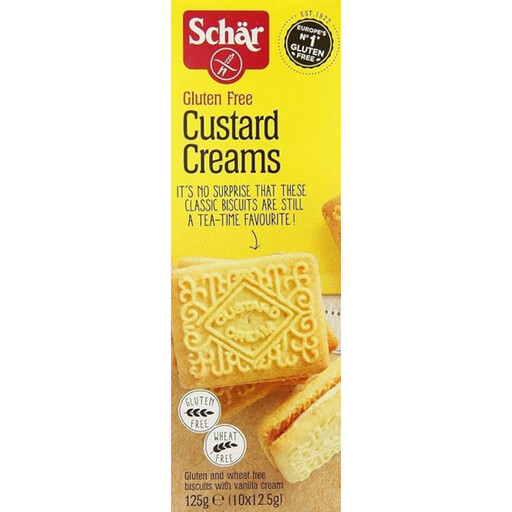
This 125g pack keeps the custard cream format and carries ‘Gluten Free’ in its product name. That wording does not establish a reduced-sugar claim or settle other allergen questions; read the current pack before choosing it for guests.
No. Being lower than another biscuit in a comparison does not establish a reduced-sugar claim. Compare nutrition information per 100g, as the NHS advises, and check any claim on the exact pack.
Start with the per-100g nutrition panels so different biscuit sizes do not distort the comparison. Then check the per-biscuit information when deciding what to serve. For solid foods, the NHS calls sugars high at more than 22.5g per 100g.
The specified ASDA, Sainsbury's, Crawford's, McVitie's and M&S products list wheat and milk, so do not assume they suit those guests. Some also carry additional ‘may contain’ statements; read the exact current pack before serving.
Use it to narrow your options, but read the packaging of the product you buy before serving. Check the ingredient declaration and any ‘may contain’ statement against each guest's requirements.