Late-night biscuit snackers
If you want something sweet before bed, a per-biscuit sugar figure helps you assess the portion you plan to have. A smaller portion does not make the product itself reduced sugar.


Do not assume a standard custard cream is a reduced-sugar choice: Sainsbury's and Tesco both mark sugars as high on their standard biscuits. If the custard-cream format matters, compare sugars per 100g and per biscuit on the packs you are considering; if reducing sugar matters more than that format, consider other biscuits, but check their nutrition labels rather than relying on names such as “zero sugar” or “no added sugar”.
If you want something sweet before bed, a per-biscuit sugar figure helps you assess the portion you plan to have. A smaller portion does not make the product itself reduced sugar.
If you want the familiar vanilla-cream sandwich biscuit, compare sugars per 100g across variants as well as sugars per biscuit. Biscuit size and added cream or coatings can change what each figure tells you.
If wheat, gluten or milk affects your choice, read the ingredients and allergen statement on the particular pack. Pioneer Foodservice identifies gluten-containing cereal and milk in its McVitie's Tasties listing, with a possible sesame warning.
Compare sugars per 100g across products, then look at the per-biscuit values for the number you intend to eat.
| Priority | What to check | Your needs |
|---|---|---|
| Sugars across products | Compare sugars per 100g on current packs. Sainsbury's lists 26.5g per 100g for its standard custard creams; M&S lists 40.2g per 100g for Extra Cream Custard Creams. Check a coated or extra-cream variant separately. | I want to compare biscuits on the same weight basis, rather than assume a familiar-looking pack has less sugar. |
| Snack portion | Check sugars and energy per biscuit, then consider how many biscuits you plan to eat. Sainsbury's lists 3.3g sugars and 59kcal per biscuit; Tesco lists 3.4g sugars and 59kcal per biscuit. | For a late-night snack, I want the figures for the amount I might actually have, not just the values for a full pack. |
| Sugar wording | Read the nutrition panel alongside any “zero sugar”, “no added sugar” or reduced-sugar wording. For a reduced-sugar claim, check what product or basis the comparison refers to. | If reducing sugar is my main reason for switching biscuits, I want to know what the wording means for this particular product. |
| Ingredients and allergens | Read the ingredients and allergen statement on the pack you receive. Check wheat, gluten, milk and any relevant precautionary statements rather than relying on the biscuit type. | I need the exact pack to meet my ingredient requirements; a different custard cream or an alternative sandwich biscuit may have a different recipe. |
Sainsbury's lists 3.3g sugars per biscuit but 26.5g per 100g for its standard custard creams, and marks sugars as high. The per-biscuit figure describes a portion, not a reduced-sugar claim.
Compare sugars per 100g between products, then use the per-biscuit figures to assess your planned portion.
M&S lists 40.2g sugars per 100g for Extra Cream Custard Creams, 43.2g for its milk-chocolate-coated version and 42.7g for its white-chocolate-coated version. Sainsbury's standard custard creams list 26.5g per 100g; these are comparisons between the named products, not every biscuit in each range.
If sugar is the deciding factor, compare the current per-100g labels before choosing a richer variant.
Ingredients and allergen information can change. A listing may help you shortlist a biscuit, but it cannot replace the label on the pack you receive.
Read that pack's ingredients, highlighted allergens and precautionary statements before eating it.
These examples show why the exact product and its current label matter more than a brand name alone.
Its standard Custard Creams provide a per-biscuit and per-100g point of comparison.
Its standard Custard Cream Biscuits are a vanilla-filled sandwich biscuit.
Its Extra Cream and chocolate-coated custard creams are distinct variants, not substitutes to judge by the standard biscuit's label.
McVitie's Tasties Custard Creams are vanilla-cream sandwich biscuits listed by UK grocery suppliers.
Tesco describes Crawford's Custard Creams as sandwich biscuits with a vanilla-flavour cream filling.
These options include one custard cream and three different biscuit styles for shoppers willing to move beyond the classic format. Product names alone do not establish how their sugar figures compare, so check each pack's nutrition panel before choosing.
 No image available
This is a sandwich biscuit option if the custard-cream flavour is not essential. The pack is 97g; check its nutrition panel to assess the “Zero Sugar” wording and the portion you plan to eat.
 No image available
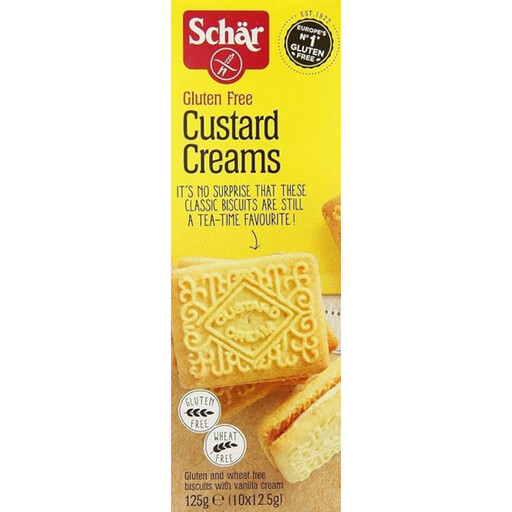
This keeps the custard-cream format and is labelled gluten free. The pack is 125g; compare its sugars per 100g and per biscuit with other custard creams rather than treating “gluten free” as a sugar claim.
 No image available
Consider this cookies-and-cream biscuit if you are open to a different flavour from a custard cream. The pack is 210g; read the sugar values on its nutrition panel as well as the “No Added Sugar” wording.
 No image available
This is an oat-and-ginger biscuit rather than a custard cream or cream-filled sandwich biscuit. The pack is 285g; compare its current nutrition panel with the biscuits you would otherwise choose.
Do not treat a standard custard cream as reduced sugar just because you intend to eat one biscuit. Sainsbury's lists 3.3g sugars per biscuit and 26.5g per 100g for its standard product; Tesco lists 3.4g per biscuit, and both mark sugars as high. Check the current label and the basis of any reduced-sugar claim on a different product.
Use both: sugars per 100g gives you a common weight basis across products, while sugars per biscuit helps you assess the portion you plan to eat. The NHS advises having foods marked high in fat, salt or sugar less often and in small amounts.
Yes, if an ingredient or allergen affects your choice, check the pack you receive. Pioneer Foodservice's McVitie's Tasties listing identifies gluten-containing cereal and milk and warns that it may contain sesame; do not assume another biscuit has the same ingredients or precautionary statement.
No. England's Food (Promotion and Placement) (England) Regulations 2021 address retail promotions; regulations 5 and 6 came into force on 1 October 2025. The Department for Education's September 2026 school-food guidance addresses separate requirements for state-funded schools under the Requirements for School Food Regulations 2014. Check the applicable school-food requirements and the exact product rather than treating a retail-promotion rule as a school-meal decision.