Long-run fuel planners
If you are considering biscuits during a run, compare total carbohydrate for the portion you would eat and practise with that snack in training. A sugars figure is only part of the carbohydrate figure.


Compare sugars per 100g if you want a custard cream with a lower listed figure, but do not mistake that comparison for a substantiated ‘reduced sugars’ claim. For a training run, also check total carbohydrate per biscuit and whether you can comfortably eat the planned portion while running; the sugar figure alone cannot settle that choice.
If you are considering biscuits during a run, compare total carbohydrate for the portion you would eat and practise with that snack in training. A sugars figure is only part of the carbohydrate figure.
Compare sugars per 100g across the exact products you are considering. A lower figure within a shortlist does not, by itself, establish a ‘reduced sugars’ claim.
Check the supplied pack’s ingredients and allergen information, then consider whether the intended portion is practical for you to eat during training.
Start with the label comparison that answers your biscuit-shopping question, then assess the portion you would actually take on a run.
| Priority | What to check | Your needs |
|---|---|---|
| Listed sugars | Compare sugars on the same per-100g basis. Sainsbury’s lists 26.5g, Tesco 28.3g and Asda 29g per 100g for the specified custard creams; these retailer figures do not establish a ‘reduced sugars’ claim. | I want a custard cream with a lower listed sugar figure, without treating a comparison between these packs as a claim on the pack. |
| Carbohydrate per portion | Check total carbohydrate, not just ‘of which sugars’, for the number of biscuits you plan to eat. Sainsbury’s lists 8.6g, Tesco 8.4g and Asda 8.1g carbohydrate per biscuit for their specified products. | For a long run, I need to know what the portion I can carry and eat contributes, rather than choosing on sugars alone. |
| Ingredients and use | Read the supplied pack’s ingredients and allergen information. Practise eating the intended portion during training and consider how you will carry it. | Will this biscuit suit my dietary restrictions and be comfortable and convenient to eat while I am running? |
A per-100g difference between selected biscuits does not establish that any one of them carries a substantiated ‘reduced sugars’ claim.
Describe the comparison as a lower listed sugars figure; check the exact pack if a ‘reduced sugars’ claim matters to your purchase.
‘Of which sugars’ does not show the full carbohydrate in a biscuit. The Australian Institute of Sport also advises practising a fuelling plan that suits the activity, hydration needs and gut comfort.
Use total carbohydrate for the portion you intend to eat, and try that portion on a training run.
Ingredients differ between products. The NHS notes that foods with substantial added polyols carry a warning about possible laxative effects; this does not mean the custard creams compared here contain polyols.
Read the alternative’s ingredients and any pack warnings, and try it during training rather than for the first time on race day.
These figures describe the specified products and pack sizes, not every biscuit sold under each brand.
Sainsbury’s Custard Creams 200g are a conventional custard-cream option.
Tesco Custard Cream Biscuits 400g are a conventional custard-cream option.
Asda Custard Creams 400g are another conventional option for a per-100g comparison.
A Tesco listing provides figures for Crawford’s Custard Creams 300g.
Morrisons lists McVitie’s Tasties Custard Creams Biscuits 300g.
M&S Extra Cream Custard Creams 165g are a distinct extra-filling version.
This gluten-free custard cream is an option to assess against your ingredient requirements and training-snack plans. Compare the current pack’s sugars and total carbohydrate before deciding how it fits your run.
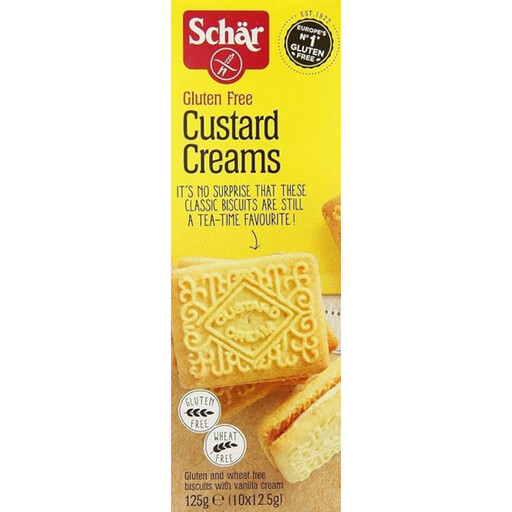 Image unavailable
The 125g gluten-free custard-cream pack may be relevant if you are comparing ingredients for a training snack. Check its current nutrition and allergen information, then try your planned portion during training before relying on it during a run.
Use total carbohydrate for the portion you plan to eat; ‘of which sugars’ is part of that total. Tesco, for example, lists 8.4g carbohydrate and 3.4g sugars per biscuit for its Custard Cream Biscuits 400g. Those figures do not set an individual fuelling target.
No. Having the lower per-100g figure among a few compared products does not establish a ‘reduced sugars’ claim. If that claim is important to you, check the exact pack rather than relying on its position in a shortlist.
Read the supplied pack’s nutrition table, ingredients and allergen information, especially if you used an online listing to compare products. Tesco and Asda both advise checking the pack because product information can change.
Packaged custard creams need no preparation, but decide in advance how you will carry and eat the portion you intend to use. Follow the pack’s storage instructions; Tesco’s listing says to keep its biscuits in a cool, dry place and in an airtight container once opened.