Hosts setting out self-serve portions
Portion packs give guests a defined serving without their handling biscuits left for others. They also let you put out more as guests arrive.


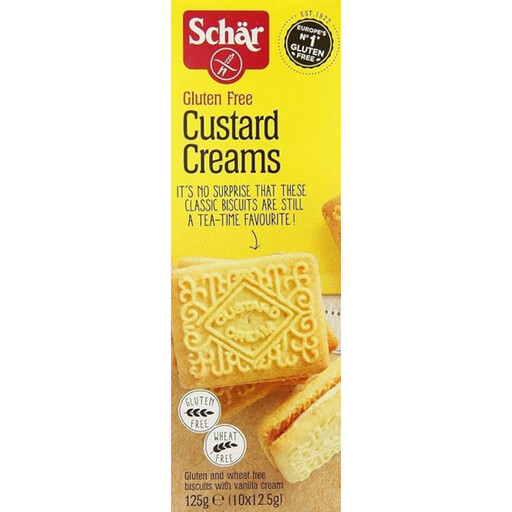
Choose portion-packed custard creams when guests will help themselves or you want to keep a gluten-free option separately packaged. Share packs suit a table where you can serve the biscuits and store the opened packet afterwards. Schär is listed in five 25 g portion packs; Roberts Bakery describes its Giants biscuit as individually wrapped, but it is a different, single-biscuit format. Check the current pack for ingredients and allergens before serving.
The useful distinction is whether guests will take sealed portions themselves or be served biscuits from an opened packet.
Portion packs give guests a defined serving without their handling biscuits left for others. They also let you put out more as guests arrive.
Look for a product labelled gluten-free and keep its packaging available for guests to check. Schär’s listed portion packs provide a separately packaged option; ordinary custard creams should not be treated as interchangeable with them.
If sealed guest portions are unnecessary, a conventional packet can be served from a plate or bowl. Plan how to cover or store any biscuits left after opening.
Decide how the biscuits will be served, then check the exact pack format and ingredient label. “Multipack” alone does not tell you whether each guest receives a sealed portion.
| Priority | What to check | Your needs |
|---|---|---|
| Sealed portions | Look for “portion packs” or “individually wrapped”. Asda lists Schär as five 25 g packs with two biscuits per pack; Roberts Bakery describes its Giants Custard Cream as one individually wrapped biscuit. | I’d like guests to pick up a sealed portion without handling the remaining biscuits. Would a two-biscuit pack or one oversized biscuit suit the table? |
| Shared serving | Check the packet size and how it should be stored after opening. Tesco and Asda list 400 g conventional packs and advise airtight storage once opened. | Someone will serve biscuits from a plate or bowl, so individual wrapping may not matter. I’ll need somewhere to put the opened packet afterwards. |
| Ingredients and allergens | Read the label on the exact pack being served, including any precautionary allergen statements. Asda describes Schär’s packs as wheat-free and gluten-free; its own-brand custard creams and Tesco’s conventional pack list wheat and milk. | I want guests with dietary requirements to be able to inspect the packaging, with specialist packs kept apart from the shared biscuits. |
| Portion format | Compare the serving inside each sealed pack, not just the total packet size. Schär’s listing specifies two biscuits per 25 g portion; Roberts Bakery’s individually wrapped Giants product is a single, oversized biscuit. | For handing biscuits round, I’d prefer to know whether each guest gets a small pack or one larger biscuit. |
| Snack-table information | Use the current pack’s ingredients, nutrition information and serving size if you are comparing biscuits for a mixed snack table. Check whether figures are given per biscuit, per serving or per 100 g. | I’m putting out several snacks and want to compare their labels on the same basis rather than judging them by packet size. |
Several ordinary packets sold together are not the same as biscuits wrapped for individual guests. Conventional Tesco, Asda and Sainsbury’s listings describe share packs, not sealed portions inside each packet.
Look for explicit “individual packs”, “portion packs” or “individually wrapped” wording, and confirm the format on the delivered packaging.
The conventional Tesco and Asda products list wheat and milk. A gluten-free label on a different product does not answer every guest’s allergen question.
Keep specialist packs separate and retain the current packaging so guests can read its ingredients and allergen statements.
The Department for Education’s school-food guidance concerns food provided by schools in England. It does not describe how to choose biscuits for an ordinary private garden party.
If a school is providing the event, check its current catering policy and the applicable school-food guidance instead of assuming private-party arrangements apply.
These examples show why the product’s serving format matters more than the brand name alone: a brand or retailer may be associated with a share pack, a portion pack or both.
Asda lists Schär Gluten-Free Custard Creams as a 125 g product made up of five 25 g portion packs.
The manufacturer describes its Giants Custard Cream as an individually wrapped biscuit.
Tesco’s 400 g own-brand custard creams are a conventional packet for shared serving.
Asda lists both its own-brand 400 g share pack and the Schär portion-pack product.
Sainsbury’s lists a 200 g conventional custard-cream packet for shared serving.
Tesco describes Crawford’s Custard Creams as a conventional 300 g packet.
The Joybuy listing describes McVitie’s Tasties Custard Creams as a 300 g conventional packet.
M&S describes its Extra Cream Custard Creams as having an additional vanilla-cream filling.
This custard-cream option is for hosts considering separately packaged portions, including a labelled gluten-free product. If you plan to serve from a shared packet instead, use the serving and label checks above to choose that format.
 No image available
The portion-pack format suits a self-serve table or a separately packaged gluten-free biscuit option. Asda describes the 125 g product as five 25 g packs with two biscuits in each, and as wheat-free, lactose-free and suitable for vegans. Check the delivered pack’s ingredients and allergen statements before serving guests.
No. Sealed portions suit guests helping themselves or a separately packaged gluten-free option. If someone will serve biscuits from a plate or bowl, a conventional share pack can work; follow its storage directions after opening.
Asda lists Schär Gluten-Free Custard Creams as five 25 g portion packs with two biscuits per pack, and describes them as wheat-free. Keep the packaging available and ask the guest to check the current ingredients and allergen statements for their own requirements.
Several do: the conventional Tesco and Asda listings state that their custard creams contain wheat and milk, while Sainsbury’s lists wheat flour and cows’ milk whey. Read the exact packet you intend to serve, including its precautionary allergen statements.
Follow the packet’s storage instructions and keep biscuits left in the opened pack covered. Tesco, Asda, Sainsbury’s and Crawford’s advise airtight storage after opening; check the instructions on the product you buy.
The Department for Education’s school-food guidance applies to food provided by schools in England, not the planning of an ordinary private party. If a school is providing the event, check its current catering policy and applicable guidance.