Custard-cream tea-break shoppers
You want the familiar filled biscuit and need to compare the sugar in the number you expect to eat. The Sainsbury's, Tesco and Asda standard listings give both per-biscuit and per-100 g figures.


If you want to keep custard creams, compare total sugars per 100 g and per biscuit, then consider how many biscuits you plan to have. If reducing the sugar in that tea-break portion matters more than keeping the cream filling, Tesco lists McVitie's Rich Tea The Light One at 1.1 g sugars per biscuit; it is a different type of biscuit, not a reduced-sugar custard cream.
The useful comparison depends on whether you want to keep the filling, change biscuit type or meet a dietary requirement.
You want the familiar filled biscuit and need to compare the sugar in the number you expect to eat. The Sainsbury's, Tesco and Asda standard listings give both per-biscuit and per-100 g figures.
You would consider a different biscuit if the cream filling is less important to you. Tesco lists McVitie's Rich Tea The Light One as a reduced-sugar rich tea biscuit, so compare it as a change of biscuit type.
You need a pack labelled for a particular dietary exclusion. Check its current ingredients and allergen information, then assess its sugar figure separately: free-from does not, by itself, mean reduced sugar.
Decide whether the cream filling is part of what you want from your tea break. Then compare labels on a common weight basis and against the portion you would eat.
Choose when: The filled sandwich biscuit matters to your tea break.
Trade-off: A lower figure among custard creams does not make that biscuit a reduced-sugar product; compare both the pack's per-100 g figure and your planned portion.
Choose when: You are willing to give up the cream filling for a biscuit listed with less sugar per biscuit.
Trade-off: Tesco lists McVitie's Rich Tea The Light One at 1.1 g sugars per biscuit, but its stated 30% comparison is with a typical semi-sweet biscuit, not a custard cream.
| Priority | What to check | Your needs |
|---|---|---|
| Sugar in your portion | Read sugars per biscuit and multiply by the number you plan to eat. Sainsbury's lists 3.3 g per biscuit for its standard custard creams; Tesco and Asda each list 3.4 g for theirs. | I want to know what my usual number of biscuits contributes, rather than compare packs as though I eat only one. |
| Like-for-like labels | Compare total sugars per 100 g when biscuit sizes differ, then check energy and saturates if those also matter to you. The NHS describes more than 22.5 g total sugars per 100 g as high for foods. | A smaller per-biscuit number could reflect a different biscuit size. I want the per-100 g figure before choosing between recipes. |
| Reduced-sugar wording | Check whether a pack actually makes a reduced-sugar claim and what product its comparison refers to. Tesco says McVitie's Rich Tea The Light One is compared with a typical semi-sweet biscuit. | If I change to rich tea, I still want to know what the claim compares. I would not treat it as a claim about custard creams. |
| Dietary suitability | Read the current ingredients and allergen declaration for the exact pack. Tesco and Asda each list 3.5 g sugars per biscuit for their separate free-from custard creams. | I need the right dietary exclusion, but I will check sugar separately rather than assume a free-from pack has less. |
| Pack and storage | Consider how much of the pack will remain after your tea break. Tesco and Sainsbury's advise keeping their opened custard-cream packs in an airtight container in a cool, dry place. | If the pack will last several tea breaks, its size and storage directions matter to me. |
Being lower than another custard cream is not the same as carrying a low- or reduced-sugar claim. Sainsbury's lists 26.5 g total sugars per 100 g for its standard pack, above the NHS guide of 22.5 g per 100 g for a food labelled high in sugars.
Describe the pack by its actual label value and check any nutrition claim on the product itself.
Per-biscuit figures help with a planned portion, but differently sized biscuits do not give a common weight basis. The M&S Extra Cream listing gives a per-100 g sugar figure, not a per-biscuit figure.
Use sugars per 100 g to compare packs, then use a stated per-biscuit figure where available to work out your portion.
A free-from label addresses the stated dietary exclusion. Tesco and Asda each list 3.5 g sugars per biscuit for their separate free-from custard creams.
Check the exclusion you need on the current pack, and make a separate comparison using its nutrition label.
These figures refer to the named products and listings, not every biscuit made or sold by each brand.
Its standard and free-from custard creams answer different shopping needs.
Its standard and free-from custard-cream listings provide serving and per-100 g nutrition.
Asda lists both a standard custard cream and a separate free-from version.
A traditional filled custard cream listed by Tesco.
Its Extra Cream Custard Creams are a distinct filled-biscuit option.
Its Tasties custard creams retain the filling, while Rich Tea The Light One is a different tea biscuit.
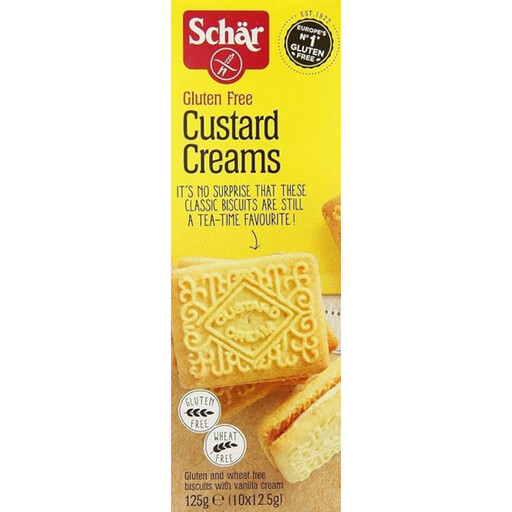
This Joybuy option is a gluten-free custard cream. If sugar is your deciding factor, compare the current pack's per-biscuit and per-100 g figures with the other biscuits you are considering.
 No image available
A gluten-free custard cream if you want a filled biscuit for your tea break. The listed pack is 125g; check its current sugar figures, ingredients and allergen declaration against your needs.
No. A lower figure than another pack does not mean the product carries a reduced-sugar claim. Compare the stated nutrition values, and check the pack itself for any claim and its comparison basis.
No. The NHS's adult daily figure of 30 g concerns free sugars, while a biscuit nutrition panel reports total sugars. Use the panel to compare biscuit portions, rather than treating those two measures as identical.
Not necessarily. Tesco and Asda each list 3.5 g sugars per biscuit for their separate free-from custard creams. Check the current pack's dietary exclusions and sugar figure independently.
Follow the directions on your pack. Tesco and Sainsbury's advise keeping their opened custard-cream packs in an airtight container in a cool, dry place.