Lunchbox shoppers
If you are considering a biscuit for a school lunch, compare ordinary and chocolate-coated versions by their ingredients and stated serving sizes. The NHS suggests fruit and fruit breads as alternatives to biscuits in lunchboxes.


Choose an ordinary custard cream if you want a vanilla sandwich biscuit; choose a chocolate-coated version only if you want that different biscuit, not because its cocoa coating proves Fairtrade sourcing. If Fairtrade matters, check the exact pack for a Fairtrade Mark and which ingredients it covers. Before putting either biscuit in a school lunchbox, check its current allergen label and the school’s arrangements.
If you are considering a biscuit for a school lunch, compare ordinary and chocolate-coated versions by their ingredients and stated serving sizes. The NHS suggests fruit and fruit breads as alternatives to biscuits in lunchboxes.
If ingredient sourcing affects your choice, look for the exact Fairtrade Mark and the ingredient it covers. A cocoa ingredient or a different certification logo does not establish a Fairtrade claim.
Check the current pack against the child’s requirements and the school’s arrangements. Ordinary custard creams can contain milk and wheat; a separately labelled free-from biscuit needs its own label check.
Start with the sourcing claim and allergen label, then use the pack’s serving information to decide whether the biscuit fits the lunch you are packing.
| Priority | What to check | Your needs |
|---|---|---|
| Fairtrade sourcing | Check the exact pack for a Fairtrade Mark. The Fairtrade Foundation distinguishes its classic Mark from its Fairtrade Sourced Ingredient Mark, which identifies a particular Fairtrade-sourced ingredient. Asda identifies the cocoa in its chocolate-coated custard creams as Rainforest Alliance certified, not Fairtrade certified. | I want to know whether the biscuit, or an ingredient in it, carries the Fairtrade claim I am looking for. A chocolate coating or another sourcing logo would not answer that question for me. |
| Allergens | Read the current ingredients and allergen declaration. Tesco’s and Asda’s ordinary custard creams list milk and wheat; Asda’s chocolate-coated version also lists soya. Asda lists a separate milk- and gluten-free variant. Check the child’s requirements and school arrangements too. | If a child must avoid milk or wheat, I need to choose by the specific pack label, not by the name “custard creams”. |
| Lunchbox portion | Check the stated biscuit serving and, for a like-for-like formulation comparison, the per-100g figures on the packs. Tesco and Asda each list 3.4g sugars per ordinary biscuit; Asda lists 13g per chocolate-coated biscuit. Those per-biscuit figures do not establish equal-sized servings. | I want to know what the portion I pack contains, rather than treating a pack size or one biscuit from each range as the same serving. The NHS also offers fruit and fruit breads as lunchbox alternatives to biscuits. |
Asda identifies Rainforest Alliance certified cocoa in its chocolate-coated custard creams. That is a different claim from the Fairtrade Marks described by the Fairtrade Foundation.
Read the mark and its ingredient wording on the exact pack before choosing on Fairtrade grounds.
The ordinary Tesco and Asda biscuits list milk and wheat, while Asda’s separately labelled Free From version is listed as milk- and gluten-free.
Check the current pack against the child’s needs and the school’s allergy arrangements.
Asda lists 3.4g sugars per ordinary custard cream and 13g per chocolate-coated biscuit. A per-biscuit comparison alone does not account for biscuit size.
Check the serving information and use the packs’ per-100g figures if you want to compare the formulations on a common basis.
These named listings show why the exact variant matters: ordinary, coated and free-from custard creams have different ingredient information.
Tesco lists ordinary custard creams in a 400g pack.
Asda lists ordinary, chocolate-coated and separately labelled Free From custard creams.
M&S lists Extra Cream Custard Creams in a 165g pack, described as having additional vanilla cream.
Sainsbury’s lists conventional custard creams in a 200g pack.
An Iceland Foods listing describes Crawford’s 300g vanilla-filled custard creams.
A Joybuy listing identifies McVitie’s Tasties Custard Creams in a 300g pack.
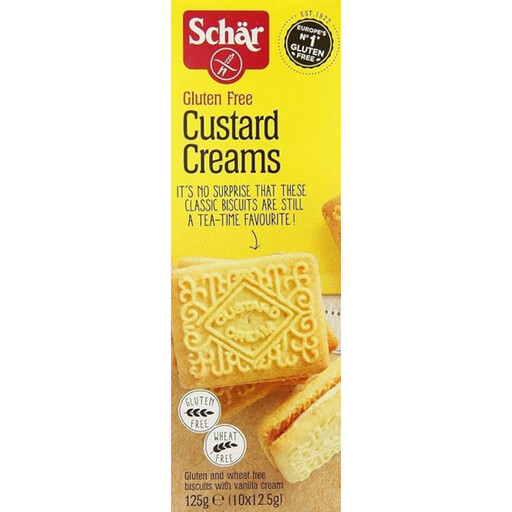
This Joybuy option is a gluten-free custard cream. If milk avoidance or Fairtrade sourcing is part of your lunchbox decision, check the exact pack for those separate requirements.
 No image available
For a school lunchbox that calls for a gluten-free biscuit, this is a 125g custard-cream option to check against the child’s requirements. Read the current pack for milk and other allergens, any Fairtrade claim and the school’s arrangements.
No. Check the exact pack for a Fairtrade Mark and which ingredient it covers. Asda identifies Rainforest Alliance certified cocoa in its listed chocolate-coated custard creams; that does not establish a Fairtrade claim.
No. Tesco’s and Asda’s listed ordinary custard creams contain milk-derived whey, while Asda lists a separate milk-free variant. Check the current ingredients and allergen declaration for the pack you intend to use.
No. Check the school’s arrangements and, where relevant, the child’s individual allergy plan. The Department for Education’s statutory allergy-safety guidance for maintained schools and academies in England says schools should consider food brought from home when developing their approaches; it does not set one identical lunchbox rule for every UK school.
Follow the instructions on its label. Tesco’s and Asda’s ordinary custard-cream listings advise cool, dry storage and an airtight container after opening.
Treat the Good Housekeeping Institute’s September 2020 taste test as an assessment of the biscuits tested then, not their current ingredients or Fairtrade claims. Check the identity and label of the pack you are buying, particularly if it is a different variant.