Parents packing a lower-sugar lunchbox
If you want to include a familiar biscuit, the number packed matters alongside any other sugary snacks or drinks in the lunchbox.


For a school lunchbox, compare the sugar in the number of custard creams you plan to pack, then use the per-100 g figures to compare biscuits of different sizes. A lower figure on an ordinary biscuit does not make it a product labelled ‘reduced sugar’; check milk ingredients and the school’s packed-lunch rules separately.
If you want to include a familiar biscuit, the number packed matters alongside any other sugary snacks or drinks in the lunchbox.
Milk-allergen information needs its own check. A biscuit chosen for milk avoidance should not be assumed to contain less sugar.
Start with the portion and the current packet, then check allergens and what the school allows before deciding whether a biscuit belongs in the lunchbox.
| Priority | What to check | Your needs |
|---|---|---|
| Sugar in the portion | Read sugars per biscuit and multiply by the number packed. For a weight-for-weight comparison, use sugars per 100 g; biscuit sizes can differ. | I want to know what the biscuits add to this lunchbox, including any other sweet snack or drink. |
| Milk and other allergens | Read the current packet’s ingredients and precautionary information. Assess an explicit milk-free claim against the child’s requirements; vegan wording alone is not an allergen check. | If my child must avoid milk, I need to establish whether this exact biscuit is suitable before considering its sugar figure. |
| Reduced-sugar wording | Look for the product’s own claim rather than treating the lowest number in a small comparison as a reduced-sugar formulation. Compare the stated serving as well as the per-100 g panel. | I’m looking for a product labelled reduced sugar, not just one ordinary custard cream with a slightly different figure. |
| School and storage | Check the school’s packed-lunch and allergy arrangements. Follow the purchased packet’s storage instructions after opening. | Before packing biscuits, I want to know they are permitted and can be kept as the maker instructs. |
Sainsbury’s lists 3.3 g sugars per biscuit for its standard custard creams, while Tesco and ASDA each list 3.4 g for theirs. Those figures compare particular biscuits; they do not establish a reduced-sugar claim.
Use the figure and serving size on the packet, and distinguish a comparison between products from a claim made for a formulation.
ASDA lists 3.5 g sugars per biscuit for its milk-free Free From by Custard Creams, compared with 3.4 g for its standard custard creams.
Check allergen suitability and sugar content as separate decisions.
Ingredients and allergy advice can change, so an earlier listing may not describe the packet being packed.
Read that packet’s ingredients and precautions, and follow the school’s allergy arrangements.
These figures describe the named products and serving sizes, not every biscuit sold by each brand. Check the packet if comparing a different size or recipe.
Standard Custard Creams in a 200 g pack.
Standard Custard Cream Biscuits in a 400 g pack.
Standard custard creams and a separate milk-free Free From option.
Standard Custard Creams documented in a 300 g wholesaler listing.
Vanilla-filled custard creams documented in a 300 g retailer listing.
Extra Cream Custard Creams, described by M&S as having extra vanilla-cream filling.
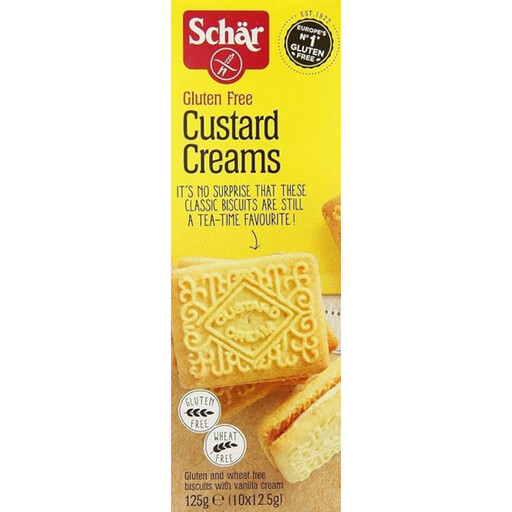
This gluten-free custard cream is an option to examine if gluten-free biscuits are needed for the lunchbox. Check its sugar and milk-allergen information on the current packet rather than treating gluten-free wording as a reduced-sugar or milk-free claim.
 No image available
For a lunchbox needing gluten-free custard creams, this is a 125 g pack. Gluten-free does not establish milk-allergy suitability or a reduced-sugar claim; check the current packet’s ingredients and sugar panel. The product information also warns of a choking risk for young children, so check its age guidance before packing it.
No. A label’s total sugars figure can include naturally occurring sugars, while NHS guidance refers to free sugars. Use the label to compare biscuit portions, not to calculate an exact remaining free-sugars allowance.
No. The Food Standards Agency warns that vegan labelling alone should not replace allergen information. Check the current packet’s ingredients, milk-free wording and precautionary information against the child’s requirements.
Check the particular school’s packed-lunch and allergy policy before packing them. Guidance about food provided by schools in England does not, by itself, tell you what that school permits in a lunch brought from home.
Follow the storage instructions on the pack you buy. The checked standard Tesco, Sainsbury’s and ASDA product information calls for dry storage and airtight storage after opening.