Carers packing snacks for outings
Separate inner packs can make snacks easier to distribute on a trip or when visiting friends. Check the included flavours, biscuits per inner pack and allergens before relying on a mixed assortment.


Choose an individually wrapped assortment for an outing or group snack if its flavour list, inner-pack count and allergens suit everyone; a mini assortment may contain other biscuits as well as custard creams. At home, a standard pack lets you serve a chosen number of biscuits, while a specifically labelled free-from pack matters when dietary requirements call for one. NHS Healthier Families recommends choosing fruit and vegetables instead of biscuits more often, rather than making biscuits the routine snack.
The useful distinction is where you will serve the biscuits and whether anyone needs a specifically labelled dietary alternative.
Separate inner packs can make snacks easier to distribute on a trip or when visiting friends. Check the included flavours, biscuits per inner pack and allergens before relying on a mixed assortment.
A standard pack allows someone serving the biscuits to choose a portion. Per-biscuit nutrition and the information per 100g offer ways to compare products with different pack sizes.
If gluten or milk must be avoided, look for a product explicitly labelled for the relevant requirement. Do not assume that a custard-cream name or a small pack means its ingredients are suitable.
Start with how the snack will be served, then compare the exact pack’s contents, nutrition and allergen information.
| Priority | What to check | Your needs |
|---|---|---|
| Pack format | For an assortment, confirm that it includes custard creams, how many relevant inner packs it contains and the biscuits in each. For a share pack, check the per-biscuit declaration when planning servings. | I need separate portions for a trip or group, rather than biscuits taken from an opened pack. |
| Nutrition and frequency | Compare the current label per biscuit and per 100g. Tesco lists 59 kcal, 3.4g sugars and 1.5g saturates per biscuit for its standard custard creams; its Free From product lists 64 kcal per 14g biscuit. The products and biscuit sizes differ. | At home, I can choose how many biscuits to serve. For routine snacks, NHS Healthier Families suggests choosing fruit and vegetables instead of biscuits more often. |
| Ingredients and allergens | Read the exact pack’s ingredients and allergen declaration. Tesco’s standard custard creams contain wheat and milk-derived ingredients and may contain sesame; its separate Free From product is labelled gluten-free and milk-free. | Someone eating the biscuits needs a clearly labelled option that meets their dietary requirements, not an assumption based on the flavour or pack size. |
Smaller packaging changes how biscuits are distributed, not the ingredients or nutrition of the biscuits inside.
Decide how many biscuits to serve and compare the label. NHS Healthier Families suggests fruit and vegetables in place of biscuits for more routine snacks.
A mixed mini-biscuit pack can contain several varieties, so its total pack count does not tell you how many custard-cream portions you will get.
Check the current flavour list, custard-cream inner-pack count and biscuits per pack before buying for a group.
Standard Tesco and Sainsbury’s custard creams contain wheat and milk-derived ingredients. Tesco’s standard product may contain sesame, while Sainsbury’s notes that its product is unsuitable for people with a barley allergy because of manufacturing methods.
Read the current pack for the person’s specific requirement, and choose an explicitly labelled alternative where needed.
Product classification, retail promotion rules and requirements for food supplied by schools address different questions. Department for Education school-food guidance concerns food and drink provided in state-funded schools in England; it does not establish a blanket rule for every home snack or UK setting.
If biscuits will be supplied by a school or holiday club, check the rules applicable there and the provider’s food policy rather than judging suitability from the biscuit category alone.
These named products illustrate different pack and label choices; a brand name alone does not establish mini-pack contents or dietary suitability.
Tesco lists both standard custard creams and a separately labelled Free From alternative.
Its standard 200g custard creams provide a per-biscuit declaration for planning a serving at home.
M&S describes its Extra Cream Custard Creams as a vanilla-cream variant, rather than a mini portion pack.
The McVitie’s Tasties Custard Creams listing describes a standard 300g packet, not individually wrapped mini portions.
This option is a 125g gluten-free custard-cream pack for dietary-led snack planning, rather than an individually wrapped mini assortment.
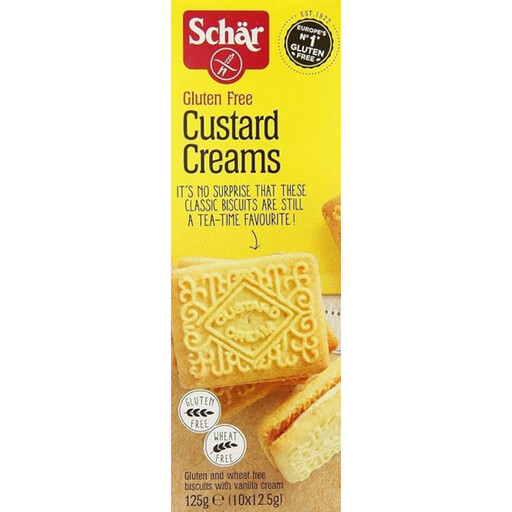 Image unavailable
Consider this pack when a gluten-free custard cream is needed for snacks served at home. It is a 125g pack, not an individually wrapped mini assortment; if milk avoidance also matters, check the current pack’s allergen information before buying.
No: a smaller or individually wrapped format changes the serving arrangement, not the biscuit’s declared nutrition. Compare the exact product’s figures per biscuit and per 100g rather than assuming that a mini pack or a Free From label means fewer calories.
NHS Healthier Families suggests choosing fruit and vegetables instead of biscuits more often. It also advises aiming for no more than two packaged snacks a day for children, so consider when a biscuit treat fits alongside the other snacks being served.
Do not assume so: the standard Tesco and Sainsbury’s examples contain wheat and milk-derived ingredients. Choose a product explicitly labelled for the requirement and read its current pack, as ingredients and allergen information can change.
No blanket conclusion about custard creams follows from an HFSS description. Department for Education guidance on school food addresses food and drink provided in state-funded schools in England, while England’s HFSS retail-promotion rules address a different setting. For food supplied by a school or holiday club, check the requirements applicable to that provider and its food policy.