Parents comparing biscuit sugar
Compare the exact custard cream and the number of biscuits you plan to serve. A relatively lower sugar figure does not, by itself, make a pack a reduced-sugars product.


For an occasional custard cream at home, compare sugars per 100 g and per biscuit on the exact packs, then decide how many biscuits to serve; a lower figure in a small comparison is not a verified reduced-sugars claim. If changing the snack matters more than keeping the biscuit, the NHS suggests fruit or prepared vegetables instead. Milk-allergy requirements and the rules for food provided by an English school need to be considered before a sugar comparison.
Compare the exact custard cream and the number of biscuits you plan to serve. A relatively lower sugar figure does not, by itself, make a pack a reduced-sugars product.
Check the current pack’s ingredients and allergen information before considering its sugar figures. Conventional custard creams in this comparison list milk ingredients; a free-from biscuit is a separate product with its own label to check.
For food provided under England’s state-funded school-food standards, the Department for Education’s snack rules also cover after-school clubs. That is a different decision from choosing a biscuit to eat at home.
Start with any allergen or school-provision requirements, then compare the exact snack and portion you intend to offer.
| Priority | What to check | Your needs |
|---|---|---|
| Sugar comparison | Compare sugars per 100 g on the exact packs, then read the per-biscuit figures. Tesco lists 28.3 g per 100 g and 3.4 g per biscuit for its 400 g custard creams. | I want to compare biscuit recipes without confusing pack size with the sugar in the portion served. |
| Snack choice | Read energy and saturates alongside sugars on the same label basis. If the biscuit itself is optional, consider the NHS’s suggested swap to fruit or prepared vegetables. | Changing the type of after-school snack matters more to me than finding a different custard cream. |
| Milk ingredients | Check the purchased pack’s ingredients, emphasised allergens and any precautionary information. Assess a specifically free-from product on its own label, not by its sugar figure. | If milk must be avoided, I need to establish whether this exact biscuit meets that requirement before serving it. |
| Portion and storage | Use the per-biscuit figure for the number actually served. Follow the pack’s instructions after opening; Tesco and ASDA specify an airtight container for the conventional packs examined. | I plan the number of biscuits offered and want to store the remaining pack as directed. |
| School provision | Establish who provides the snack. The Department for Education’s standards for covered provision in England restrict snacks during the school day, including after-school clubs, while allowing biscuits at lunchtime. | I am choosing food for an English school or after-school club, rather than a snack eaten at home. |
Retailer-declared figures can compare the particular packs examined, but their order does not establish a substantiated reduced-sugars claim.
Compare the exact packs per 100 g and check the purchased pack for any claim rather than assigning one from a small comparison.
ASDA lists 3.5 g sugars per biscuit for its Free From custard creams and 3.4 g for its conventional 400 g pack. Milk avoidance and sugar comparison answer different questions.
Check allergen suitability first when relevant, then compare sugars per 100 g and per biscuit for the products you are considering.
England’s Department for Education school-food standards concern covered school provision, including after-school clubs; they do not make every after-school snack a school-provided snack.
Establish who supplies the food and where it is served before applying the school-food requirements.
These figures describe specific listed packs, not every custard cream sold under each brand.
A conventional 200 g custard cream pack for comparing declared sugars.
A conventional 400 g pack with both per-100 g and per-biscuit figures.
Its conventional 400 g custard creams and separately labelled Free From 125 g custard creams address different requirements.
A branded conventional custard cream listed by Tesco in a 300 g pack.
Extra Cream Custard Creams are a distinct filling variation.
Tasties Custard Creams are a branded 300 g listing, not an established reduced-sugars option.
This gluten-free custard cream is an option to examine when choosing a biscuit for an after-school snack; check its current pack separately if milk avoidance is required.
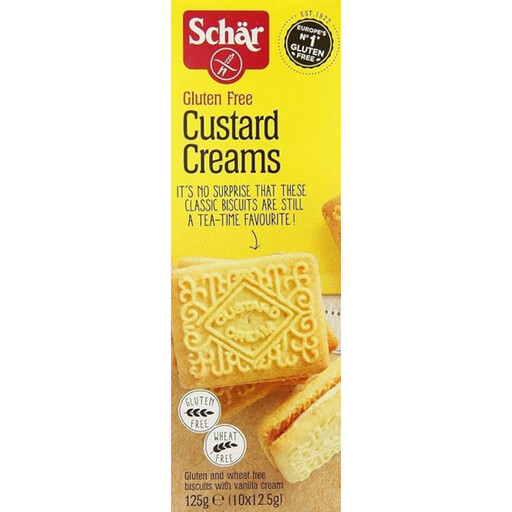 Image unavailable
For an after-school biscuit where gluten-free labelling matters, compare the current pack’s nutrition and check its ingredients before serving, especially if milk must be avoided.
No. The listed sugars per 100 g let you compare those particular biscuits, but a relative difference in this comparison does not substantiate a reduced-sugars claim for a pack. Check the exact product’s labelling rather than treating the lowest figure as a claim.
No. The label states total sugars; the NHS distinguishes free sugars from sugars naturally present in milk, fruit and vegetables. Use the biscuit’s declared figure to compare labelled portions, not as a direct measurement of its free sugars.
No. ASDA lists 3.5 g sugars per biscuit for its Free From custard creams, compared with 3.4 g for its conventional 400 g pack. Check sugar figures and the current pack’s allergen information as separate parts of the decision.
For provision covered by England’s current state-funded school-food standards, the Department for Education’s snack restriction includes after-school clubs; the standards distinguish biscuits allowed at lunchtime. This does not govern a parent serving a biscuit at home. The Department for Education says proposed updated standards are subject to Parliamentary approval for September 2027.
Follow the purchased pack’s instructions. The examined conventional Tesco and ASDA listings say to keep the biscuits somewhere cool and dry and use an airtight container after opening.