Hosts comparing sugar figures
Compare the listed sugar per 100g, then check the amount in each biscuit. A lower figure in this group of products is not, by itself, a formal reduced-sugars claim.


For a Christmas party, compare the ‘of which sugars’ figure per 100g before looking at sugar per biscuit, pack size and guests’ food exclusions. Tesco lists 19.9g sugars per 100g for its Free From custard creams and Lovemore lists 20.1g for its Vegan Custard Creams, below the figures in the checked conventional listings from Sainsbury’s, Tesco and Crawford’s. Those comparisons do not establish that either free-from biscuit carries a formal reduced-sugars claim.
Compare the listed sugar per 100g, then check the amount in each biscuit. A lower figure in this group of products is not, by itself, a formal reduced-sugars claim.
Check the ingredients and allergen information on the pack you will serve. Gluten-, wheat- and milk-free descriptions address different questions from the sugar declaration.
Use pack weight to plan how many biscuits to buy. The checked packs range from Lovemore’s 110g pack to Tesco’s 400g ordinary custard creams; follow each pack’s storage instructions after opening.
Start with the same per-100g sugar measure across products, then check portions, food exclusions and the quantity needed for the party.
| Priority | What to check | Your needs |
|---|---|---|
| Sugar comparison | Compare ‘of which sugars’ per 100g. Tesco lists 19.9g for Free From and 28.3g for ordinary custard creams; Lovemore lists 20.1g, Sainsbury’s 26.5g and Crawford’s 30.7g for the specified products. Check the current packs before relying on these figures. | I want to compare the biscuits on the same basis, without assuming that a lower listed figure amounts to a reduced-sugars claim. |
| Portions | Read sugar per biscuit alongside biscuit weight: Tesco lists 2.8g sugars per 14g Free From biscuit, while Tesco’s ordinary listing gives 3.4g per biscuit. Different biscuit sizes make per-biscuit figures a poor substitute for a per-100g comparison. | When putting out biscuits for guests, I want to know what the serving figure refers to, not just which number looks smaller. |
| Food exclusions | Check the full ingredients and precautionary information on the pack. Tesco describes its Free From biscuits as gluten- and milk-free; Lovemore describes its biscuits as gluten-, wheat- and milk-free. | A guest may need a particular ingredient excluded, so I need to check the exact biscuits I serve rather than assume every free-from pack meets the same needs. |
| Pack planning | Match pack weight to the number of guests: the checked Lovemore, Tesco Free From and Tesco ordinary packs are 110g, 125g and 400g respectively. Follow the chosen pack’s storage directions once opened. | I want enough biscuits for sharing and a way to keep any opened packs as directed until they are served. |
Tesco Free From lists 19.9g sugars per 100g, and Lovemore lists 20.1g. Their ingredient exclusions do not describe their sugar content.
Use the nutrition declaration on the current pack when comparing sugar, and keep food-exclusion claims separate.
Tesco specifies a 14g Free From biscuit, whereas Crawford’s specifies an 11.9g biscuit. Their per-biscuit sugar figures therefore refer to different amounts of food.
Compare per 100g first, then use the per-biscuit figure for the portion you plan to serve.
Food exclusions differ between products, and online ingredient information can change.
Check the delivered pack’s ingredients and precautionary allergen information against each guest’s relevant exclusions before serving.
Its Free From and ordinary custard creams offer a comparison within the same retailer’s listings.
Its 200g ordinary custard creams provide a conventional biscuit comparison.
The 300g custard creams are a conventional branded comparison.
Tasties Custard Creams are a branded 300g option to check against guests’ ingredient needs.
Extra Cream Custard Creams are a 165g variant distinguished by their filling.
Its Vegan Custard Creams are a 110g free-from option.
This gluten-free custard cream option may be relevant when planning biscuits for a guest who needs that exclusion. Check its current nutrition and full allergen label separately when comparing sugar and other ingredients.
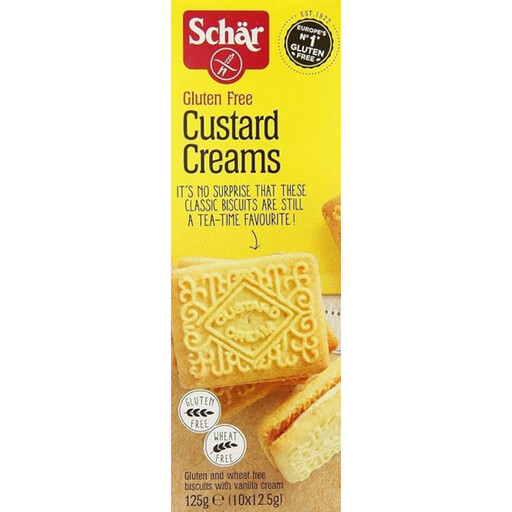 No image available
The gluten-free description is relevant if a party guest needs that exclusion. This is a 125g pack; check its current sugar declaration per 100g and full allergen information before serving.
No. Tesco Free From lists 19.9g sugars per 100g and Lovemore lists 20.1g per 100g. Their food-exclusion descriptions and sugar declarations answer different questions; these figures do not establish a formal reduced-sugars claim.
Follow the directions on the pack you buy. Tesco’s ordinary custard creams listing says to store them in a cool, dry place and put them in an airtight container once opened.
Read the delivered pack before serving, particularly when a guest has an ingredient exclusion. Tesco advises that recipes, nutrition and allergen information can change and that customers should not rely solely on its website.
No. The Department for Education describes England’s school-food requirements as applying to food and drink provided to pupils at state-funded schools on school premises, not to a private party. That guidance does not establish an individual HFSS classification for every custard cream; the further school-standard changes described for September 2027 remain subject to Parliamentary approval.