TV-night snackers comparing sugar
If you want custard creams while paying attention to sugar, compare labels per 100 g first. Per-biscuit information then helps you relate those figures to the number you intend to serve.


Compare sugars per 100 g to choose between custard creams, then check the amount you plan to serve. Among the three retailer-labelled examples here, Sainsbury’s lists 26.5 g per 100 g, Tesco 28.3 g and M&S Extra Cream 40.2 g; all exceed the NHS high-sugars guide of more than 22.5 g per 100 g for solid food. A lower figure in this comparison does not, by itself, establish a regulated ‘reduced sugars’ claim.
If you want custard creams while paying attention to sugar, compare labels per 100 g first. Per-biscuit information then helps you relate those figures to the number you intend to serve.
When several people are sharing a pack, the number of biscuits matters as well as the per-100 g figure. Check the exact product’s ingredients and allergen information if a guest has a food allergy.
Start with a like-for-like label comparison, then use the serving information and ingredients to decide whether a pack suits your TV night.
| Priority | What to check | Your needs |
|---|---|---|
| Sugars per 100 g | Compare the same unit on each pack. Sainsbury’s lists 26.5 g, Tesco 28.3 g and M&S Extra Cream 40.2 g sugars per 100 g for the products discussed here. | I want to compare custard creams by labelled sugar content rather than by pack size or the description of the filling. |
| Serving size | Check sugars and energy per biscuit where listed, then consider how many biscuits you will serve. Sainsbury’s lists 3.3 g sugars and 59 kcal per biscuit; Tesco lists 3.4 g and 59 kcal. | For a TV night, the number of biscuits on the plate matters more to me than assuming I will eat 100 g. |
| Sugar wording | Keep a relative comparison separate from a ‘low sugar’ or ‘reduced sugars’ claim. The NHS guide describes more than 22.5 g total sugars per 100 g of solid food as high, and 5 g or less as low. | I want a lower figure between the packs I am comparing, without mistaking it for a claim that the biscuit is low in sugar. |
| Ingredients | Read the exact pack’s ingredient and allergen information before serving. The Tesco listing includes wheat and milk ingredients and says the biscuits may contain sesame; do not apply that list to another product. | Someone sharing the biscuits may need me to check the particular pack, not just the biscuit category. |
Sainsbury’s 26.5 g sugars per 100 g is the lowest of the three retailer-labelled examples, but it still exceeds the NHS high-sugars guide of more than 22.5 g per 100 g for solid food.
Describe it as lower than the other products in this comparison, and use per-biscuit information separately when deciding how many to serve.
M&S Extra Cream Custard Creams list 40.2 g sugars and 502 kcal per 100 g; Sainsbury’s standard custard creams list 26.5 g and 474 kcal per 100 g. The filling is also a different product feature.
Compare the same units, then decide whether the filling or the labelled sugar figure is more important for this purchase. The difference alone does not establish a ‘reduced sugars’ claim.
The Sainsbury’s listing for the biscuit compared here says out of stock, while the Joybuy page for McVitie’s Tasties Custard Creams 300g says that item is no longer available.
Check the exact product page’s availability when you are ready to order.
These references concern the named biscuits, not every product made by each brand.
Its standard Custard Creams 200g provide both per-100 g and per-biscuit figures.
Tesco Custard Cream Biscuits 400G offer another standard biscuit with comparable label units.
Extra Cream Custard Creams are a distinct option if the filling is central to your choice.
The named Tasties Custard Creams 300g have appeared on Joybuy.
This Joybuy option is a gluten-free custard cream in a 125 g pack. Check its own nutrition label before comparing its sugar content with the standard and extra-cream biscuits discussed above.
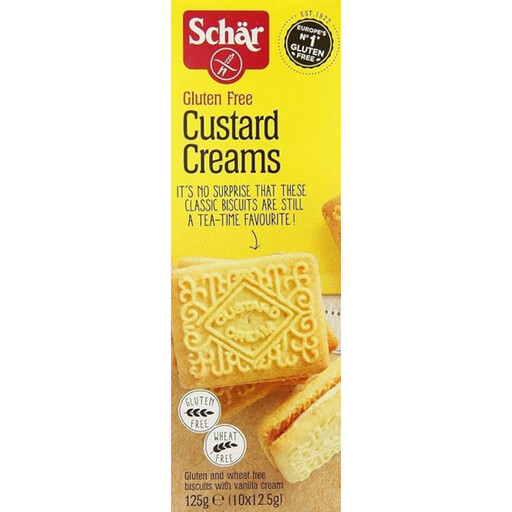 Image unavailable
For a TV-night serving, compare the pack’s sugars per 100 g with other custard creams and use a per-biscuit figure if shown. This is a 125 g pack of gluten-free custard creams; check its ingredients and allergen information when sharing.
No. A lower figure than another biscuit is a relative comparison. The NHS guide for solid food describes 5 g or less total sugars per 100 g as low and more than 22.5 g as high; the three Sainsbury’s, Tesco and M&S products compared here all exceed the high-sugars figure.
Use them alongside the number of biscuits you intend to serve. The listed Sainsbury’s biscuit has 3.3 g sugars and 59 kcal per biscuit, while Tesco’s has 3.4 g sugars and 59 kcal; a per-100 g figure is for comparing products on the same weight basis.
Check the exact pack’s ingredients and allergen information before serving. The Tesco custard cream listing includes wheat and milk ingredients and says it may contain sesame, but another brand or recipe needs its own check.
Choose by its label rather than the filling description. M&S Extra Cream Custard Creams list 40.2 g sugars per 100 g, compared with 26.5 g for the Sainsbury’s standard product and 28.3 g for Tesco’s standard product; the extra filling remains a separate preference.