Travellers comparing sugar figures
If you want custard creams for the journey, the sugars figure per 100g lets you compare packets on the same weight basis. The per-biscuit figure helps you consider the number you expect to eat.


If you want custard creams for a train journey, compare total sugars per 100g, then check the per-biscuit figure against the number you plan to eat. Among four specific standard packets, Sainsbury’s lists 26.5g per 100g, Tesco 28.3g, Asda 29g and Crawford’s 30.7g, according to their respective retailer listings; that comparison does not establish a reduced-sugars claim for any of them. Check the current pack’s allergens and how you will store any biscuits left after opening.
If you want custard creams for the journey, the sugars figure per 100g lets you compare packets on the same weight basis. The per-biscuit figure helps you consider the number you expect to eat.
Packet weights vary, so consider how many biscuits you need for the people travelling. If the packet will be opened before the journey ends, check its storage directions for what remains.
Check the ingredients and allergen statements on the specific packet before comparing its sugar figure. The Tesco and Asda standard custard-cream listings identify wheat and milk; a free-from name and a sugars figure answer different questions.
Start with the nutrition panel on the packet you are considering, then match its size and storage directions to the journey.
| Priority | What to check | Your needs |
|---|---|---|
| Sugars and portion | Compare total sugars per 100g, then check sugars per biscuit against the number you intend to eat. The NHS notes that a manufacturer’s stated portion may differ from yours. | I want to compare custard creams without treating the smallest per-100g figure as a reduced-sugars claim. I also need to know what my planned number of biscuits represents. |
| Packet and storage | Check packet weight and any stated serving count. Read the after-opening directions: the Sainsbury’s, Tesco and Asda listings advise airtight storage once opened. | We may share a packet on the train, but I want to pack only what we expect to eat and be able to store the rest as directed. |
| Ingredients and allergens | Read the current pack’s ingredients, allergen information and any precautionary statements. Check a free-from biscuit’s nutrition panel separately from its ingredient exclusions. | If I need to avoid an ingredient, the specific packet must meet that requirement; its sugars figure is a separate comparison. |
A comparison between particular packets does not, by itself, establish a reduced-sugars nutrition claim for any one of them.
Use the stated grams of total sugars per 100g to compare the packets, and check the actual label if you are looking for a product carrying a specific claim.
Those descriptions refer to different product characteristics, not a common sugar measure. Sainsbury’s lists 24.9g sugars per 100g for its Free From custard creams, while M&S lists 40.2g per 100g for its Extra Cream packet.
Check the current nutrition panel and any allergens you need to avoid as separate parts of the decision.
The Sainsbury’s, Tesco and Asda listings advise keeping biscuits in an airtight container once opened, which matters if some are coming home after the journey.
Decide how many to take out for the train and follow the packet’s directions for the remainder.
These figures describe the named packets, not every biscuit made by each brand. Compare the current pack before buying.
Sainsbury’s lists a standard 200g packet and a separate 125g Free From packet.
Tesco lists standard custard cream biscuits in a 400g packet.
Asda lists standard custard creams in a 400g packet and a separate Free From product.
A Tesco listing describes Crawford’s custard creams in a 300g packet.
McVitie’s Tasties Custard Creams are identified as a 300g packet.
M&S describes additional vanilla cream in its 165g Extra Cream Custard Creams.
This gluten-free custard-cream option is relevant if you are checking ingredients as well as comparing sugar figures for a train snack. Check its current label against your own requirements rather than assuming a free-from description answers both questions.
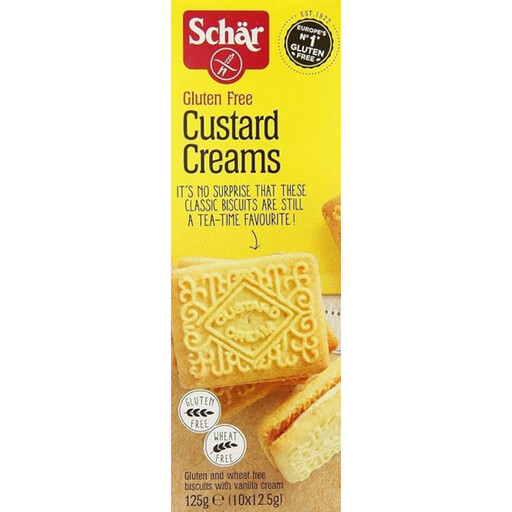 Image unavailable
The 125g packet is an option to check if you want gluten-free custard creams for the journey. Read its current ingredients and allergen statements, then compare its labelled sugars per 100g and per biscuit with other packets.
No. Sainsbury’s lists the lowest total sugars per 100g among the four standard packets compared here, but their retailer figures alone do not establish a reduced-sugars claim for any packet. Compare the stated figures without treating this limited ordering as a claim on the product label.
Read it alongside the number of biscuits you plan to eat; use sugars per 100g when comparing different packets on the same weight basis. The NHS notes that a manufacturer’s portion may differ from yours, and labelled total sugars are not the same measure as free sugars.
No: the description identifies specified ingredient exclusions, not a sugar level. Sainsbury’s lists 24.9g sugars per 100g for its Free From custard creams and Asda lists 25g per 100g for its Free From product; check each current pack’s nutrition and allergen information separately.
Check the ingredients, allergen statements and any precautionary wording on the actual packet before eating it. The Tesco and Asda standard custard-cream listings identify wheat and milk, so a comparison of their sugar figures cannot establish whether they meet your ingredient requirements.
Follow the directions on your packet. The Sainsbury’s, Tesco and Asda listings advise airtight storage after opening, so consider how you will store any biscuits left at the end of the train journey.