Custard-cream lunch packers
If you want the sandwich biscuit in your lunch, the sugar figure per biscuit helps you assess the portion you actually pack. The per-100 g figure lets you compare products independently of biscuit size.


For a packed lunch, keep custard creams if the filling matters and compare sugars per biscuit for the number you intend to pack. The cited standard products list 3.3 g per biscuit at Sainsbury’s, 3.4 g at Tesco and Asda, and 3.6 g for Crawford’s on Tesco’s listing; those differences do not establish a reduced-sugars claim. If changing biscuit type is acceptable, McVitie’s lists 1.3 g sugars per The Light One digestive.
If you want the sandwich biscuit in your lunch, the sugar figure per biscuit helps you assess the portion you actually pack. The per-100 g figure lets you compare products independently of biscuit size.
If a lower labelled sugar amount per biscuit matters more than the custard filling, a digestive is another option to consider. It has a different flavour and format from a custard cream.
If you need to avoid a particular ingredient, check the supplied pack’s ingredients and allergen statements. A Free From label addresses stated exclusions; it does not, by itself, tell you whether the biscuit contains less sugar.
Decide whether the custard filling, the labelled sugar in your portion or an ingredient exclusion takes priority, then compare the relevant pack information.
| Priority | What to check | Your needs |
|---|---|---|
| Sugar in the portion | Check sugars per biscuit and the number you will pack. For the cited standard products, Sainsbury’s lists 3.3 g, Tesco and Asda 3.4 g, and Crawford’s 3.6 g per biscuit on Tesco’s listing. | I want to know how much sugar the biscuits I take contribute, rather than judge a portion by the size of the packet. |
| Recipe comparison | Use sugars per 100 g to compare biscuits independently of serving size. The same listings give 26.5 g for Sainsbury’s, 28.3 g for Tesco, 29 g for Asda and 30.7 g for Crawford’s. | If biscuits differ in size, I want a like-for-like label measure as well as the figure for each biscuit. |
| Biscuit type | Check whether you are comparing custard creams or another biscuit. McVitie’s lists 1.3 g sugars per The Light One digestive; its stated 30% reduction is against the average digestive biscuit, not custard creams. | I could switch biscuit type if the labelled sugar per biscuit matters more to me than the custard filling. |
| Ingredients and storage | Read the supplied pack’s ingredients and allergen statements for any exclusion. If splitting a pack across lunches, follow its storage directions; Tesco and Asda advise cool, dry storage and an airtight container after opening for their listed custard creams. | I need to check suitability before packing biscuits, and I may keep the opened packet for another lunch. |
A smaller sugar figure than another ordinary custard cream does not, on its own, establish a reduced-sugars claim.
Compare the labelled grams per biscuit and per 100 g without treating the lowest figure in this group as a claimed reduced-sugars product.
Per-100 g figures compare products, but the number of biscuits in your lunch determines the sugar contributed by that portion.
Check the label’s per-biscuit figure and use the number you intend to take when comparing lunch portions.
Sainsbury’s lists 3.5 g sugars per Free From custard cream and 3.3 g per standard custard cream. McVitie’s The Light One is a digestive, not a custard cream.
Check ingredient suitability separately from sugar, and decide whether keeping the custard filling matters to you.
These figures describe the named products, not every biscuit made by each brand; check the pack when choosing a particular variant.
The cited standard and Free From custard creams address different shopping needs.
Its listed standard custard creams provide both per-biscuit and per-100 g sugar figures.
Its listed standard custard creams include portion and storage information.
Tesco’s listing gives sugar figures for the named 300 g custard creams.
Extra Cream is a distinct custard-cream variant for readers considering the filling as well as the nutrition label.
Its Tasties custard creams and The Light One Digestives are different biscuit types.
This gluten-free custard-cream option keeps the sandwich-biscuit format. Check its current nutrition panel for sugars per biscuit before comparing a packed portion with the standard products above.
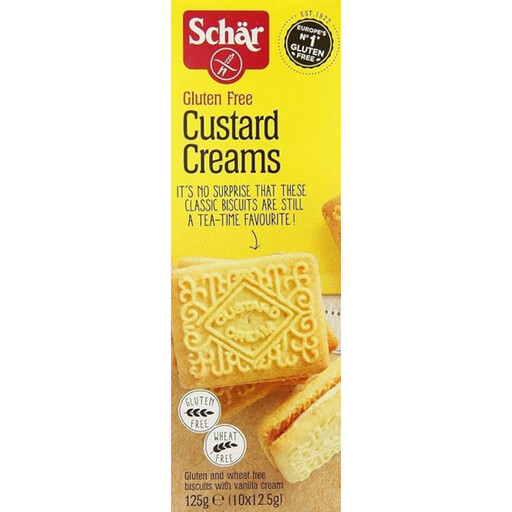 Image unavailable
If you want custard creams in a packed lunch, use the current pack’s per-biscuit sugar figure to assess the number you plan to take. Check its ingredients and allergen statements if a food exclusion matters.
No: a lower figure than another ordinary biscuit does not by itself establish a reduced-sugars claim. For a separate label comparison, NHS food-label guidance describes more than 22.5 g total sugars per 100 g as high; the four cited standard custard creams list 26.5–30.7 g per 100 g in the Sainsbury’s, Tesco and Asda listings.
Not necessarily. Sainsbury’s lists 3.5 g sugars per Free From biscuit and 3.3 g per biscuit for its standard custard creams. Check the supplied pack for both the exclusion you need and its sugar figure.
Follow the packet’s storage instructions. The cited Tesco and Asda custard-cream listings advise cool, dry storage and an airtight container after opening.
Check the supplied product’s ingredients, emphasised allergens and any precautionary statements for the particular ingredient you need to avoid. As the UK Food Standards Agency explains, a precautionary “may contain” statement concerns possible unintended allergen presence; a product name alone does not answer that question.