What should you check?
Start with the child’s age and allergen needs. Then compare the nutrition on the pack and consider whether the snack is for home or a setting.
| Priority | What to check | Your needs |
|---|
| Snack choice |
Read the nutrition per biscuit and its traffic-light indicators. Sainsbury’s lists 3.3 g sugars per biscuit for its standard custard creams, with high sugar and saturated-fat indicators. |
I’m choosing an occasional biscuit, not the usual snack. NHS Healthier Families recommends fruit and vegetable snacks and advises a maximum of two packaged snacks a day for children. |
| Age suitability |
Check the age guidance and choking warnings for the exact product. Joybuy product information for Schär Gluten Free Custard Creams warns that they are not suitable for young children because of choking risk. |
Before serving a biscuit to a toddler, I need to know that this particular product is suitable for their age. |
| Milk and wheat |
Read the ingredient list, declared allergens and any precautionary statement on the pack. Sainsbury’s standard custard creams list wheat flour and whey powder from cows’ milk. |
If the child must avoid milk or wheat, I can’t judge suitability from the name “custard cream” or from another brand’s label. |
| Free-from choice |
Confirm which exclusions the exact label covers. Sainsbury’s describes its Free From Custard Creams as milk and gluten free; its guide still lists 3.5 g sugars per biscuit and high saturated fat. |
I need a biscuit labelled for the relevant exclusion, but I still want to check age suitability and nutrition. “Lactose-free” alone is not the same claim as “milk-free”. |
| Food at a setting |
Ask the setting which menu and allergen rules apply. Department for Education guidance says meals, snacks and drinks provided under England’s early-years framework must be healthy, balanced and nutritious; school food has separate requirements. |
A biscuit for nursery or school needs to fit the setting’s requirements, not just a household snack decision. |
Brand and product-line references
These examples show why the product variant and its current label matter more than a brand name alone.
McVitie’s
Joybuy lists McVitie’s Tasties Custard Creams Biscuits in a 300 g pack.
- The Joybuy product information provides nutrition per 100 g, including 30.6 g sugars and 13.5 g saturates.
- Its allergen statement lists milk and wheat and says it may contain sesame. Check the pack for the child’s requirements.
Crawford’s
Crawford’s Custard Creams are listed by Tesco in a 300 g pack.
- Crawford’s product data identifies wheat flour and milk-derived whey solids in this biscuit.
- Tesco warns that formulations and allergen information may change; check the pack supplied.
Sainsbury’s
Sainsbury’s lists a standard 200 g custard cream and a separate 125 g Free From version.
- The standard biscuit’s guide lists 3.3 g sugars per biscuit; the Free From product is described as milk and gluten free.
- The Free From guide lists 3.5 g sugars per biscuit and high saturated fat. Confirm the current label and age suitability rather than assuming it is a toddler snack.
Tesco
Tesco lists standard and Free From custard cream products as distinct options.
- The separate listings give shoppers products whose labels they can compare for their dietary needs.
- Tesco advises reading the product label because ingredients, nutrition and allergen information can change.
Schär
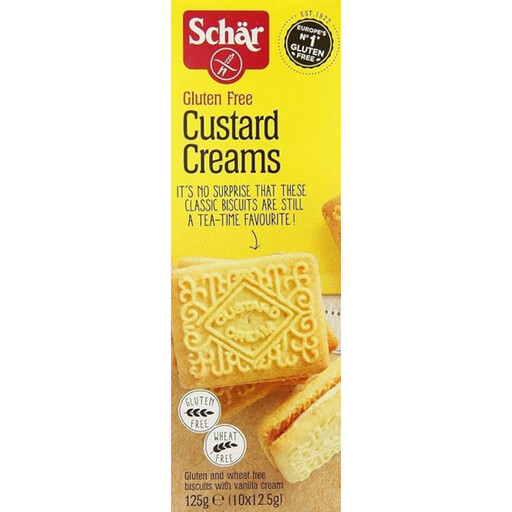
Joybuy lists Schär Gluten Free Custard Creams in a 125 g pack.
- Joybuy describes this product as gluten-free and lactose-free and says it is suitable for vegans.
- Joybuy product information warns that it is not suitable for young children because of choking risk. Do not treat its free-from positioning as toddler suitability.
M&S
M&S lists Extra Cream Custard Creams and a separate milk-chocolate-coated custard cream.
- The listings distinguish a plain custard-cream option from a chocolate-coated variant.
- M&S warns that ingredient, nutrition and allergen information may change; check the label of the variant chosen.
Joybuy product options
This Joybuy option is a gluten-free custard cream, but its stated young-child choking warning makes it unsuitable for the toddler snack occasion addressed here.
 No image available
Schär Gluten Free Custard Creams 125 g
For shoppers comparing free-from custard creams, Joybuy describes this pack as gluten-free and lactose-free and says it is suitable for vegans. Its product information also warns that it is not suitable for young children because of choking risk; do not choose it for toddler snack time. Check the pack’s allergen statement for the individual person who would eat it.
View on Joybuy
Questions about toddler snack time
Are custard creams digestives?
No. Custard creams are cream-filled sandwich biscuits, while digestives are a different type of biscuit. Check custard-cream labels rather than assuming the ingredients or nutrition of a digestive apply.
Can a toddler have a custard cream as a snack?
A custard cream can be considered as an occasional biscuit only if the particular product is age-appropriate and its ingredients suit the child. NHS Healthier Families recommends fruit and vegetable snacks and advises a maximum of two packaged snacks a day for children. Check product-specific warnings: Joybuy information for Schär Gluten Free Custard Creams says they are not suitable for young children because of choking risk.
Do all custard creams contain milk?
No. Sainsbury’s describes its Free From Custard Creams as milk and gluten free, whereas its standard custard creams list whey powder from cows’ milk. Check the exact pack each time, including its allergen and precautionary statements.
Does milk-free mean suitable for every allergy?
No. A milk-free description does not establish suitability for other allergies. Read the complete ingredient list, declared allergens and any precautionary allergen statement for the specific product and child.
Can an early-years setting serve custard creams at snack time?
Check the setting’s menu and nutrition policy rather than assuming a retail biscuit listing settles the question. Department for Education guidance says that meals, snacks and drinks provided under England’s early-years framework must be healthy, balanced and nutritious; it does not establish that every custard cream is either permitted or prohibited.


