Hosts serving one biscuit
A conventional packet lets you put one custard cream on a plate. Check the pack size and its storage instructions if biscuits will remain after tea.


If you want to serve one custard cream at afternoon tea, take one from a conventional packet and store the rest as directed. Choose a portion-packed format when separate servings matter, but check how many biscuits are in each portion and how many portions you must buy. If the person has difficulty swallowing dry or crumbly food, follow their individual speech and language therapy advice rather than assuming a cream-filled biscuit is suitable.
The useful distinction is between serving one biscuit and buying a separately packed serving; neither format establishes suitability for every guest.
A conventional packet lets you put one custard cream on a plate. Check the pack size and its storage instructions if biscuits will remain after tea.
Separate portions may be useful across visits, but the inner packet and the whole order can contain very different quantities. Hill Biscuits, for example, specifies three biscuits per packet and 48 packets per case.
Check the exact biscuit’s ingredients when an allergy or gluten restriction matters. If the guest has swallowing difficulties, use their individual advice about food textures; age alone does not establish that need.
Decide first whether you need one biscuit from a packet or separately packed servings. Then compare the quantity offered, the label and any requirements of the person eating it.
Choose when: One biscuit is enough for tea and you can store the remainder according to the pack instructions.
Trade-off: The remaining biscuits are not separately wrapped portions.
Choose when: Keeping servings in their own packets matters across several visits or hosts.
Trade-off: A portion need not contain one biscuit, and a catering case can contain many portions.
Choose this approach when: The person has difficulty with dry or crumbly foods.
Limit: A cream filling or portion wrapper cannot establish whether a biscuit is suitable for someone with swallowing difficulties.
| Priority | What to check | Your needs |
|---|---|---|
| Serving format | Check biscuits per inner packet and packets per order. Hill Biscuits specifies three biscuits per packet and 48 packets per case; Schär describes its 125g product as portion packed. | I only want to put one biscuit out for tea, or I need separate packets for later visits. I would check the inner serving before treating either format as a one-biscuit purchase. |
| Pack size and storage | Compare the total pack size with how often biscuits will be served. Tesco and Asda advise an airtight container after opening their conventional packets. | A smaller packet may suit me if I expect to serve biscuits only occasionally; for repeated visits, I can consider whether separate portions are useful. |
| Label figures | Compare total sugars on the same basis: per biscuit with per biscuit, or per 100g with per 100g. Tesco lists 3.4g per biscuit; M&S lists 40.2g per 100g for its Extra Cream variant. The NHS notes that total sugars on labels and free sugars are different measures. | If I am comparing what I will actually serve, I need to account for the number and size of biscuits rather than assume the smaller-looking label figure describes the smaller portion. |
| Ingredients | Read the current label for the exact variant and its allergy statements. Tesco lists wheat and milk ingredients and a sesame precaution; Schär describes its custard creams as gluten- and wheat-free. | If someone needs to avoid an ingredient, I cannot use a gluten-free description to answer a separate milk-allergy question. |
| Food texture | For someone with dysphagia, check their individual eating and swallowing advice. Kent Community Health NHS Foundation Trust identifies dry biscuits among crunchy and crumbly foods that may require avoidance or particular care. | If dry biscuits are difficult for my guest, I need their specific texture advice before serving a custard cream; the filling does not settle that question. |
A biscuit served from an ordinary packet is different from a separately packed portion. Hill Biscuits’ catering format contains three biscuits in each of 48 packets.
Check both the number of biscuits inside each packet and the number of packets in the outer order.
A catering case means storing or serving many more biscuits than one tea visit may require.
Kent Community Health NHS Foundation Trust identifies dry biscuits as potentially difficult for people with dysphagia; a product’s filling does not replace an individual texture assessment.
If the person has swallowing difficulties, follow their speech and language therapist’s advice before offering this type of biscuit.
A per-biscuit figure and a per-100g figure describe different quantities. The NHS also distinguishes the total sugars shown on labels from free sugars.
Use the same measurement basis when comparing products, and consider the number of biscuits being served.
These examples illustrate different pack formats and labelled details; a brand’s inclusion does not establish that its products share the same ingredients or serving size.
Tesco lists a conventional 400g packet from which a host can serve one biscuit.
Sainsbury’s lists a conventional 200g packet, smaller in total pack weight than the cited 400g Tesco and Asda packets.
Asda lists a conventional 400g custard cream packet.
Tesco lists Crawford’s conventional custard creams in a 300g packet.
M&S describes its 165g Extra Cream Custard Creams as having additional vanilla filling.
Hill Biscuits specifies a catering format of 48 packets containing three custard creams each.
Schär describes its 125g custard creams as gluten- and wheat-free and portion packed.
A Sainsbury’s listing names Custard Cream among the varieties in McVitie’s Family Circle assortment.
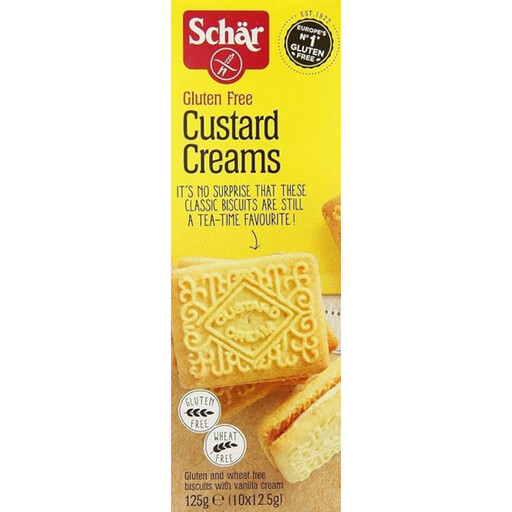
This Joybuy option is a portion-packed, gluten-free custard cream for buyers checking that particular format. It does not replace the choice between serving one biscuit from a conventional packet and buying separate portions.
 No image available
Consider this portion-packed format when separate servings and a gluten-free custard cream are relevant to your guest. Schär describes its 125g product as gluten- and wheat-free and lists a 25g piece weight and 23g total sugars per 100g.
Check the current pack for any other ingredient restrictions. Portion packing does not establish suitability for someone who has difficulty swallowing dry or crumbly biscuits; follow their individual texture advice.
No. You can serve one biscuit from a conventional packet, but the others remain in that packet rather than becoming separately wrapped servings. If you buy a portion-packed format, check how many biscuits each inner packet contains.
Follow the instructions on the exact pack. Tesco and Asda advise transferring their custard creams to an airtight container after opening.
Do not assume it does. Kent Community Health NHS Foundation Trust identifies dry biscuits as potentially difficult for people with dysphagia and says a speech and language therapist advises whether particular foods should be avoided or need special care. Follow the person’s individual advice rather than relying on dunking.
A gluten-free description does not answer a milk-allergy question. Check the ingredients and precautionary statements on the current package of the exact custard cream before serving it to someone with that allergy.