A large carton suits a household that will use its measured portions within the pack’s opened-storage period; a smaller tin can be more practical for fewer servings, while powder lets you make a chosen quantity. None is automatically suitable for someone managing diabetes: compare total carbohydrate for the portion actually served, and check the ingredients and preparation method where relevant.
Who is this for?
People counting carbohydrate in dessert portions
If a meal plan involves counting carbohydrate, the useful figure is the amount in the custard actually served, not just the pack’s stated serving. Diabetes UK identifies total carbohydrate consumed as an important consideration for glucose levels after eating.
Households comparing lighter custards
A reduced-sugar or reduced-fat label can prompt a comparison with standard custard, but the two claims describe different things. Check the named comparator and the nutrition values for an equivalent portion.
Smaller households trying to avoid leftovers
A 400g tin, 500g carton and 1kg sharing carton leave different amounts to store. Check how many portions your household will use and follow the opened-pack instructions on the custard you buy.
What matters when choosing?
For a shared dessert, start with the portion each person will have, then choose a pack and format that fit how the household will serve it. Diabetes UK emphasises total carbohydrate consumed when considering glucose levels after eating.
| Concern |
What to check |
Who this matters to |
| Carbohydrate in the served portion |
Compare total carbohydrate per 100g and per stated serving, then account for the amount you will serve. |
When a meal plan calls for counting carbohydrate, the amount in each bowl matters more than the pack’s suggested portion alone. About 36% of consumers put carbohydrate in the served portion first. |
| Reduced-sugar and lower-fat claims |
Check what a reduction is compared with, and compare carbohydrate and sugars on the same weight basis. |
For a shared dessert, some consumers want to consider a lighter-labelled option without assuming the label settles the carbohydrate question. About 29% of consumers make that comparison their primary concern. |
| Pack size and leftovers |
Match the pack to the portions you will use; read its refrigeration and use-after-opening instructions. |
If only a few portions will be served, finishing a large carton after opening may be difficult. Pack size and leftovers come first for about 21% of consumers. |
| Ready-to-serve or powder |
Decide whether you want to serve custard from the pack or prepare a chosen quantity; for powder, check the prepared nutrition. |
When preparation time is the deciding factor, consumers weigh ready-to-serve custard against making only the quantity needed. About 14% of consumers put that format choice first. |
Buying pitfalls
-
Treating reduced sugar as a suitability guarantee
Ambrosia says its Light Devon Custard has 30% less sugar and 30% less fat than Ambrosia Devon Custard, yet ASDA lists 15.1g carbohydrate per 125g portion of the Light product. The reduction applies to that named comparison, not to every custard or every portion size.
Compare total carbohydrate and sugars for the amount you intend to serve, using your own diabetes-management advice where needed.
-
Reading lower fat as lower carbohydrate
Tesco lists its Light Custard as reduced fat and gives 15.7g carbohydrate per 100g. A fat claim does not establish how its carbohydrate value compares with another custard.
Put the products’ nutrition panels on the same per-100g or measured-portion basis before comparing them.
-
Opening a sharing carton without planning the portions
Tesco’s Light 1kg custard and Sainsbury's Ready To Eat Custard 1kg instruct shoppers to refrigerate after opening and consume within three days.
Choose a pack size that fits the portions your household expects to serve within the instructions on the exact pack.
An unfinished carton can mean avoidable food waste.
-
Relying on the word “diabetic” instead of the label
Diabetes UK says there is no single diabetic diet. A description aimed at people managing diabetes does not replace the product’s ingredients, nutrition panel or portion information.
Check those details alongside any personal dietary advice that applies to you.
Brands to compare
Ambrosia
Ready-to-serve custard in standard and Light formats, including a 1kg Light carton for sharing.
- Ambrosia compares its Light 1kg carton with its standard Devon Custard, stating 30% less sugar and 30% less fat. ASDA lists 15.1g carbohydrate and 9.3g sugars per 125g portion of the Light carton.
- The comparison does not establish suitability for an individual diabetes plan. The carton contains milk and, according to Ambrosia, must be refrigerated and used within three days after opening.
Tesco
Own-label ready-to-serve custard includes a 400g tin and a 1kg reduced-fat carton.
- Tesco lists 26.5g carbohydrate for a 200g half-can serving of its 400g standard custard, giving shoppers a stated serving to compare with what they pour.
- Tesco Light Custard lists 15.7g carbohydrate per 100g despite its reduced-fat description; compare carbohydrate separately from fat.
Sainsbury's
Own-label ready-to-eat custard includes cartons for smaller and larger households.
- Sainsbury's lists eight 125g servings and 20.9g carbohydrate per serving for its standard 1kg custard.
- Its 1kg product instructs shoppers to refrigerate after opening and consume within three days; plan the servings before choosing that size.
Bird's
A custard-powder option rather than a ready-to-serve sharing carton.
- Powder offers the option of preparing the quantity a household needs.
- Check the preparation instructions and nutrition for the custard as made; ingredients added during preparation affect the final serving.
M&S
Its Madagascan Vanilla Luxury Custard represents a chilled dessert option rather than an ambient tinned custard.
- Marks & Spencer describes this custard as made with Channel Island milk, British cream, egg yolks and Madagascan vanilla extract.
- Assess its current nutrition panel and intended portion before comparing it with a ready-to-serve sharing tin or carton.
Joybuy custard selections
These ready-to-serve options cover a 1kg sharing carton and smaller 400g or 500g packs. Compare their current labels for the portion you will serve; the lower-fat and reduced-sugar names do not answer that question on their own.
 No image available
Ambrosia Light Devon Custard 1kg
Consider this ready-to-serve carton when several people will share measured portions. Ambrosia states that it has 30% less sugar and 30% less fat than Ambrosia Devon Custard; ASDA lists 15.1g carbohydrate and 9.3g sugars per 125g portion. Check the amount actually served. It contains milk, and Ambrosia instructs shoppers to refrigerate it after opening and use it within three days.
View on Joybuy
 No image available
Ambrosia Strawberry Flavour Devon Custard 400g
This 400g tin is a smaller ready-to-serve option for a shared dessert. Keep its strawberry-flavour variant distinct when comparing labels, and use the carbohydrate figure for the portion you actually serve rather than assuming a smaller pack means a smaller serving.
View on Joybuy
 No image available
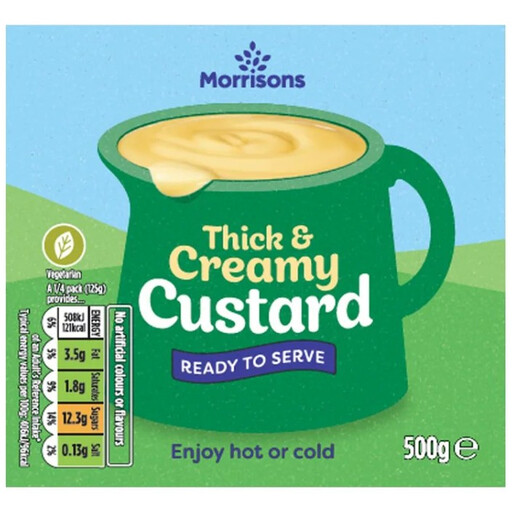
Morrisons Ready To Serve Custard 500g
This 500g pack offers a ready-to-serve size between the listed 400g tins and 1kg carton. Decide how much each person will have, then check the current nutrition label against that portion.
View on Joybuy
 No image available
Ambrosia Low Fat Custard 400g
This 400g ready-to-serve tin is an option when you want a smaller pack and are comparing lower-fat products. Its name does not establish a lower carbohydrate value: check carbohydrate and sugars separately on the current label, using the amount you will serve.
View on Joybuy
Common questions
Is tinned custard automatically suitable for someone managing diabetes?
No. Diabetes UK says there is no single diabetic diet and identifies total carbohydrate consumed as important for glucose levels after eating. Check the carbohydrate in the portion being served against the person’s own management plan rather than relying on a product description.
Should I look at sugars or total carbohydrate first?
Start with total carbohydrate for the portion you will serve, then review sugars and other nutrition values relevant to your choice. Diabetes UK says total carbohydrate consumed has the biggest effect on glucose levels after eating.
Does low-fat custard contain less carbohydrate?
A low-fat label alone cannot tell you that. Tesco lists 15.7g carbohydrate per 100g for its reduced-fat Light Custard; compare the carbohydrate values of the exact products on the same weight basis.
How long can a sharing carton be kept after opening?
Tesco’s Light 1kg custard and Sainsbury's Ready To Eat Custard 1kg both instruct shoppers to refrigerate after opening and consume within three days. Follow the instructions on the exact pack you buy.
What should I check if someone sharing the custard has an allergy?
Read the current pack’s ingredients and highlighted allergen information before serving it. The Tesco and Sainsbury's ready-to-serve custards discussed here contain milk ingredients; check the exact product rather than assuming all custards have the same recipe.


