For a biscuit-based dessert that calls for a prepared custard filling or topping, ready-to-serve custard avoids making it from powder. Tesco uses ready-made custard in baked pastry tarts, but that does not establish how it will behave in every biscuit bake. Choose a lighter version by comparing the per-100g label values, and check the pack’s storage instructions and allergens whichever format you buy.
Who is this for?
Quick dessert makers
If your recipe calls for prepared custard, a ready-made product saves the mixing step. Tesco’s custard-tart recipe shows one use for ready-made custard in pastry cases; check a biscuit-based recipe’s own instructions before treating it as a baked filling.
Shoppers comparing sugar and fat
Compare sugars and fat per 100g when choosing between standard and lighter ready-to-serve custards. Ambrosia publishes values for its standard and Light Devon Custard cans, allowing a comparison between those products.
Store-cupboard planners
An unopened ambient custard may suit a cupboard plan, but opening it changes the storage requirements. Ambrosia instructs customers to remove leftovers from its standard and light cans, refrigerate them and use them within three days.
What matters when choosing custard?
Start with the form your recipe requires: ready-made custard is not the same ingredient as powder that must first be prepared. Then compare the amount you will use, the label values and the storage instructions.
| Concern |
What to check |
Who this matters to |
| Ready-made convenience |
Check whether the recipe specifies prepared custard or a mix. Tesco’s pastry-tart recipe uses 300g of ready-made custard; a biscuit recipe may call for a different method. |
If I am assembling a biscuit-based dessert without making custard first, I want a filling or topping my recipe can use directly. About 46% of consumers put that ready-made convenience first. |
| Pack size and leftovers |
Match the pack size to the recipe quantity and check its instructions for leftovers. Ambrosia says to refrigerate custard remaining from its standard and light cans and use it within three days. |
When a bake uses only part of a pack, I need a realistic plan for the rest before opening it. For about 36% of consumers, usable quantity and leftovers are the primary concern. |
| Sugars, fat and allergens |
Compare sugars and fat per 100g, and read the current pack’s allergen declaration. Both standard and light Ambrosia Devon Custard contain milk. |
For a dessert served to people with different dietary needs, I want to compare the label and check ingredients before deciding. Nutrition and allergen suitability come first for about 18% of consumers. |
Mistakes to avoid
-
Treating every custard format as interchangeable
Bird’s custard powder needs preparation, while M&S Madagascan Vanilla Luxury Custard is a chilled product. Neither is automatically a substitute for a recipe that specifies ready-made ambient custard.
Follow the recipe’s wording and preparation method. If cupboard storage is essential, check the unopened pack’s storage instructions before choosing.
-
Buying more than the bake will use
A pack that is convenient before opening can leave custard that needs prompt refrigeration and another use.
Compare the recipe quantity with the pack size, then plan for any leftovers within the period stated on that product’s label.
Unused custard may go to waste if you cannot use it within the labelled period.
-
Assuming lighter custard is free from milk
Ambrosia’s standard and light Devon Custard products both contain milk. A sugar or fat comparison does not answer an allergen question.
Read the current physical pack’s ingredient and allergen information before serving custard to anyone with an allergy.
-
Leaving an opened can in the cupboard
Ambrosia’s directions for its standard and light cans require the remaining custard to be removed from the can, refrigerated and consumed within three days. Ambient storage before opening does not extend to leftovers.
Transfer the remainder to a covered container and follow the instructions on the particular pack.
Brands and formats to consider
Ambrosia
Its standard and light 400g Devon Custard cans offer ready-to-serve options for recipes that call for prepared custard.
- Ambrosia states that its Light Devon Custard has 30% less sugar and fat than its standard Devon Custard.
- Both products contain milk; leftovers must be removed from the can, refrigerated and used within three days.
Tesco
Tesco lists a 400g Ready To Serve Custard in its tinned-custard range and uses ready-made custard in a pastry-tart recipe.
- The recipe provides a concrete example of filling pastry cases with prepared custard before baking.
- That pastry method does not establish suitability for every biscuit base or baked biscuit filling.
Sainsbury's
Its ambient custard range includes ready-to-eat products in different pack sizes.
- Pack-size choices make it worth matching the quantity bought to the amount a recipe needs.
- Check the specific product’s format, ingredients and storage directions rather than assuming all ready-to-eat packs are tins.
Bird's
Bird's Original Custard Powder is a preparation-from-mix alternative, not ready-made tinned custard.
- It is relevant when a recipe calls for custard prepared from powder.
- Follow the pack’s preparation directions before considering it for a recipe requiring a finished filling.
M&S
M&S Madagascan Vanilla Luxury Custard is a chilled serving-custard alternative rather than an ambient cupboard product.
- M&S lists milk, cream and egg yolk among its ingredients.
- M&S instructs customers to keep it refrigerated at 0°C to +5°C; check its current allergen information and use-by date.
Ready-to-serve custard on Joybuy
These ready-to-serve custards offer options for prepared fillings or toppings when a recipe accepts them. Pack formats vary, so check the packaging if a tin or unopened cupboard storage is essential; do not assume that a pastry-tart method will work in a biscuit bake.
 Image unavailable
Ambrosia Devon Custard 400g
Consider this ready-to-serve custard when a dessert calls for prepared custard rather than a mix. Ambrosia’s standard 400g can may be served hot or cold and contains milk. After opening, remove leftovers from the can, refrigerate them and use them within three days. Check the recipe before baking it into a biscuit-based filling.
View on Joybuy
 Image unavailable
Ambrosia Low Fat Custard 400g
For a ready-made option when fat content is a priority, compare this product’s current per-100g label with the standard version rather than relying on the name alone. It contains milk. Follow its instructions to refrigerate leftovers and use them within three days, and check your recipe before using it as a baked filling.
View on Joybuy
 Image unavailable
Ambrosia Light Devon Custard 1kg
The 1kg size is worth considering when several planned uses justify opening a larger pack. It contains milk, and leftovers need refrigeration and use within three days. If a tin is essential, confirm the pack format; follow the biscuit recipe before using this custard as a baked filling.
View on Joybuy
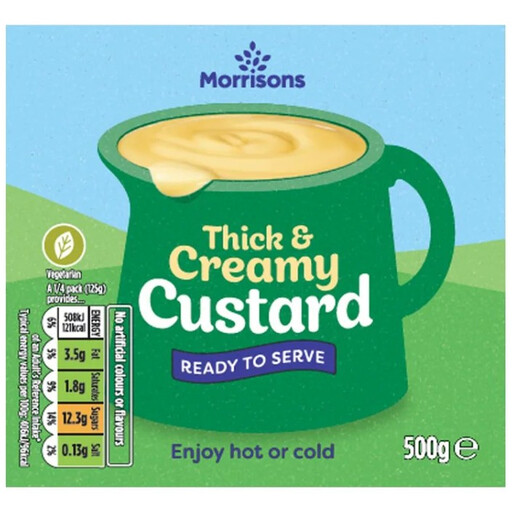 Image unavailable
Morrisons Ready To Serve Custard 500g
This 500g ready-to-serve option avoids preparing custard from powder when the recipe calls for a finished product. It contains milk, and leftovers require refrigeration and use within three days. Check the packaging if you specifically need a tin, and follow the recipe’s method for any baked filling.
View on Joybuy
 Image unavailable
Ambrosia Strawberry Flavour Devon Custard 400g
Consider this strawberry-flavoured, ready-to-eat custard only if its flavour suits the dessert. It contains milk, and leftovers need refrigeration and use within three days. Check the unopened pack’s storage directions before treating it as a cupboard staple, and check the recipe before baking with it.
View on Joybuy
Questions about baking and storage
Can I bake with ready-made custard in a biscuit-based dessert?
Use it as a baked filling only when your particular recipe calls for ready-made custard and gives a suitable method. Tesco bakes ready-made custard in pastry cases, but that recipe does not establish a method for every biscuit dough or base.
What should I do with custard left in an opened tin?
Follow that tin’s label. Ambrosia directs customers to remove the remainder from its standard and light cans, refrigerate it and consume it within three days. Food Standards Scotland also advises checking food labels for storage instructions.
How does Ambrosia Light compare with standard Devon Custard?
Ambrosia lists 7.4g sugars and 2.0g fat per 100g for its light 400g can, compared with 10.6g sugars and 2.9g fat per 100g for its standard 400g can. Both contain milk, so the lighter product is not an option for someone with a milk allergy.
What should I check before keeping custard in the cupboard?
Check the unopened product’s storage directions rather than assuming every ready-to-serve custard is ambient. Read its current ingredients, allergen information and date marking too; a chilled product such as M&S Madagascan Vanilla Luxury Custard requires refrigeration at 0°C to +5°C.


