Convenience-focused sharers
If this is your first food shop, an ambient, ready-to-serve tin lets you keep custard in the cupboard before opening and serve it cold or warmed without making it from scratch.


Choose a ready-to-serve 400g tin if you want custard for a small shared pudding without buying ingredients to make it. A larger pack makes sense only if you can use the opened custard within its stated storage period; powder needs milk, sugar and preparation, while chilled custard needs fridge space and attention to its use-by date. Check the exact pack for portions, ingredients and allergens.
If this is your first food shop, an ambient, ready-to-serve tin lets you keep custard in the cupboard before opening and serve it cold or warmed without making it from scratch.
Check how many servings the pack states and whether you can finish any leftovers after opening. A larger pack is not automatically a better fit for one shared pudding.
Compare the exact recipes and nutrition labels rather than treating standard, lighter, powdered and chilled custard as interchangeable. Check the current pack’s allergen statement.
Start with how you will serve the custard and store it after opening, then compare portions and the exact recipe.
| Concern | What to check | Who this matters to |
|---|---|---|
| Convenience and cupboard storage | Look for ready-to-serve instructions and unopened storage directions; check how to warm the custard if needed. | If I want a shared dessert without buying milk or preparing custard, an ambient tin fits that priority. About 31% of consumers would put immediate convenience first. |
| Portions and leftovers | Compare stated servings with your planned portions and read the opened-pack storage instructions. | When only one pudding is planned, I want a pack I can realistically finish after opening. For about 25% of consumers, portion planning would be the primary concern. |
| Fat and sugar values | Compare sugars and saturated fat per 100g on the exact variants; check the stated serving size too. | If I am choosing between standard and lighter ready-made recipes, I want to compare their labels rather than rely on the product name. About 19% of consumers would make that comparison their first priority. |
| Recipe or preparation control | Decide whether you want a chilled recipe or are willing to make powder with milk, sugar and heat; check storage and allergens. | I might prefer the ingredients of a chilled custard, or want to adjust custard I make from powder, even though either choice changes how I shop and prepare it. Recipe or preparation control would come first for about 25% of consumers. |
The ambient tins checked can be stored in a cool, dry place before opening. The M&S chilled custard instead needs refrigeration at 0°C to +5°C and has a use-by date.
Choose your storage space before buying, and follow the directions on the exact pack.
The Ambrosia 750g pack listed by ASDA states six portions, but its opened contents must be refrigerated and used within three days.
Match the pack to the desserts you expect to serve during its stated opened life.
Unused custard may go to waste if the pack is too large for those occasions.
The checked microwave instructions call for transferring custard to a suitable container; heating and reheating directions vary by product.
Empty it into a microwave-safe bowl or use a saucepan, then follow the pack’s heating and stirring instructions.
The ready-to-serve tins checked contain milk. Bird's powder says it may contain milk, while the checked M&S chilled custard contains milk and egg and carries nut and peanut suitability warnings.
For an allergy, read the current ingredients and allergen statement of the exact product rather than substituting by format alone.
Ambient ready-to-serve custard includes the checked 400g Devon tin, a 750g pack and a 400g Light variant.
Custard powder is an option if you want to make a batch rather than open ready-to-serve custard.
The checked own-label ambient choices include 400g Creamy Custard and Just Essentials custard tins.
The checked 500g Madagascan vanilla custard is a chilled alternative made with milk, cream and egg yolks, not a cupboard-stored tin.
These selections cover ambient ready-to-serve custard for shared desserts, including smaller packs, a larger pack and a 500g tub rather than a tin.
 Image unavailable
A ready-to-serve tin for a small shared pudding, served cold or warmed after transferring it from the can. ASDA Groceries states three portions for this 400g product. Store unopened in a cool, dry place; refrigerate after opening and use within three days. Contains milk.
 Image unavailable
Consider this ready-to-serve pack if you expect several shared servings soon after opening. Its listing describes approximately eight servings and hot or cold serving. Store unopened in a cool, dry place; refrigerate after opening and use within three days. Contains milk.
 Image unavailable
A ready-to-serve 400g option if you want to compare a low-fat variant with standard custard. Check the exact pack’s nutrition values and stated portions for that comparison. It can be served hot or cold; refrigerate after opening and use within three days. Contains milk.
 Image unavailable
This ready-to-serve 400g variant offers strawberry flavour for a shared dessert. It can be served hot or cold and stored in a cool, dry place before opening. Check the pack for portions; refrigerate after opening and use within three days. Contains milk.
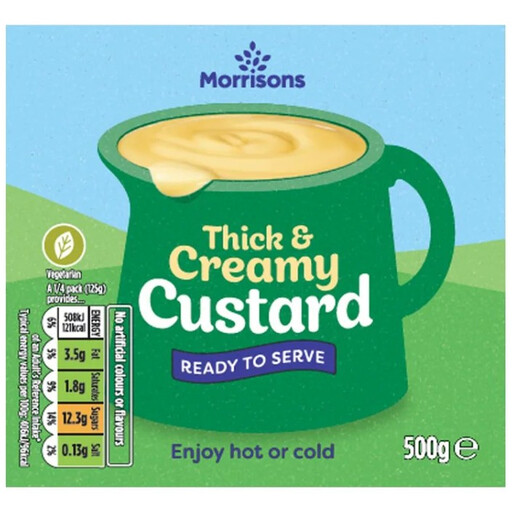 Image unavailable
A 500g tub, rather than a tin, for shoppers who want ready-to-serve custard to share. Its listing describes cold serving or gentle heating and cool, dry storage before opening. Check the pack for portions; refrigerate after opening and use within three days. Contains milk.
The ambient tins checked can be stored unopened in a cool, dry place. Check the exact product: the M&S chilled custard instead needs refrigeration at 0°C to +5°C and has a use-by date.
Follow the exact pack’s storage instructions. The checked Ambrosia and ASDA tins call for refrigeration and use within three days of opening; ASDA’s own-label instructions also say to transfer unused contents to a covered, non-metallic container.
No. Transfer it to a microwave-safe container and follow the pack’s heating, stirring and reheating directions.
Read the current ingredients and allergen statement on the exact pack; the ready-to-serve custards checked contain milk. GOV.UK identifies milk as an allergen that must be declared when present in prepacked food.
Compare the exact variants’ values per 100g and their stated portion sizes, rather than relying on the front label. ASDA Groceries lists 7.4g sugars and 1.0g saturated fat per 100g for the checked Ambrosia Light 400g tin, against 10.6g sugars and 1.5g saturated fat for the checked standard Ambrosia Devon Custard 400g tin. The NHS notes that a manufacturer’s stated portion may differ from the amount you serve.