Choose a ready-to-serve light tin if you want custard for a few diners without making it: Ambrosia’s 400g Light Devon Custard lists 2.0g fat and 7.4g sugars per 100g. A larger light carton suits planned repeat servings, while powder gives you control over the milk, sugar and thickness but needs cooking. For an Italian-night menu, decide whether a British-style custard accompaniment suits the dessert, then compare nutrition per 100g and check milk allergens and opened-pack instructions.
Who each format suits
Lower-fat dessert planners
If fat is a priority, compare the per-100g panel rather than relying on a light or reduced-fat description. The NHS guide for low total fat in food is 3g or less per 100g; sugar, saturates and the amount you serve are separate considerations.
Hosts serving a few diners
A ready-to-serve 400g tin avoids making custard for a small dessert course. Ambrosia states that its Light Devon Custard can serves three; plan for any remainder using the pack’s opened-storage instructions.
Cooks who want recipe control
Bird’s Original Custard Powder lets you choose the milk, vary the sugar and adjust the consistency. It takes preparation and is not a ready-to-serve tin.
What to check before choosing
For this dessert, decide whether a tin, a larger ready-to-serve pack or custard made from powder fits your plans; then compare nutrition and portions on the same basis.
| Concern |
What to check |
Who this matters to |
| Fat and sugar |
Compare fat, saturates and sugars per 100g. NHS food-label guidance uses 3g or less fat and 5g or less sugars per 100g as separate low-level guides. |
If I am choosing custard chiefly for its fat content, I still want to see its sugar figure before settling on a dessert. About 36% of consumers put fat and saturates first. |
| Preparation |
Check whether the custard is ready to serve and follow its directions if heating it. |
When dessert follows several dishes, I may want to serve custard without making it from scratch. For about 29% of consumers, avoiding preparation is the primary need. |
| Pack size |
Check the stated servings and how soon the opened pack must be used; plan for any remainder. |
For a small dinner, I want enough custard without leaving a large opened pack to use up. Matching portions and leftovers comes first for about 21% of consumers. |
| Recipe control |
For powder, check the preparation recipe, chosen milk and sugar quantity, and allergen statement. |
If I am willing to cook, I may prefer to decide how to make the custard rather than accept a fixed ready-to-serve recipe. About 14% of consumers put that control first. |
Common buying mistakes
-
Reading “less fat” as “low sugar”
A comparison with a brand’s standard custard does not tell you whether the product meets the NHS low-sugars guide. Ambrosia lists 7.4g sugars per 100g for its Light Devon Custard can, above that guide’s 5g-per-100g level for food.
Compare the fat and sugars figures separately on the products you are considering.
-
Comparing serving figures alone
Pack serving sizes can differ, so their per-serving nutrition figures may describe different amounts of custard.
Compare products per 100g first, then use the per-serving figures to judge the amount you expect to serve.
-
Opening a large carton for a small dinner
A larger pack can leave more custard than the diners need. The reviewed Ambrosia and Tesco ready-to-serve products instruct users to refrigerate opened custard and consume it within 3 days.
Choose a pack size around your planned servings, or decide how you will use the remainder within the product’s stated period.
Custard left unused beyond its opened-pack instructions may have to be discarded.
-
Assuming “light” means milk-free
The reviewed Ambrosia light ready-to-serve custards contain milk, and Bird’s Original Custard Powder has a may-contain-milk statement. A lower-fat description is not an allergen statement.
If a milk allergy affects the choice, read the current pack’s ingredients and allergen information rather than substituting powder or another light product on the basis of its name.
Relevant brands for reference
Ambrosia
Its Light Devon Custard comes as a 400g ready-to-serve can and a 1kg carton, giving shoppers a choice of pack size.
- Ambrosia lists 2.0g fat and 7.4g sugars per 100g for the light can, which it says serves three.
- Both light formats contain milk. Ambrosia instructs users to refrigerate opened custard and consume it within 3 days.
Tesco
Tesco Light Custard Ready To Serve is a 1kg carton for shoppers whose pack-format preference is flexible.
- Tesco lists 1.5g fat per 100g for this product.
- It is not a tin, contains milk and carries a refrigerate-and-use-within-3-days instruction after opening.
Sainsbury’s
Sainsbury’s Ready To Eat Lighter Custard is a 500g ready-to-serve carton rather than a tin.
- Sainsbury’s lists 1.5g fat per 100g for this lighter custard.
- It contains milk and should be refrigerated and consumed within 3 days after opening.
Bird’s
Bird’s Original Custard Powder is an option when control over preparation matters more than a ready-to-serve format.
- Bird’s instructions allow a choice of milk and an adjustable sugar quantity and consistency.
- The powder requires cooking and may contain milk; its prepared nutrition depends on the recipe used.
Custard options on Joybuy
These selections include 400g custards for a small dessert course and larger ready-to-serve alternatives. Check each product’s format and nutrition panel against your priorities: a standard custard is not necessarily a reduced-fat variant, and a carton or tub is not a tin.
 No image available
Ambrosia Devon Custard 400g
Consider this 400g standard custard for a small dessert course if a light-labelled variant is not essential. Compare its current per-100g fat and sugars panel with the light options before choosing.
View on Joybuy
 No image available
Ambrosia Low Fat Custard 400g
This ready-to-serve 400g can suits a dessert for a few diners; Ambrosia states three portions. Its listed nutrition is 2.0g fat and 7.4g sugars per 100g, so consider sugar separately from fat. It contains milk; transfer any remainder out of the can, refrigerate it and use it within 3 days.
View on Joybuy
 No image available
Ambrosia Strawberry Flavour Devon Custard 400g
Choose the strawberry-flavoured variant only if that flavour fits the planned dessert. Its 400g pack may fit a smaller meal; check the current nutrition panel and portion guidance rather than treating the flavour as a sign of lower fat or sugar.
View on Joybuy
 No image available
Ambrosia Light Devon Custard 1kg
This ready-to-serve carton fits a larger dessert course or planned repeat servings, provided you do not specifically need a tin. Ambrosia states approximately eight portions and lists 2.0g fat and 7.4g sugars per 100g. It contains milk; refrigerate after opening and consume within 3 days.
View on Joybuy
 No image available
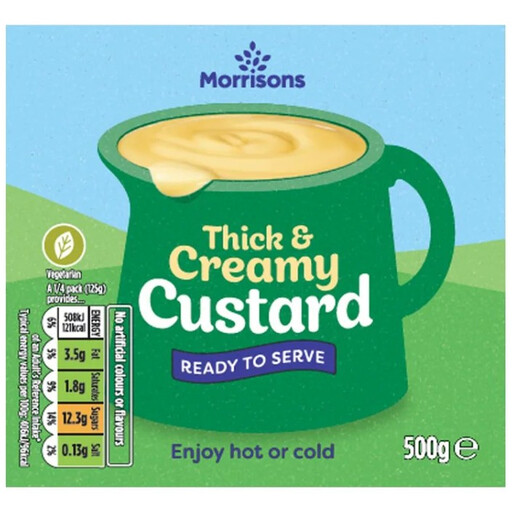
Morrisons Ready To Serve Custard 500g
This 500g ready-to-serve alternative is worth considering if a tin is not essential. Check its current pack format, per-100g nutrition and portion guidance against the number of diners.
View on Joybuy
Questions about custard
Does light custard also have low sugar?
Not necessarily: check sugars per 100g separately. NHS food-label guidance sets its low-sugars guide at 5g or less per 100g, while Ambrosia lists 7.4g per 100g for its Light Devon Custard can.
What does the UK low-fat guide mean for custard?
NHS food-label guidance uses 3g total fat or less per 100g for food. Ambrosia lists 2.0g fat per 100g for its Light Devon Custard can; check the current pack and compare sugars separately.
Can ready-to-serve custard be served warm?
The reviewed Ambrosia ready-to-serve can and light carton can be served hot or cold. For warming, decant the custard into a suitable saucepan or microwaveable container and follow the individual pack instructions; do not heat it in the can.
Is light custard suitable for someone with a milk allergy?
Do not assume it is. The reviewed Ambrosia light ready-to-serve products contain milk, and Bird’s Original Custard Powder may contain milk. Check the current product’s ingredients and allergen statement before serving it.
How should I plan for custard left after dessert?
Follow the instructions for the product you open. The reviewed Ambrosia and Tesco ready-to-serve custards specify refrigeration and use within 3 days after opening; Ambrosia also instructs users to remove any remainder from its can before refrigerating it.


