Desk workers sharing a small pack
A ready-to-eat tin can be served cold or warmed for a quick lunch. Plan how to refrigerate and use anything left after sharing it.


Choose a ready-to-eat 400g tin for a small shared desk lunch if you can refrigerate what remains. A 500g or 1kg carton makes more sense when several portions will be used within its opened-storage period, while a single-serve pot avoids leftovers but is not a family pack. Check the exact pack for portions, milk ingredients and instructions for storing or heating it.
A ready-to-eat tin can be served cold or warmed for a quick lunch. Plan how to refrigerate and use anything left after sharing it.
A larger carton suits people who expect to serve custard more than once. Sainsbury's and Ambrosia each describe cited 1kg cartons as providing eight servings; the opened-pack instructions still matter.
An individual pot avoids keeping an opened family pack at work. Sainsbury's describes the Ambrosia 150g snack pot as not needing chilling before opening.
Start with the portions you will actually use, then check whether cold serving, fridge access or a particular formulation changes your choice.
| Concern | What to check | Who this matters to |
|---|---|---|
| Quick serving | Check that the custard is ready to eat cold. If warming it, follow the pack's decanting instructions. | For a short desk break, I want to serve custard without preparing it from powder or needing a microwave. About 36% of consumers put that immediate convenience first. |
| Shared portions | Compare the stated serving count with the number of people eating; a 400g tin and a 1kg carton need not provide the same number of portions. | When several people will share the pack, I need enough stated servings without opening more than we can use. Shared portions are the main concern for about 29% of consumers. |
| Leftovers | Read the exact opened-storage period and whether custard must be transferred from its container. | If I cannot keep an opened pack refrigerated at work, avoiding leftovers matters more than its size. That is the primary need for about 21% of consumers. |
| Sugar and fat information | Compare labels per 100g and per serving; check which standard product a lighter variant is compared with. | When choosing between standard and lighter custard, I want to compare the sugar and fat figures for the portion I would serve. About 14% of consumers make this their first consideration. |
The cited 1kg family-size products are cartons, while Ambrosia's standard 400g product is a can. A single-serve pot answers a different portion need again.
Check the format and stated servings before choosing a pack for sharing.
Ambrosia directs users to refrigerate its standard 400g can after opening and consume it within three days. Sainsbury's gives three days for its cited 1kg carton, but one day for the Stamford Street Co. 400g tin.
Follow the instructions on the exact product and plan any remaining portions around them.
The cited heating instructions call for custard to be transferred to a suitable dish before microwaving, not heated in its tin or carton.
If you plan to warm lunch at work, arrange a microwave-safe container or choose a product you are happy to serve cold.
Warming it at a desk may mean bringing a bowl or jug as well as finding a microwave.
Its cited ready-to-serve range includes a 400g can, 1kg cartons and a 150g individual pot.
The cited ready-to-eat products include a 400g Stamford Street Co. tin and Sainsbury's 500g and 1kg cartons.
Tesco Groceries lists a Tesco Ready To Serve Custard 400G alongside an Ambrosia 400g tin, making it another tin to examine when choosing a smaller pack.
Bird's Original Custard Powder is a make-from-powder alternative listed by Sainsbury's, rather than a ready-to-eat tin.
These selections cover ready-to-serve tins and cartons for desk lunches or planned sharing. A carton offers a different pack format from the tinned custard in the original question.
 Image unavailable
Consider this carton when several people will share custard and you want to compare its sugar and fat figures with the standard Ambrosia recipe.
Ambrosia describes the 1kg Light carton as eight 125g servings and compares its formulation specifically with Ambrosia Devon Custard. Refrigerate after opening and use within the pack's stated three-day period.
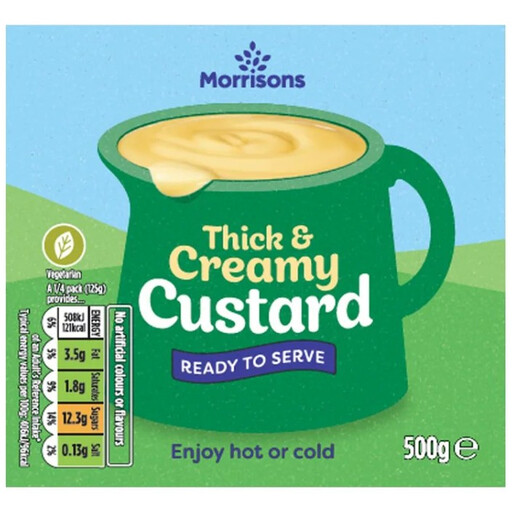 Image unavailable
This mid-sized carton is worth considering if a 1kg pack would leave too much custard after lunch.
It is ready to serve; check the carton's opened-storage and milk-allergen information when planning where to keep the remainder.
 Image unavailable
This ready-to-serve tin suits a small shared lunch when you can refrigerate any custard left over.
Ambrosia lists three 130g portions and says the custard can be served hot or cold. After opening, transfer any remainder from the can, refrigerate it and consume it within three days. The product contains milk.
 Image unavailable
This 400g tin gives shoppers considering a low-fat variant a smaller pack to compare with family-size cartons.
Check its stated servings and nutrition label for the portion you intend to eat. Refrigerate any opened remainder and follow the tin's heating instructions if serving it warm.
 Image unavailable
Choose this 400g tin if strawberry flavour is part of your lunch choice and a smaller shared pack suits your plans.
Check the label for its serving count, milk ingredients and instructions for refrigerating leftovers or warming the custard.
Yes, for products labelled for cold serving. Ambrosia describes its standard 400g can as suitable hot or cold, and Sainsbury's says the same of its cited 1kg ready-to-eat carton; follow any serving directions on your chosen pack.
No. For the cited tinned products, transfer the custard to a suitable microwave-safe dish before heating and follow the product's directions.
Follow the exact pack's instructions. Ambrosia's standard 400g can and Sainsbury's cited 1kg carton specify refrigeration and use within three days, while the Stamford Street Co. 400g tin specifies transfer to a non-metallic container, refrigeration and use within one day.
Check the current ingredients and allergen label of the exact product. The cited Ambrosia 400g can and Sainsbury's 1kg carton both list milk ingredients, so neither should be assumed suitable for someone avoiding milk.