Hosts serving a larger family
If custard needs to cover several desserts at once, start with the stated number of servings rather than pack weight alone. A larger pack may save opening several tins, but plan what you will do with any remainder.


Choose by the number of dessert servings you need, then consider how much custard you can use after opening. Ambrosia labels its 400g Devon Custard tin as three portions, while Iceland Foods describes a Bird's 750g carton as six servings; check the serving statement on whichever pack you buy. A larger ready-to-serve pack means fewer packs to open for a group, but its own storage instructions matter if custard will be left over.
If custard needs to cover several desserts at once, start with the stated number of servings rather than pack weight alone. A larger pack may save opening several tins, but plan what you will do with any remainder.
When you expect to serve only a little custard, a smaller cupboard-stored pack lets you open less at once. Ambrosia states three portions for its 400g Devon Custard tin.
If ingredients or a particular recipe matter to your guests, compare the current packs rather than assuming all ready-to-serve custards are alike. Check the ingredients, emphasised allergens, nutrition information, date mark and storage directions on the product you choose.
Work out the dessert servings first, then choose a pack you can store and use as directed after opening. A tin is not the only ready-to-serve format worth considering for a larger table.
| Concern | What to check | Who this matters to |
|---|---|---|
| Enough for dessert | Check the pack’s stated servings against your guest count, allowing for whether custard is the only accompaniment. Ambrosia states three portions for its 400g tin; Iceland Foods describes the Bird's 750g carton as six servings. | If I am serving custard to everyone at a family roast, I need to know whether one pack covers the table. About 42% of consumers put getting enough servings first. |
| Opened-pack storage | Check whether the pack needs chilling before opening and follow its own instructions for leftovers. Ambrosia says to transfer leftovers from its 400g tin, refrigerate them and use them within three days; M&S gives two days for its Silky Smooth Custard tin. | When I expect some custard to remain, I want to open an amount I can store and use within the labelled period. For about 33% of consumers, managing leftovers is the primary concern. |
| Recipe and allergens | Read the current pack’s ingredients and emphasised allergens. If comparing recipes or nutrition values, use the same per-100g or per-serving basis and check which products the figures describe. | If a guest needs an ingredient checked, or I want a particular custard recipe, pack size alone cannot settle the choice. Recipe and label fit come first for about 25% of consumers. |
Larger ready-to-serve custard can come in other formats. Tesco lists 1kg ready-to-serve products, while Iceland Foods describes a 750g Bird's carton as six servings.
Compare tins and ready-to-serve cartons by their stated servings and storage directions before choosing a format.
Post-opening directions differ even between 400g tins: Ambrosia specifies three days for its Devon Custard, while M&S specifies two days for Silky Smooth Custard.
Read the exact pack before opening it and plan another use for any remainder within its stated period.
An opened pack that cannot be used within its labelled period may leave custard to discard.
Ingredients and allergen information need to match the product actually being served. The Food Standards Agency says allergens present in prepacked food must be emphasised in its ingredients list.
Check the physical pack’s ingredients and allergen statement before serving, particularly when a guest has an allergy.
A chilled recipe may contain different ingredients from an ambient tin. Sainsbury's lists whole milk, whipping cream and egg yolk in its Taste the Difference Vanilla Custard and states 16.1g fat and 9.6g saturates per 125g serving.
Compare the exact products’ ingredient lists and nutrition panels if recipe composition matters; do not apply figures or claims from one variant to another.
Ready-to-serve custard in smaller tins and larger formats, including a 400g Devon Custard tin and 1kg products listed by Tesco.
A ready-to-serve carton format to compare when dessert needs to reach a larger group.
Own-brand ready-to-serve custard appears in different pack sizes in Tesco’s custard category.
A chilled 500g Vanilla Custard for shoppers considering a different recipe rather than a cupboard-stored family tin.
A 400g Silky Smooth Custard tin made with whole milk and cream.
These ready-to-serve custards offer different pack sizes for planning a roast dessert. Check the serving guidance and pack format of the product you choose rather than treating pack weight alone as a portion count.
 Image unavailable
Consider this 1kg pack when you want a larger amount of ready-to-serve custard for dessert. Check its stated servings and whether the pack is a tin or carton if the container format matters to you; use the current pack’s own ingredients and storage directions.
 Image unavailable
This 400g tin is a smaller-pack choice when you expect to serve fewer people or prefer to open custard as needed. Ambrosia states three portions; for leftovers, it instructs you to transfer the custard from the tin, refrigerate it and consume it within three days.
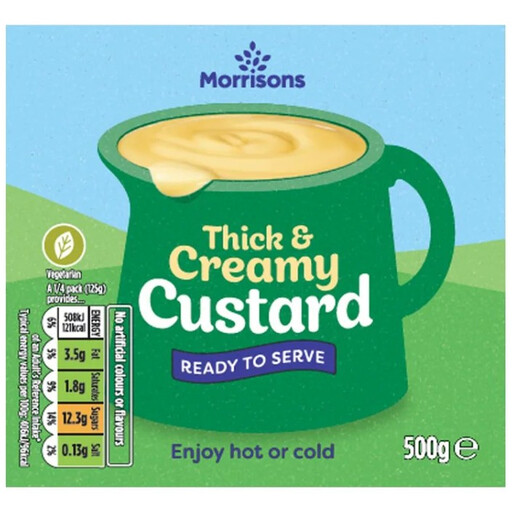 Image unavailable
This 500g ready-to-serve pack offers another size to consider for a roast dessert. Check its serving count against your guest list and confirm the container format if you specifically want a tin.
Start with the serving statement on the exact pack and the number of people eating dessert. Ambrosia states three portions for its 400g Devon Custard tin, while Iceland Foods describes the Bird's 750g carton as six servings; consider whether anyone is likely to want seconds.
No. Ambrosia’s instructions for its 400g Devon Custard tin say to empty the custard into a microwaveable container before heating. Follow the heating instructions on the product you use.
Follow the instructions on your exact tin. Ambrosia says to remove leftovers from its 400g Devon Custard can, refrigerate them and consume them within three days; M&S says to refrigerate its Silky Smooth Custard after opening and eat it within two days.
GOV.UK explains that a use-by date relates to food safety, while a best-before date relates to quality. Read the date mark and storage directions on your particular custard pack rather than assuming every format carries the same instructions.
Check the ingredients and emphasised allergens on the physical pack before serving. The Food Standards Agency says allergens present in prepacked food must be emphasised in the ingredients list; the standard Ambrosia tin and the Bird's carton described here contain milk-derived ingredients.