For a small Italian-night dessert spread, choose the amount of custard by the portions on the pack, not its weight alone: Sainsbury’s labels one 400g can as two servings, while Ambrosia labels its standard 400g can as three portions. An ambient, ready-to-serve pack keeps preparation simple; consider a larger pack if those portions will not cover the desserts, a chilled cream-and-egg custard if its recipe and refrigeration needs suit your plans, or powder if you can prepare the quantity you need.
Who is choosing custard?
Small-table dessert hosts
If you are serving a few people, compare labelled portions before treating a 400g can as a fixed sharing size. Ambrosia and Sainsbury’s give different serving counts for their 400g custards, and their instructions for opened leftovers differ too.
Rich-dessert planners
If custard is a noticeable part of the dessert rather than a small pour-over, a cream-and-egg recipe may fit your plans. M&S sells a chilled 500g version, so fridge space and the pack’s allergen information matter to this choice.
Low-preparation hosts
If dessert is being assembled near serving time, ready-to-serve custard avoids making a batch from powder. Check the serving guidance on the exact pack so convenience does not leave you short at the table.
What matters when choosing?
Choose the format you can store and prepare, then check how much the particular pack is intended to serve.
Ambient ready-to-serve custard
Choose when: You want custard that can be kept in the cupboard before opening and served without making a batch.
Bear in mind: Even at 400g, labelled serving counts and opened-pack storage instructions differ between products.
Chilled luxury custard
Choose when: A cream-and-egg custard suits the dessert and you can keep it refrigerated until serving.
Bear in mind: M&S instructs shoppers to keep its 500g Madagascan Vanilla Luxury Custard at 0°C to +5°C; it is not an ambient tin.
Custard powder
Choose when: You want to prepare the quantity needed rather than open a ready-to-serve pack.
Bear in mind: Powder adds a preparation step, and the current pack’s ingredients and precautionary allergen wording still need checking.
| Concern |
What to check |
Who this matters to |
| Enough to serve |
Compare pack weight with labelled portions, then allow for whether custard is the main dessert element or a pour-over. |
If I am serving several desserts, I want enough custard for each without opening more than I need; about 42% of consumers put portion planning first. |
| Preparation effort |
Check whether the pack is ready to serve or needs preparing, particularly if dessert will be assembled just before serving. |
When I have little time before dessert, I would rather serve custard straight from the pack than prepare powder. Serving convenience comes first for about 33% of consumers. |
| Recipe and allergens |
Read the current pack’s ingredients and allergen wording; for a chilled option, check its storage temperature too. |
If I am choosing a cream-and-egg recipe or serving someone with an allergy, I need to know exactly which pack will be served; roughly 25% of consumers put recipe and allergen fit first. |
Checks before you buy
-
Assuming every 400g can serves the same number
Sainsbury’s labels its 400g Stamford Street Co. custard as two servings; Ambrosia labels its standard 400g Devon Custard as three portions. The weight alone does not tell you how many desserts a pack will cover.
Start with the exact product’s serving guidance and consider how much custard you intend to serve with each dessert.
-
Treating chilled custard like a cupboard product
M&S Madagascan Vanilla Luxury Custard needs refrigeration at 0°C to +5°C. It does not offer the before-opening cupboard storage of an ambient can.
Check fridge space and the pack’s date before choosing the chilled product; use an ambient option if cupboard storage is important to your plans.
-
Relying on an older ingredient listing for guests
Recipes and precautionary allergen statements can differ by product and may change. A different flavour or pack size is not a substitute for checking the one you will serve.
For a guest with an allergy or intolerance, read the current physical pack’s ingredients and precautionary wording before serving.
-
Assuming opened custard keeps for the same length of time
The stated instructions differ: Sainsbury’s gives one day after transferring its custard to a non-metallic container and refrigerating it; M&S gives two days for Silky Smooth Custard; Ambrosia gives three days after removing the remainder from its standard can and refrigerating it.
Follow the storage and use instructions on your particular pack rather than applying another product’s timeframe.
Brands to consider
Ambrosia
Ambrosia lists several ready-to-serve custard variants. Its standard Devon Custard 400g can provides a useful reference when planning portions.
- Ambrosia states that the standard 400g can contains three portions and can be enjoyed hot or cold.
- The standard recipe contains milk. Ambrosia instructs users to remove leftovers from the can, refrigerate them and consume them within three days.
Tesco
Tesco lists its own 400g ready-to-serve custard alongside branded tinned options.
- The own-label 400g format gives shoppers another ready-to-serve pack to compare for a small dessert spread.
- Check the exact pack’s serving guidance and ingredients rather than assuming they match a branded 400g can.
Sainsbury’s
Stamford Street Co. 400g Custard is an ambient, ready-to-eat own-label option.
- Sainsbury’s labels it as serving two and provides hob and microwave heating instructions.
- Its listed ingredients include milk and whey. After opening, Sainsbury’s instructs users to transfer it to a non-metallic container, refrigerate it and use it within one day.
M&S
M&S has an ambient 400g Silky Smooth Custard and a separate chilled 500g Madagascan Vanilla Luxury Custard. Their storage requirements make them different choices for a dessert spread.
- The ambient product can be stored cool and dry before opening; the chilled recipe contains cream and egg yolk.
- M&S says to refrigerate the ambient product after opening and eat it within two days. Its chilled luxury custard must be kept at 0°C to +5°C and is stated to be unsuitable for people with a nut or peanut allergy.
Bird’s
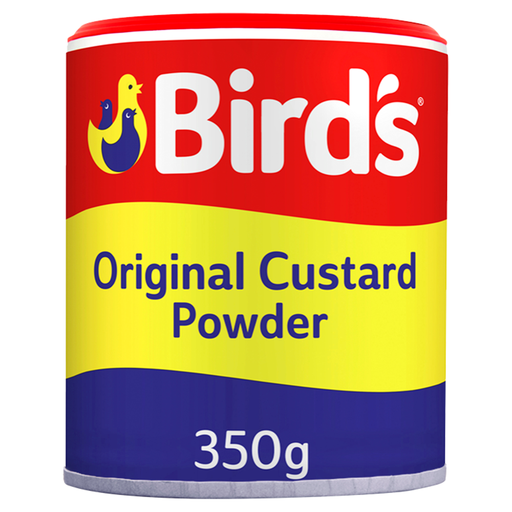
Bird’s Original Custard Powder is a make-your-own alternative, not a ready-to-serve tin.
- Bird’s describes its 350g pack as making 40 portions, with the amount prepared chosen for the occasion.
- It needs preparation. Tesco’s listing for the powder says it may contain milk, so check the current pack when serving a guest with a milk allergy.
Joybuy products for this dessert
These selections include Ambrosia ready-to-serve custard in 400g and 1kg packs, plus Bird’s powder for preparing custard. Choose by the portions you need, the flavour you want and whether you have time to prepare it.
 No image available
Ambrosia Light Devon Custard 1kg
Consider the 1kg pack if your planned portions exceed those of a smaller pack. Check its serving guidance and confirm the packaging format before buying if you specifically need a tin; read the current pack’s milk allergen information before serving.
View on Joybuy
 No image available
Ambrosia Low Fat Custard 400g
This 400g Low Fat variant is an option to compare if you want an Ambrosia custard for a small dessert spread. Check its own labelled portions rather than applying the serving count of the standard Devon can, and read the current pack’s allergen information.
View on Joybuy
 No image available
Ambrosia Strawberry Flavour Devon Custard 400g
Choose this 400g variant if strawberry flavour suits the dessert you are serving. Use its own serving guidance to plan the quantity, and check the current pack’s ingredients and allergen wording for your guests.
View on Joybuy
 No image available
Bird’s Custard Powder 350g
Choose powder if you can prepare the amount required before dessert rather than serve custard straight from a pack. Bird’s describes this 350g pack as making 40 portions; follow the current pack’s preparation directions and check its precautionary milk allergen wording.
View on Joybuy
 No image available
Ambrosia Devon Custard 400g
For a small dessert spread, Ambrosia labels this standard 400g custard as containing three portions and says it can be enjoyed hot or cold. Compare that portion guide with your desserts; the recipe contains milk, and Ambrosia instructs users to remove leftovers from the can, refrigerate them and consume them within three days.
View on Joybuy
Questions about serving custard
Will one 400g can be enough to share?
Check the particular can and how much custard you want with each dessert. Sainsbury’s labels its 400g custard as two servings, while Ambrosia labels its standard 400g can as three portions, so the weight alone is not a reliable guest count.
Can I serve ready-to-serve custard warm?
Yes, when the particular pack gives heating directions. Ambrosia says its standard 400g Devon Custard can be enjoyed hot or cold; Sainsbury’s also gives hob and microwave instructions for its own-label can. Follow the directions on the product you buy, including any reheating restrictions.
What should I do with custard left after opening?
Follow the instructions on that pack and refrigerate leftovers as directed. Ambrosia says to remove the remainder from its standard can and consume it within three days; Sainsbury’s specifies a non-metallic container and one day for its custard; M&S says to refrigerate Silky Smooth Custard and eat it within two days.
How do I check whether custard is suitable for a guest with an allergy?
Read the ingredients and precautionary allergen wording on the exact physical pack before serving. The standard Ambrosia custard contains milk, M&S Madagascan Vanilla Luxury Custard contains milk and egg and is stated to be unsuitable for people with a nut or peanut allergy, and Tesco’s listing says Bird’s Original Custard Powder may contain milk.


