Last-minute dessert hosts
A ready-to-serve can avoids making a sauce after dinner. Ambrosia says its 400g Devon Custard can be served hot or cold.


For an Italian-night dessert that needs little preparation, choose a ready-to-serve custard; a standard tin offers a straightforward hot-or-cold option, while a lighter or cream-enriched recipe depends on what you want to serve. Custard powder gives you control over consistency but needs milk, sugar and heating. Check the exact pack’s allergens, size and storage instructions before buying.
A ready-to-serve can avoids making a sauce after dinner. Ambrosia says its 400g Devon Custard can be served hot or cold.
A ready-made lighter recipe keeps preparation simple. Ambrosia says its Light Devon Custard can has 30% less sugar and 30% less fat than its standard Devon Custard; check the label of the exact variant you choose.
Bird’s custard powder suits cooks who want to prepare the sauce and adjust its consistency. It requires milk, sugar and heating, unlike a ready-to-serve tin.
For an Italian-night dessert, decide whether immediate serving, the recipe, a richer finish or control during preparation matters most.
| Concern | What to check | Who this matters to |
|---|---|---|
| Immediate serving | Look for “ready to serve”, hot-or-cold directions and a pack size that suits the table. | After preparing dinner, I want to serve dessert without making another sauce. About 36% of consumers put minimal preparation first. |
| Recipe preference | Read the exact basis of any reduced claim, the nutrition panel and the milk allergen statement. | I want ready-made custard, but the recipe matters more to me than a richer finish. About 29% of consumers make that their primary concern. |
| Richer finish | Check whether the recipe contains cream and compare nutrition using the same serving basis. | If custard is a prominent part of my dessert, I may prefer a cream-enriched recipe. For about 21% of consumers, that finish comes first. |
| Preparation control | For powder, check the required milk, sugar and heating method before starting. | I would rather make the custard myself so I can adjust its consistency, even if it takes longer. About 14% of consumers prioritise that control. |
Bird’s powder needs milk, sugar and heating, so it will not do the same last-minute job as an opened tin.
Choose a product marked ready to serve if you need custard immediately; choose powder when you can prepare it.
Powder also calls for extra ingredients and preparation time.
Open-life directions differ: Ambrosia Devon Custard specifies three days after opening, while M&S Silky Smooth Custard specifies two days.
Follow the instructions on your pack, refrigerate leftovers as directed and choose a size you can use.
Ambrosia’s comparison for its Light can is against its standard Devon Custard. It does not replace the nutrition panel or milk allergen statement.
Check the claim’s comparator, ingredients and allergen declaration on the exact pack.
GOV.UK distinguishes best-before dates, which concern quality, from use-by dates, which concern safety. The date does not replace a product’s storage directions.
Read the date wording and storage instructions, and check the condition of the can and its contents before serving.
Its ready-to-serve range includes standard Devon Custard and alternative recipes listed by Tesco.
Tesco lists its own Ready To Serve Custard 400g alongside branded tins.
Sainsbury’s lists own-brand custard in several ambient pack sizes.
M&S Silky Smooth Custard is a 400g food-cupboard option made with milk and cream.
Bird’s Original Custard Powder 350g is a make-from-scratch alternative, not ready-to-serve tinned custard.
These options cover ready-to-serve custard for a quick dessert, including standard and flavoured choices. If a tin is essential, check the packaging of the larger or other ready-to-serve packs before ordering.
 Image unavailable
For a dessert needing ready-made custard, Ambrosia says this 400g option can be served hot or cold. It contains milk; follow the pack’s directions for refrigerating leftovers and using them within three days.
 Image unavailable
A 400g ready-made option when a lower-fat recipe is the priority. Check this exact pack’s nutrition panel if sugar content also matters, and read its milk allergen and storage directions.
 Image unavailable
Consider this larger ready-made pack when serving several diners and a light recipe is your preference. It is a carton rather than a tin; check that the format, milk allergen statement and storage directions suit your plans.
 Image unavailable
A 400g flavoured custard to consider if strawberry suits the dessert you have planned, rather than when you need a plain sauce. Check the milk allergen statement and serving directions on the pack.
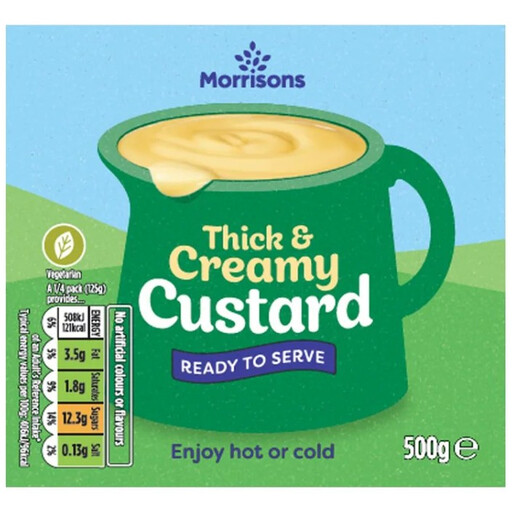 Image unavailable
A 500g ready-to-serve choice for a dessert sauce. Confirm the packaging before ordering if you specifically need a tin, and check the pack’s milk allergen and storage instructions.
Ambrosia says its Devon Custard 400g can be served hot or cold. If warming it, follow that product’s heating directions rather than heating it in the can.
Follow the exact pack: Ambrosia Devon Custard directs you to remove leftovers from the can, refrigerate them and use them within three days; M&S Silky Smooth Custard specifies two days after opening.
GOV.UK says best-before dates concern quality, whereas use-by dates concern safety. Follow the tin’s storage directions and check its condition; do not treat the general date distinction as a substitute for product instructions.
Do not assume they can. Ambrosia Devon Custard and M&S Silky Smooth Custard list milk ingredients, while Bird’s powder may contain milk and its stated preparation uses milk. Check the current label of the exact product before serving it.
Not when you need to serve custard immediately: Bird’s Original Custard Powder requires milk, sugar and heating. Choose it when you have time to prepare the sauce and want to adjust its consistency.