Cupboard-first shoppers
If custard is an occasional sweet finish to a breakfast gathering, an ambient ready-to-serve pack can wait unopened in the cupboard. Check the pack’s storage instructions before treating it as a cupboard item.


Treat custard as an optional sweet course after the savoury breakfast, rather than an ingredient in the breakfast itself. Choose an ambient ready-to-serve tin if cupboard storage and serving without preparation matter most; choose powder if you are willing to add the recipe ingredients and heat it. A larger ambient carton can suit a plan for several servings, while a light-labelled tin still calls for a check of its per-100g nutrition and milk declaration.
If custard is an occasional sweet finish to a breakfast gathering, an ambient ready-to-serve pack can wait unopened in the cupboard. Check the pack’s storage instructions before treating it as a cupboard item.
If you are choosing between standard and light-labelled custard, compare sugars and fat per 100g on the current packs. Ambrosia’s stated comparison for its light can is against Ambrosia Devon Custard, not every custard on the shelf.
For a sweet course shared by several people, compare pack size and stated servings with what you expect to use. Opened-product storage matters too: Ambrosia instructs shoppers to refrigerate leftovers from its verified cans and use them within three days.
| Concern | What to check | Who this matters to |
|---|---|---|
| Cupboard convenience | Confirm unopened ambient storage and whether the custard is ready to serve. | If I am serving a sweet course after breakfast, I want custard ready without mixing powder; about 38% of consumers put cupboard-ready convenience first. |
| Nutrition label | Compare sugars and fat per 100g, and read the named comparator behind a light claim. | For a light-labelled tin, I want to judge the per-100g figures rather than the word “light”; about 25% of consumers put label comparison first. |
| Pack size and leftovers | Check the pack weight, stated servings and instructions for storing it after opening. | When several people will share a pudding, I need enough custard without leaving more than I can use after opening; for about 25% of consumers, pack size and leftovers are the primary concern. |
| Made-to-order preparation | Read the powder’s recipe for required ingredients and heating steps. | If I prefer to make custard when it is needed, I can allow for ingredients and heating; about 12% of consumers put made-to-order preparation first. |
Ambrosia’s verified cans have cool, dry storage instructions before opening. The Sainsbury’s and M&S chilled examples require refrigeration, so they do not serve the same unopened storecupboard plan.
Read the storage directions on the exact pack before adding it to a cupboard shopping list.
Ambrosia compares its light can with its standard Devon Custard for fat and sugar, but both verified cans contain milk. The relative claim does not settle an allergen or dietary decision.
Check the current allergen declaration and compare the per-100g nutrition panels for the products you are considering.
A product listing alone does not establish that the pack is available for your shop. Pack sizes also differ, which affects how much custard you will have to use after opening.
Confirm current availability and choose a size that fits the number of servings you plan to make.
Ambrosia directs shoppers to remove leftovers from its verified cans, refrigerate them and consume them within three days. Bird’s says made-up custard should be refrigerated and treated as fresh food.
Follow the instructions for your pack and plan when you will use any leftovers.
Unused leftovers may be wasted if they cannot be eaten within the stated storage period.
Ambrosia offers standard and light 400g ready-to-serve custard cans for ambient storage before opening.
Bird’s Original Custard Powder is a cupboard-stored option for making custard, not a ready-to-serve tin.
Tesco’s tinned-custard category listed a Tesco Ready To Serve Custard 400g alongside branded products.
Asda’s 30% Less Fat Custard 500g is an ambient, ready-to-serve carton.
Sainsbury’s Taste the Difference Vanilla Custard 500g is a chilled alternative made with cream and egg yolk.
M&S Madagascan Vanilla Luxury Custard is a chilled product made with Channel Island milk, cream and egg yolks.
These ready-to-serve ambient custards suit a sweet course after the savoury breakfast. The selection includes tins and larger non-tin packs; check the format and pack size if a tin is essential.
 No image available
For a ready-to-serve sweet course when you also want to compare a lower-fat variant’s label with standard custard.
The 400g custard is stored cool and dry before opening and can be served hot or cold. It contains milk; after opening, transfer leftovers from the can, refrigerate them and consume within three days.
 No image available
For shoppers who want a standard ready-to-serve tin to keep in the cupboard until a later sweet course.
This 400g custard can be served hot or cold; Ambrosia identifies a 130g portion. It contains milk. Once opened, remove leftovers from the can, refrigerate them and use them within three days.
 No image available
For a strawberry-flavour variation on a ready-to-serve custard tin for the sweet course.
The 400g pack has cool, dry storage instructions before opening and can be served hot or cold. It contains milk; refrigerate leftovers after opening and consume them within three days.
 No image available
For a plan involving several servings when an ambient carton, rather than a tin, works for the cupboard shop.
The 1kg carton is described as providing approximately eight servings and can be served hot or cold. It contains milk; refrigerate after opening and consume within three days. Compare its current per-100g label if the light claim matters to your choice.
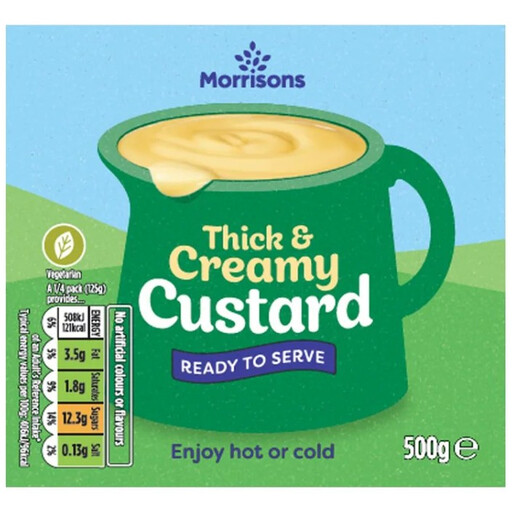 No image available
For a ready-to-serve cupboard option when a 500g tub suits the planned sweet course better than a tin.
The custard is stored cool and dry before opening and can be served chilled or gently heated. It contains milk; refrigerate after opening and consume within three days.
Plan custard as an optional sweet course after the savoury breakfast, rather than as an ingredient in it. Ambrosia and Bird’s present the custards discussed here as products for desserts, puddings or snacks.
Ambrosia instructs shoppers to store its verified 400g cans unopened in a cool, dry place. Check the instructions on the exact pack, particularly if you are considering a chilled product or a different format.
For the verified Ambrosia cans, remove the remaining custard from the can, refrigerate it and consume it within three days. Follow the individual pack rather than applying that period to every brand or format.
Ambrosia’s directions call for emptying the custard into a saucepan or microwaveable container before heating, then heating it gently without boiling. Follow the heating directions for the particular product you choose.
Do not assume it is: the verified Ambrosia cans and Asda reduced-fat custard contain milk. Check the current allergen declaration for the exact product and variant before serving it.