Last-minute afternoon-tea hosts
If several desserts need serving at once, a ready-to-serve custard avoids making a separate batch. Ambrosia, Tesco and Sainsbury’s describe the ready-made products covered here as suitable for hot or cold serving.


Choose ready-to-serve custard if you want to put dessert on the table without making a batch; the Ambrosia, Tesco and Sainsbury’s products described here can be served cold or warmed. Match the pack to the number of portions you expect, or choose Bird’s powder if adjusting the quantity and consistency matters more than avoiding preparation. Check the particular pack’s milk-allergen and opened-storage instructions before serving guests.
The useful distinction for an afternoon tea is whether custard needs to be ready when the desserts are, or whether there is time to make it.
If several desserts need serving at once, a ready-to-serve custard avoids making a separate batch. Ambrosia, Tesco and Sainsbury’s describe the ready-made products covered here as suitable for hot or cold serving.
Pack size matters when several guests will have custard. Sainsbury’s states that its 1kg ready-to-eat pack contains eight 125g servings; compare that serving reference with the desserts planned and the likelihood of leftovers.
Ambrosia offers a Light ready-to-serve can for those comparing it with the brand’s standard Devon Custard. Bird’s powder offers control over milk quantity, sugar and consistency, but needs preparation before guests eat.
Decide how much preparation you can do, then check the serving reference and storage instructions for the pack you intend to open.
| Concern | What to check | Who this matters to |
|---|---|---|
| Serving without preparation | Look for ready-to-serve or ready-to-eat wording; check the pack’s hot and cold serving directions. | When cakes and fruit are already being plated, I want custard I can serve without mixing a batch. About 36% of consumers put minimal preparation first. |
| Portions and leftovers | Compare the stated serving size with your desserts, then read the opened-pack storage instructions. | For a table with several custard eaters, I need enough to go round without opening far more than we will use. Matching pack quantity to portions comes first for about 29% of consumers. |
| Light ready-made option | Compare nutrition information on the specific packs and note which product a reduction claim uses as its reference. | If I still want a ready-made can, I may look for an option with less sugar and fat than the standard version I am considering. About 21% of consumers make that comparison their primary concern. |
| Control over the batch | For powder, check the required ingredients, preparation method and allergen statement. | I would rather make the amount needed and vary its sweetness or thickness, even if that takes time. That flexibility is the first priority for about 14% of consumers. |
Bird’s custard powder needs milk, sugar, stirring and heating. It cannot be opened and poured like a ready-to-serve custard.
Choose an explicitly ready-to-serve product if there is no time to make custard before dessert; choose powder when you want to adjust the recipe.
Sainsbury’s describes its 1kg custard as eight 125g servings and instructs customers to refrigerate it after opening and consume it within three days.
Count the likely dessert portions before choosing the pack, and consider when any remainder will be used.
Ambrosia’s stated sugar-and-fat reduction for its 400g Light can is relative to its standard Devon Custard. The Light product still contains milk ingredients.
Compare the exact nutrition panels if that difference matters to you, and check the allergen declaration on the pack being served.
The heating directions for the ready-to-serve products covered here call for transfer to suitable cookware or a microwave-safe container, with stirring and care not to boil the custard.
Follow the method and heating times on your particular pack rather than putting a metal can in the microwave.
These examples illustrate format and serving differences, rather than a ranking of whole brands. Check the current pack when ingredients, allergens or storage instructions affect your choice.
Ready-to-serve Devon Custard in standard and Light 400g cans.
Custard powder for making a batch rather than opening ready-to-serve custard.
Own-label ready-to-serve custard in the 400g and 500g products covered here.
A 1kg ready-to-eat custard format for planning a larger dessert table.
A 400g Silky Smooth Custard made with whole milk, as described by Marks & Spencer.
These Joybuy selections cover ready-to-serve custards for an afternoon tea, from standard and flavoured 400g products to a 500g pack and a 1kg Light option. Choose by the format and quantity your desserts call for; a lighter-sounding name does not replace checking the specific nutrition panel.
 No image available
A 1kg ready-to-serve option to consider when several guests will have custard. Check the serving guidance and nutrition panel for this particular pack; it contains milk, and opened leftovers need refrigeration.
 No image available
A standard ready-to-serve can for a smaller dessert table. Ambrosia states that this 400g product contains three portions and can be served hot or cold. It contains milk; refrigerate the remainder after opening and follow the pack’s three-day instruction.
 No image available
A 400g ready-made can for hosts comparing fat information on specific custards. Read this variant’s nutrition panel and serving guidance rather than applying figures from another Ambrosia Light product. It contains milk; follow its instructions for opened leftovers.
 No image available
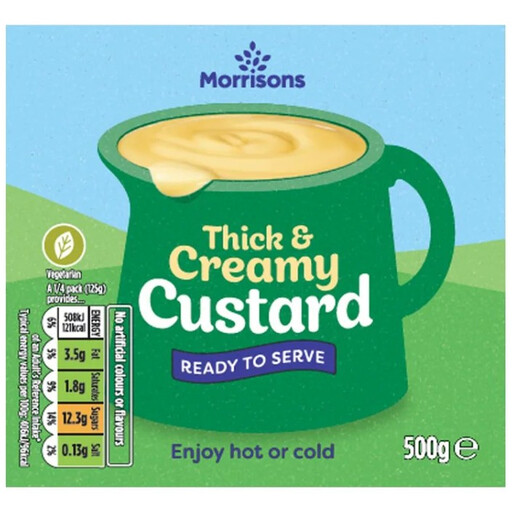
A ready-to-serve 500g pack for dessert service without making custard from powder. Use its label to judge portions for your table. It contains milk, and any remainder needs refrigeration after opening.
 No image available
A 400g ready-made custard to consider if strawberry flavour suits the desserts being served. Check the pack’s serving guidance when planning quantities. It contains milk; refrigerate leftovers after opening as directed.
Yes, for the ready-to-serve Ambrosia, Tesco and Sainsbury’s products described here: their product directions allow hot or cold serving. If you warm custard, transfer it to suitable cookware and follow that pack’s heating instructions.
Start with the serving reference for the exact product, then consider how much each dessert will need. Ambrosia states three portions for its standard 400g can, while Sainsbury’s states eight 125g servings for its 1kg ready-to-eat custard; neither figure dictates how much guests must take.
Do not assume any of these products is suitable. The Ambrosia, Tesco, Sainsbury’s and M&S ready-to-serve examples contain milk ingredients, while Bird’s powder says it may contain milk and its standard preparation uses milk. Check the physical pack’s ingredients and allergen information for the product you will serve.
Follow the instruction on the particular pack and refrigerate opened custard as directed. Ambrosia’s standard and Light cans, Tesco’s standard custard and Sainsbury’s 1kg custard state three days after opening; M&S Silky Smooth Custard states two days.
Choose Bird’s powder if you have time to make custard and want to vary the milk quantity, sugar or consistency for your desserts. Its preparation requires additional ingredients and heating, so a ready-to-serve product is the simpler choice when dessert needs to be plated straight away.