Hosts serving pudding promptly
A ready-to-serve tin suits a dessert that needs little preparation once the meal is over. Ambrosia says its Devon Custard can be served hot or cold without making custard from milk and sugar.


For a pudding after pie and mash, choose a ready-to-serve tin if you want custard without measuring milk or sugar; it can be served cold or heated according to the pack. A light or cream-containing tin offers a different recipe to compare, while custard powder gives you control over preparation but needs extra ingredients and time.
A ready-to-serve tin suits a dessert that needs little preparation once the meal is over. Ambrosia says its Devon Custard can be served hot or cold without making custard from milk and sugar.
If the recipe matters more than the format, compare sugars, fat and saturates per 100g. Ambrosia lists less sugar and fat for its Light Devon Custard than for its standard Devon Custard; check the current pack for the variant you choose.
Bird's Original Custard Powder suits someone willing to mix and heat custard, adjusting the milk quantity or sugar rather than opening a ready-made tin.
Decide whether immediate serving, the recipe on the label or control over preparation matters most for your pudding.
| Concern | What to check | Who this matters to |
|---|---|---|
| Quick serving | Look for a ready-to-serve label and follow the pack's heating instructions. | When pudding follows straight after the meal, I want to open a tin rather than make custard from scratch. About 46% of consumers put quick serving first. |
| Recipe comparison | Compare sugars, fat and saturates per 100g on the particular packs you are considering. | If I am choosing between light, standard and cream-containing custard, I want the recipe to guide my choice. For about 27% of consumers, the nutrition label is the primary concern. |
| Preparation control | Read the powder instructions and make sure you have the required milk and sugar. | I would rather adjust how I make custard for the pudding than rely on a ready-made recipe. Preparation control comes first for about 27% of consumers. |
Bird's Original Custard Powder needs milk, sugar, mixing and heating. That makes it a different choice from a ready-to-serve tin when pudding needs to be served promptly.
Choose a pack labelled ready to serve for minimal preparation; choose powder when you are happy to make the custard.
Keep the milk and sugar required by the powder instructions available as well.
Serving sizes can differ between packs. For the cited Ambrosia recipes, the standard can lists 10.6g sugars and 2.9g fat per 100g, while Light Devon Custard lists 7.4g sugars and 2.0g fat per 100g.
Use the same per-100g basis when comparing recipes, then check how much custard you intend to serve.
The cited Ambrosia canned custards contain milk, while Bird's Original Custard Powder states that it may contain milk. A powder is not automatically a milk-free alternative.
For someone with an allergy or intolerance, read the ingredients and allergen statement on the current pack before serving.
M&S lists its Madagascan Vanilla Luxury Custard as a chilled product requiring storage at 0°C to +5°C. It does not serve the same ambient-storage purpose as a cupboard tin.
If you need custard to keep in the cupboard until pie night, check the unopened pack's storage directions before buying.
Ambrosia offers standard Devon Custard, Light Devon Custard and Deluxe Custard in 400g cans, giving shoppers distinct ready-to-serve recipes to compare.
Bird's Original Custard Powder is a dry-store alternative for making custard rather than opening a ready-to-serve tin.
Tesco Groceries lists a 400g Ready To Serve Custard alongside branded tins in its tinned-custard category.
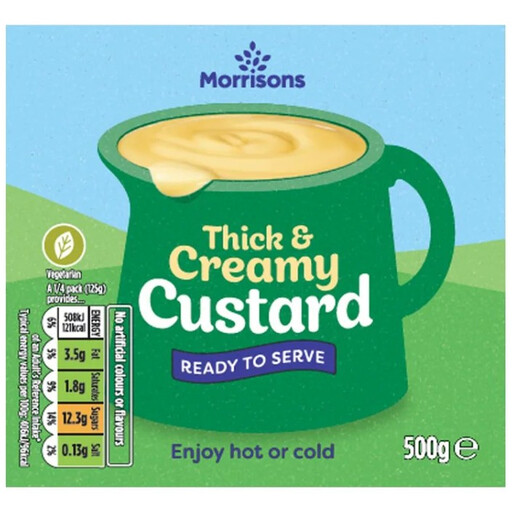
These options include ready-to-serve custards for a quick pudding and a powder for making custard yourself. The Morrisons product is a tub, not a tin, so check the format if a tin is essential to your cupboard plan.
 No image available
A ready-to-serve tin for pudding without making custard from powder. It can be served hot or cold; the 400g can is presented as three portions. It contains milk, and opened leftovers should be refrigerated and used within three days.
 No image available
A ready-to-serve option for shoppers comparing the fat listed on custard labels. This 400g product lists 2.0g fat per 100g and can be served hot or cold. It contains milk; refrigerate leftovers after opening and use them within three days.
 No image available
A ready-to-serve custard for pie or pudding if a tub rather than a tin suits your cupboard. The listing gives cool, dry storage directions for the unopened 500g product. It contains milk; refrigerate leftovers after opening and use them within three days.
 No image available
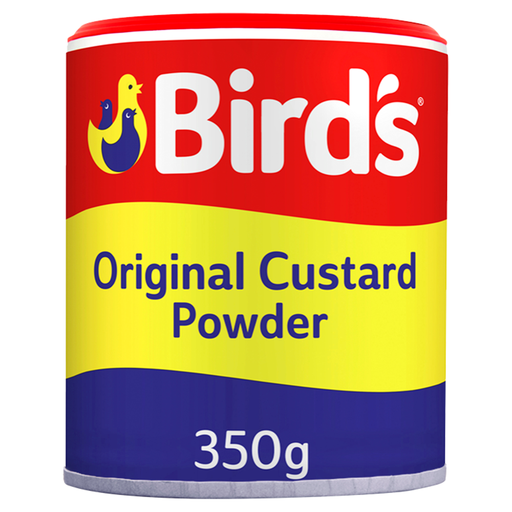
A dry-store powder for cooks who want to make custard and adjust its consistency or sweetness. Bird's lists 40 portions for the 350g pack; preparation needs milk, sugar, mixing and heating. The powder may contain milk, and made-up custard should be refrigerated and treated as fresh food.
Keep a ready-to-serve tin if you want custard without making it from scratch. Choose powder if you have milk and sugar available and are willing to mix and heat it; Bird's instructions specify 568ml milk, 35g powder and 35g sugar for four servings.
Follow Ambrosia's directions to empty the custard into a saucepan for hob heating or a microwaveable container for microwave heating. For hob heating, the instructions say to heat gently and not boil it.
For the cited Ambrosia standard and light cans, refrigerate remaining custard after opening and use it within three days. Bird's says to keep its dry powder in a cool, dry place, then refrigerate made-up custard and treat it as fresh food.
Not necessarily: Bird's Original Custard Powder states that it may contain milk, while the cited Ambrosia canned custards contain milk. Check the current pack's ingredients and allergen statement before serving anyone with an allergy.
Not if you need ambient storage. M&S specifies refrigeration at 0°C to +5°C for its Madagascan Vanilla Luxury Custard, so check the storage directions before choosing it in place of a cupboard tin.