What should you check before choosing?
Decide whether the cola is meant to contribute carbohydrate, then check caffeine, your fluid plan and whether the fizz suits you during exercise.
| Priority | What to check | Your needs |
|---|
| Carbohydrate |
Read carbohydrate per can, not just ‘regular’ or ‘zero sugar’. Coca-Cola Original Taste is listed at 35 g per 330 ml can by Joybuy; Pepsi UK lists 15 g for Pepsi Classic, and Tesco lists 14.8 g for Tesco Classic Cola. British Cycling suggests 30–60 g per hour for indoor rides over 90 minutes. |
For a longer session, I want to know how much of my planned carbohydrate comes from the can and what else I need to take. |
| Fluid and electrolytes |
Plan the drink’s carbohydrate contribution separately from fluid and electrolytes. British Cycling advises adding electrolytes to fluid for indoor cycling; a cola label alone does not establish that it meets that need. |
I need a fluid plan for the conditions, rather than expecting one cola to do every job. |
| Caffeine |
Check the exact variant for caffeine and its stated amount. Pepsi Max No Caffeine and Coca-Cola Zero Sugar Zero Caffeine are distinct from caffeinated zero-sugar colas. |
If I am counting caffeine from other drinks or gels, I want to avoid adding it unintentionally with my cola. |
| Fizz during exercise |
Try the chosen drink and serving size in training at a relevant riding intensity. A study published in the International Journal of Sport Nutrition and Exercise Metabolism found no effect of carbonation on gastric emptying under its test conditions; that result does not establish how every rider will feel drinking cola. |
Before an event, I want to know whether the amount and fizz are comfortable for me while riding. |
| Current can label |
Check serving size, carbohydrate, sugars and ingredients on the purchased pack. Pepsi UK lists 15 g carbohydrate per 330 ml for Pepsi Classic, while a Joybuy Pepsi Regular listing states 34 g per can; do not use those figures interchangeably. |
When a ride plan depends on a particular carbohydrate amount, I need the figure for the cans I will actually carry. |
Relevant cola brand references
These labelled variants illustrate different carbohydrate and caffeine choices; a brand name alone does not identify the formulation in a particular can.
Coca-Cola
Joybuy lists 35 g carbohydrate per 330 ml for Coca-Cola Original Taste, while Sainsbury’s lists 0 g sugars per 330 ml for Coca-Cola Zero Sugar Zero Caffeine.
- The Original Taste can has a stated carbohydrate amount that can be counted in a longer-ride plan.
- The zero-sugar, caffeine-free variant serves a different purpose: its stated sugar content does not make it carbohydrate fuel. Check the pack of the variant you buy.
Pepsi
Pepsi UK lists 15 g carbohydrate per 330 ml for Pepsi Classic, 0 g for Pepsi Max and 0.2 g for Pepsi Max No Caffeine.
- The named variants allow a choice between a stated carbohydrate contribution and zero-sugar or caffeine-free cola.
- A Joybuy Pepsi Regular listing states 34 g carbohydrate per can rather than the 15 g on Pepsi UK’s Classic page. Use the purchased can’s label for fuelling calculations.
Tesco
Tesco lists 14.8 g carbohydrate and 14.5 g sugars per 330 ml can of Tesco Classic Cola.
- The stated per-can amounts let you calculate its contribution without treating it as equivalent to every other regular cola.
- Tesco describes this variant as containing sugar and sweeteners. Check the current can for its ingredients and nutrition values.
Joybuy cola options
These options cover a regular cola that can contribute carbohydrate, two named alternatives for drinking cola without relying on it as fuel, and another regular cola whose pack label is worth checking before a fuelling calculation.
 No image available
Coca-Cola Original Taste 24 × 330 ml
For a longer ride where you intend to count cola towards carbohydrate intake, Joybuy lists 35 g carbohydrate per 330 ml can for this variant. Try the drink during training, and plan fluid and electrolytes separately where needed.
View on Joybuy
 No image available
Diet Coke No Caffeine 24 × 330 ml
This named caffeine-free variant is a choice when you want cola without adding caffeine to your drinks plan. The pack contains 24 × 330 ml cans; check the can’s carbohydrate label rather than counting it as ride fuel by name alone.
View on Joybuy
 No image available
Pepsi Max 24 × 330 ml
For cola flavour without counting the drink as carbohydrate fuel, Joybuy lists 0 g carbohydrate and 0 g sugars per 330 ml can. This variant contains caffeine; check the pack if you are keeping track of your intake.
View on Joybuy
 No image available
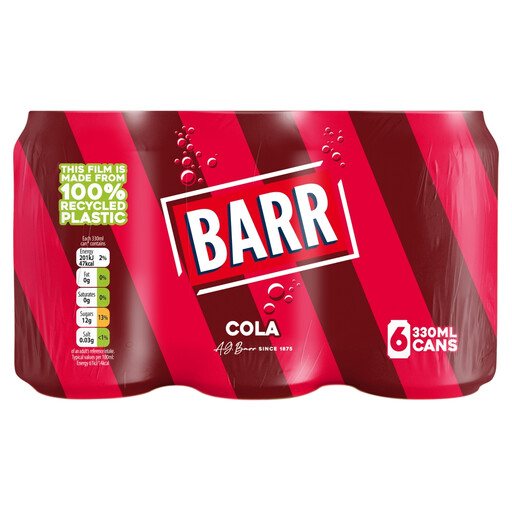
Barr Cola 6 × 330 ml
If you want to include this cola in a ride-fuelling plan, read the carbohydrate value on the can before calculating its contribution. The multipack contains six 330 ml cans; check the caffeine information too if you are tracking intake.
View on Joybuy
Questions about cola and cycling
Can cola replace a sports drink on a long ride?
Not automatically. British Cycling suggests 30–60 g carbohydrate per hour for indoor rides over 90 minutes and advises adding electrolytes to fluid for indoor cycling. A regular cola can contribute its labelled carbohydrate amount, but work out your fluid and electrolyte needs separately.
How much carbohydrate is in a 330 ml can of cola?
It varies by product: Joybuy lists 35 g for Coca-Cola Original Taste, Pepsi UK lists 15 g for Pepsi Classic and 0 g for Pepsi Max, and Tesco lists 14.8 g for Tesco Classic Cola. The Joybuy Pepsi Regular listing differs from Pepsi UK’s Classic figure, so use the label on the can you buy for a ride calculation.
Does zero-sugar cola count as cycling fuel?
Not as a meaningful carbohydrate source: Pepsi UK lists 0 g carbohydrate per 330 ml for Pepsi Max. If you are planning carbohydrate for a longer ride, count it from other drinks or food instead.
Will fizzy cola be uncomfortable while cycling?
You cannot tell from carbonation alone how a particular drink will feel during your ride. A study in the International Journal of Sport Nutrition and Exercise Metabolism found no effect on gastric emptying under its tested conditions, but that does not establish individual comfort. Try your chosen serving during training before relying on it at an event.
Is zero-sugar cola also caffeine-free?
Not necessarily. Pepsi Max and the separately named Pepsi Max No Caffeine are different variants. Check the exact can; if you are pregnant, NHS guidance says to have no more than 200 mg caffeine a day from all sources, including cola.


