Leisure cyclists packing a snack
A pre-portioned biscuit snack can be kept for a stop or packed with lunch. British Cycling recommends planning where food goes and choosing a safe moment to eat, rather than struggling with packaging while riding.


Choose an internally divided pack if you want to allocate custard creams across several rides or lunchboxes; a larger single pack also works if you portion it before leaving. The biscuits can contribute carbohydrate as a snack, but British Cycling advises planning food and fluids throughout longer rides rather than relying on one packet. Check the per-biscuit nutrition and the exact pack’s allergen declaration before buying.
The useful pack size depends on whether the biscuits are going into a ride bag, being shared at home or meeting a specific dietary requirement.
A pre-portioned biscuit snack can be kept for a stop or packed with lunch. British Cycling recommends planning where food goes and choosing a safe moment to eat, rather than struggling with packaging while riding.
An internally divided pack lets you set aside smaller unopened packs. Tesco lists its 750g custard creams as five 150g packs; a larger single pack needs portioning separately.
Check the declaration on the exact product. ASDA’s standard custard creams list wheat and milk, while its separate Free From custard creams are labelled gluten free and milk free.
Start with how you will carry and portion the biscuits, then compare the nutrition and allergen information on the packs that suit that plan.
| Priority | What to check | Your needs |
|---|---|---|
| Pack format | Check whether the total weight is split into inner packs. Tesco lists five 150g packs within its 750g product; the ASDA 400g and McVitie’s Tasties 300g listings describe standard packs. | I want to set aside biscuits for several rides or lunchboxes without opening the whole supply, or I can portion a single pack myself. |
| Carbohydrate and drinks | Read carbohydrate per biscuit and count the portion you plan to carry. Tesco lists 8.8g per biscuit and ASDA’s standard 400g product lists 8.1g. Plan drinks separately; British Cycling advises steady food and fluid intake on longer rides. | For a longer ride, I need to know what my carried snack contributes without treating a packet of biscuits as my entire food-and-drink plan. |
| Allergen labels | Compare the exact product’s ingredients and any may-contain statement. ASDA’s standard custard creams list wheat and milk; its separate Free From product is labelled gluten free and milk free. | If I avoid gluten or milk, I need a pack with the relevant declaration, not an assumption based on the words “custard creams”. |
| Portion and nutrition | Compare values on the same basis, such as per biscuit or per 100g. ASDA lists 8.1g carbohydrate and 3.4g sugars per biscuit for its standard 400g product; check fat and saturates on the packet too. | I would rather decide how many biscuits to pack than take an open large packet and lose track of the portion. |
| Access on the ride | Choose packaging or a container you can manage at a stop. British Cycling advises planning pocket access and choosing a safe stretch before eating. | I need the snack to be easy to reach without handling a large packet or compromising bike control. |
Custard creams contribute carbohydrate, but a packet does not plan your drinks or the timing of food across a long ride. British Cycling advises a steady intake of food and fluids.
Use the packet’s per-biscuit figures to decide what to carry, and plan drinks and other food for the demands of the ride.
Tesco’s 750g product is five 150g packs. The ASDA 400g and McVitie’s Tasties 300g products are listed as standard packs, so they do not offer the same stated inner-pack arrangement.
If separate unopened supplies matter, check the pack format. Otherwise, put a planned portion in a suitable container before leaving.
ASDA’s standard product lists wheat and milk, while its Free From version is separately labelled gluten free and milk free.
Check the exact packet’s ingredients and may-contain statement against your requirements before eating.
Handling food or wrappers at an awkward moment can interfere with bike control. British Cycling recommends planning access and allowing time to finish eating.
Prepare the portion beforehand and eat when stopped or when you can do so safely without compromising control.
These product lines illustrate different pack formats and labels; check the particular packet rather than applying one product’s details to an entire brand.
Tesco lists a 750g custard-cream product containing five 150g packs.
ASDA lists both a standard 400g custard-cream pack and a separate 125g Free From product.
Morrisons lists McVitie’s Tasties Custard Creams as a 300g standard pack.
Crawfords describes its custard creams as vanilla-cream-filled biscuits with embossed shells.
Marks & Spencer describes its Extra Cream Custard Creams as containing extra vanilla cream and custard powder.
Sainsbury’s lists standard custard creams in a 200g pack.
This Joybuy option is a small gluten-free custard-cream pack to consider for a portioned snack, rather than an internally divided multi-pack. Check its current packet if you also need to avoid milk.
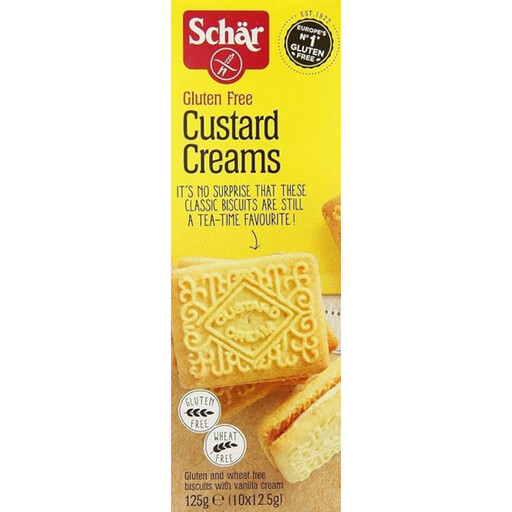 Image unavailable
A gluten-free custard-cream biscuit pack that could be portioned for a ride stop or lunchbox. At 125g, it is not an internally divided multi-pack; check the packet’s milk declaration if you need to avoid milk.
They can contribute carbohydrate as a solid snack, but they are not a complete plan for a longer ride. Tesco lists 8.8g carbohydrate per biscuit and ASDA lists 8.1g for its standard 400g product; British Cycling advises planning food and fluids throughout longer rides.
Use the per-biscuit carbohydrate figure on your actual packet and the food plan for your ride rather than a fixed biscuit count. The listed Tesco and ASDA standard products differ slightly at 8.8g and 8.1g carbohydrate per biscuit respectively, and drinks need planning separately.
An internally divided pack is practical when you want to allocate unopened supplies across rides or lunchboxes: Tesco lists its 750g product as five 150g packs. With a single large pack, portion what you intend to carry into a suitable container before leaving.
The listed ASDA standard custard creams contain wheat and milk, while Morrisons identifies both for McVitie’s Tasties and also notes possible sesame. ASDA’s separate Free From product is labelled gluten free and milk free; check the exact packet’s current declaration before eating.
Eat when you can handle the food without compromising bike control, including at a stop if that is easier. British Cycling recommends planning pocket access and choosing a safe stretch of road or trail with enough time to finish.