What should you check?
Start with the role of the drink: a serving of juice with food, a contribution to ride fuelling, or an orange-flavoured drink chosen for a different sugar profile. Then compare like-sized prepared servings.
| Priority | What to check | Your needs |
|---|
| Ride fuelling |
Read carbohydrate per serving and note the portion size. British Cycling’s general event-day rule is one gram of carbohydrate per kilogram of bodyweight per hour; plan the rest of your food and drink accordingly. |
For a long ride, I want to know what this drink contributes without relying on it for my entire carbohydrate intake. |
| Sugar and drink type |
Compare the ingredients, juice content and “of which sugars” value for the same serving size. Tropicana declares 13g sugars per 150ml for Smooth orange juice and 10g per 150ml for Fresh & Light Morning Orange, which is a blend rather than pure orange juice. |
Reducing sugar in my drink matters, but I also want to know whether I am buying juice, a blend or a squash. “No added sugar” alone does not tell me the total sugar content. |
| Portion |
Check the amount you intend to pour against the nutrition panel’s serving size. The NHS counts sugars in unsweetened fruit juice as free sugars, even when none have been added. |
I would rather measure a serving than assume that a larger carton or bottle represents one portion. |
| Preparation |
Check whether the drink is ready to consume or must be diluted. For squash, compare nutrition for the prepared drink and follow the pack’s dilution and storage instructions. |
If I am packing a drink for a ride, I need to know whether it can go straight into a bottle or requires preparation first. |
Brand and retailer references
These examples help distinguish product types; a brand name alone does not establish the ingredients or nutrition of a particular carton.
Tropicana
Tropicana’s Smooth is a 100% orange juice, while its Fresh & Light Morning Orange is an orange-based blend.
- Tropicana declares 14g carbohydrate and 13g sugars per 150ml for Smooth, compared with 10g carbohydrate and 10g sugars per 150ml for Fresh & Light Morning Orange.
- Fresh & Light contains water and other fruit ingredients; it is neither 100% orange juice nor zero sugar.
Innocent
Tesco Groceries lists Innocent orange juice in smooth and with-bits versions.
- The listed formats give shoppers a texture choice.
- Check the nutrition panel of the specific carton before comparing it with another juice.
Tesco
Tesco Groceries lists own-brand 100% pure squeezed orange juice as well as separately named orange drinks.
- Category wording helps identify a pure-juice option.
- Do not treat every Tesco orange drink as nutritionally equivalent to its 100% juice.
M&S
M&S describes its Smooth Orange Juice as not from concentrate.
- M&S declares 9.3g carbohydrate and 9.3g sugars per 100g for this product.
- Its declaration is per 100g, not per 150ml; check the current carton before making a serving-by-serving comparison.
Joybuy orange drink options
These options are a ready-to-drink orange juice drink and a squash to dilute. Neither should be mistaken for a 100% orange juice when choosing a serving of pure juice with food.
 No image available
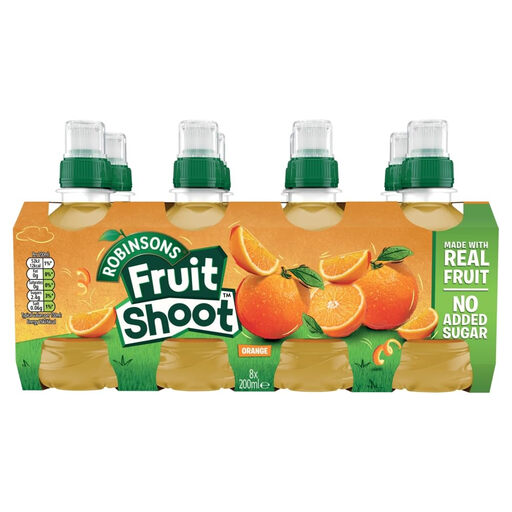
Fruitshoot Orange Low Sugar 8 x 200 ml
Consider this ready-to-drink option if you want an orange drink in individual bottles rather than pure juice. Its listing describes 12% orange juice from concentrate, sweeteners, and 1.2g carbohydrate and 1.2g sugars per 100ml; do not assume it covers the carbohydrate needs of a long ride.
View on Joybuy
 No image available
Robinsons No Added Sugar Squash Orange 1L
Choose this squash if you want an orange drink to dilute rather than a serving of 100% juice. Its listing identifies 10% orange fruit from concentrate, sweeteners and naturally occurring fruit sugars. Follow the label’s dilution instructions and compare carbohydrate and sugars for the prepared serving; “no added sugar” does not mean zero sugar.
View on Joybuy
Frequently asked questions
Can orange juice be my main drink for a long cycle ride?
Do not rely on orange juice alone for long-ride fuelling. British Cycling’s general event-day rule is one gram of carbohydrate per kilogram of bodyweight per hour, while Tropicana declares 14g carbohydrate in a 150ml serving of Smooth orange juice. Count any juice you drink as one contribution within your wider food and fluid plan.
Does “no added sugar” mean an orange drink has zero sugar?
No. The NHS counts sugars in unsweetened fruit juice as free sugars, and Tropicana Smooth declares 13g sugars per 150ml despite its no-added-sugar label. Read the nutrition declaration for the specific drink and serving.
Should I choose pure orange juice or a lower-sugar blend?
Choose 100% orange juice when the pure-juice category matters to you; choose a lower-sugar blend if its ingredients and smaller sugar contribution better fit what you want from the serving. Tropicana declares 13g sugars per 150ml for Smooth orange juice and 10g per 150ml for Fresh & Light Morning Orange, a blend rather than pure juice. Neither is zero sugar.
Is orange squash interchangeable with orange juice?
No. Squash is diluted before drinking, so check its ingredients and nutrition for the prepared serving rather than comparing the concentrate directly with a carton of juice. Robinsons No Added Sugar Squash Orange is a squash containing orange fruit from concentrate, not a 100% orange juice.
How should I store orange juice after opening?
Follow the instructions on the particular carton. M&S advises refrigerating its Smooth Orange Juice after opening and consuming it within 24 hours; another product may have different instructions.


