Who is this for?

Cyclists planning pasta meals around training

You want pasta as the carbohydrate component of a meal and need to consider the portion and timing in relation to your ride. The British Dietetic Association says carbohydrate needs depend on the training programme and overall dietary goals.

Shoppers avoiding added sugar in sauce

You want to check the sauce separately from the pasta. A no-added-sugar tomato sauce can still contain sugars from its ingredients, so the nutrition label matters as well as the claim on the front.

Cyclists choosing a convenient or specific pasta format

You may be considering a ready-to-heat product, gluten-free pasta or protein-enriched pasta. Check the serving size, ingredients, allergens and preparation instructions for the exact product you plan to use.

What matters when choosing?

The British Dietetic Association describes carbohydrate as a main fuel for exercising muscles. For a cycling pasta meal, assess the pasta portion first, then compare the sauce or ready-to-eat format against your other priorities.

Concern What to check Who this matters to
Meal carbohydrate and timing Check carbohydrate per serving on the pasta pack and consider when you plan to eat the meal. For a longer or harder ride, I want the pasta portion to fit the carbohydrate role of my meal, rather than making sauce sugar the whole decision. About 44% of consumers put meal carbohydrate and timing first.
Added sugar in sauce Read the ingredients and compare sugars and salt per 100g, as well as the portion you will use. If I am avoiding added sugar, I want to understand what the sauce claim covers without assuming the finished sauce contains no sugars. Avoiding added sugar in sauce is the primary concern for about 33% of consumers.
Format and dietary compatibility Check the serving size, preparation instructions and relevant ingredient or allergen information. When preparation time or a particular ingredient restriction shapes my choice, the exact pasta or sauce format matters more than a sugar claim. About 23% of consumers place convenience or dietary compatibility first.

Common buying mistakes

  • Reading “no added sugar” as “sugar-free”

    Tomato and vegetable ingredients can contribute sugars even when a sauce has no added sugar. Asda describes its no-added-sugar Smooth Bolognese as containing naturally occurring sugars.

    Compare the sugars line per 100g and for your intended portion, rather than treating the two phrases as interchangeable.

  • Letting the sauce claim determine the whole meal

    A sauce with no added sugar does not establish how much carbohydrate the complete pasta meal provides. The British Dietetic Association says carbohydrate requirements vary with training.

    Decide on the pasta portion and meal timing for your ride, then choose a sauce whose label and ingredients suit you.

  • Equating canned pasta with a dried-pasta meal

    A ready-to-eat serving and a meal assembled from dried pasta need not provide the same amount of carbohydrate. A reduced-sugar claim alone does not tell you the serving size.

    Check the ready-to-eat product’s stated serving and carbohydrate amount before choosing it for a cycling meal.

  • Checking sugar but overlooking other label details

    Sauce labels also differ in salt, ingredients and instructions after opening. Tesco lists 0.64g salt per 100g for its No Added Sugar Bolognese, while Sainsbury’s lists 0.61g per 100g for its No Added Sugar Tomato & Hidden Veg sauce.

    Check salt for the portion you will use, any relevant allergens and the storage instructions on the current pack.

Brands to consider for pasta and sauce

Dolmio

Dolmio has a no-added-sugar pasta-sauce range alongside other sauces and microwave pouches.

  • The no-added-sugar range is relevant if added sugar in sauce is your main concern.
  • The claim does not cover every Dolmio sauce: Dolmio lists sugar as an ingredient in its Original Sauce for Bolognese, which has 5.4g sugars per 100g.

Barilla

Barilla offers whole-wheat and Protein+ spaghetti variants for shoppers choosing the pasta itself.

  • Barilla lists 20g protein per 100g for Protein+ Spaghetti.
  • A protein-enriched or whole-wheat formulation is not, by itself, a reduced-sugar claim; check the exact product’s label for your intended meal.

Tesco

Tesco’s own-label examples span no-added-sugar Bolognese sauce, gluten-free dried spaghetti and reduced-sugar-and-salt spaghetti letters.

  • Tesco lists 4.5g sugars per 100g for its No Added Sugar Bolognese sauce.
  • The same sauce lists 0.64g salt per 100g. Compare the full label rather than choosing on the sugar claim alone.

Sainsbury’s

Sainsbury’s has a No Added Sugar Tomato & Hidden Veg pasta sauce.

  • Sainsbury’s describes this sauce as having no added sugar or sweetener and lists 3.9g sugars per 100g.
  • It also lists 0.61g salt per 100g; follow the jar’s instructions after opening.

Asda

Asda’s Smooth Bolognese is a no-added-sugar sauce option.

  • Asda explicitly notes that the sauce contains naturally occurring sugars, making the claim’s scope clear.
  • Do not assume no added sugar means sugar-free or that it has fewer sugars than every other sauce; compare labels per 100g.

M&S

The M&S example here is a conventional tomato-and-basil pasta sauce, not a no-added-sugar selection.

  • Marks & Spencer lists 4.3g sugars and 0.60g salt per 100g for this sauce, allowing a per-100g label comparison.
  • Marks & Spencer says the product is not suitable for people with a milk allergy; check the current label for any dietary restriction.

Joybuy pasta-sauce selection

This carbonara pasta-bake sauce is a choice for a meal where avoiding added sugars in the sauce matters. Pair it with a pasta portion chosen separately for your cycling meal; it is not a tomato sauce or a dried-pasta product.
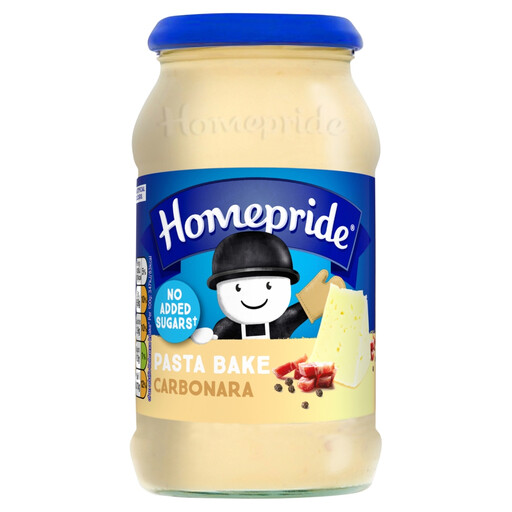
Homepride No Added Sugar Carbonara Pasta Bake 485g sauce

Homepride No Added Sugar Carbonara Pasta Bake 485g

Choose this pasta-bake sauce if avoiding added sugars in the sauce is your priority, while planning the pasta portion separately.

The product listing gives 1.1g sugars, 5.6g carbohydrate and 0.6g salt per 100g. Its no-added-sugar description does not establish that it has reduced sugars compared with another sauce.

Contains barley, celery, eggs and milk; the ingredients also include bacon. Refrigerate after opening and use within three days.

View on Joybuy

Frequently asked questions

Does no added sugar mean a pasta sauce is sugar-free?

No. “No added sugar” concerns added sweetening ingredients; sugars from ingredients such as tomatoes can remain. Asda explicitly says its no-added-sugar Smooth Bolognese contains naturally occurring sugars, so check the sugars line on the nutrition label.

Are reduced sugar and no added sugar the same claim?

No. Reduced sugar describes a comparison with a similar product, while no added sugar concerns what has been added to the food. If that distinction matters to your purchase, check the exact wording, ingredients and sugars per 100g rather than treating either claim as a measure of the whole pasta meal.

Is a no-added-sugar sauce enough for a cycling pasta meal?

The sauce claim cannot answer that on its own. Pasta is the meal’s main pasta-carbohydrate component, while the British Dietetic Association says carbohydrate needs depend on the training programme and overall dietary goals. Check the pasta serving as well as the sauce label.

How should I time a pasta meal before a ride?

Choose the portion and timing with the planned ride and your tolerance in mind, and try an unfamiliar meal during ordinary training rather than for the first time before an important ride. The British Dietetic Association notes that carbohydrate requirements vary with training.

How long can I keep an opened pasta sauce?

Follow the instructions on the particular jar or pouch, not a rule assumed for all sauces. Check its refrigeration and use-after-opening directions before choosing a size you expect to finish.